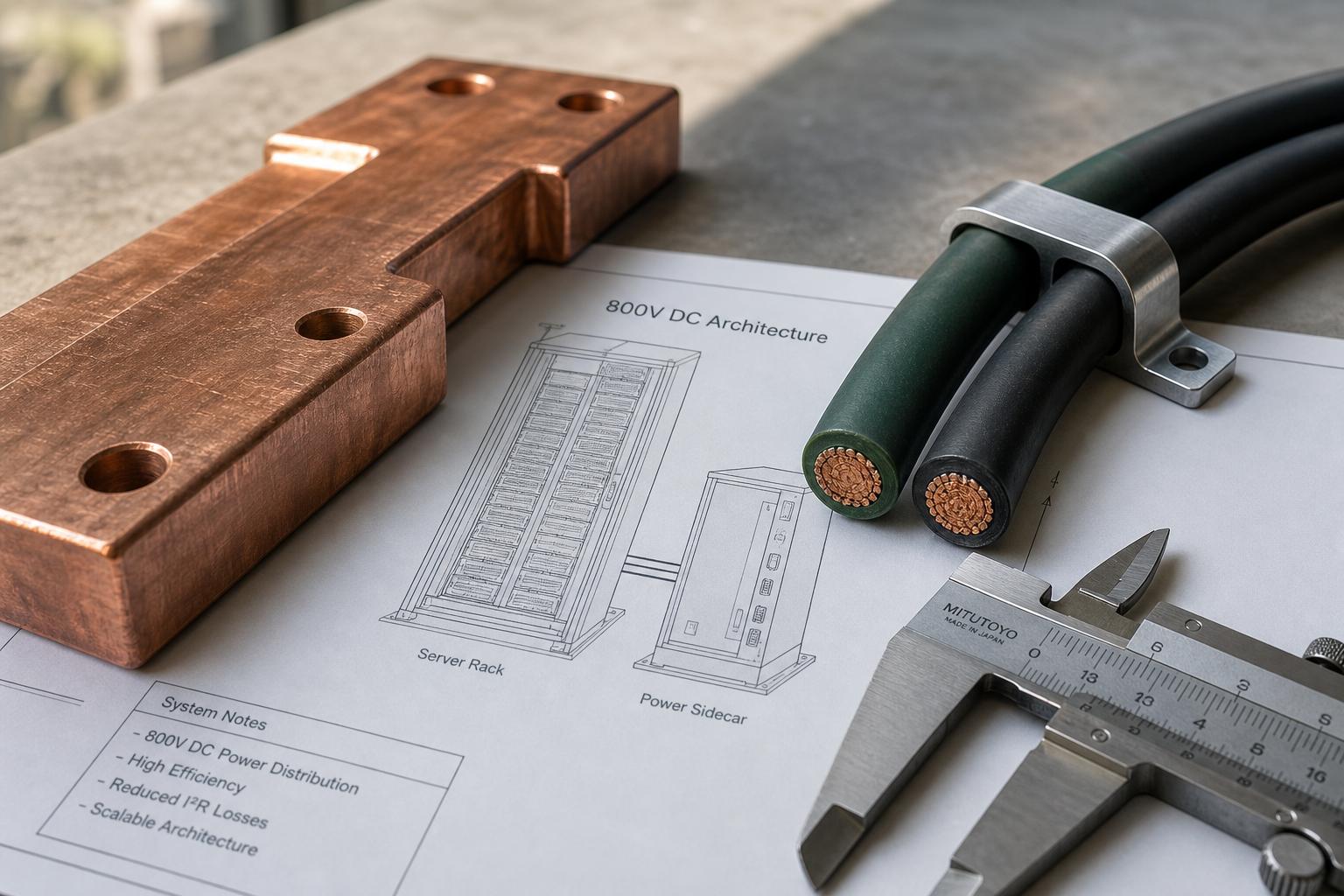
GPUSmith Article
400 VDC vs 800 VDC vs 415V AC: AI Datacenter Power Architecture
Summary
- 01NVIDIA states it is leading the transition to 800 VDC data center power infrastructure to support 1 MW IT racks and beyond, starting in 2027, timed to the 2027 debut of its Kyber rack housing 576 Rubin Ultra GPUs.
- 02"800VDC" is not one architecture but two rival electrical topologies: NVIDIA's closed monopolar 800V design and OCP's open bipolar ±400V Diablo 400 specification, which reuses EV supply-chain components.
- 03Moving distribution voltage up to 800 VDC enables 85% more power to be transmitted through the same conductor size while reducing copper requirements by 45%.
- 04Schneider Electric says the legacy 400V AC and 48VDC approach becomes difficult at 200 kW per rack and impossible at 400 kW per rack, thresholds NVIDIA's GB300 NVL72 racks (142 kW) are already approaching.
- 05National Electrical Code updates for DC fault interruption are targeted for the 2029 revision cycle, meaning codes remain the primary obstacle to widescale HVDC adoption rather than the underlying silicon.
- 06Vendors such as Vertiv are hedging by supporting both the monopolar and bipolar topologies, signaling that mixed 415V AC, 800 VDC, and ±400 VDC deployments are expected to coexist for years.
Inside this article
- 01400 VDC vs 800 VDC vs 415V AC: AI Datacenter Power Architecture
- 02Introduction and Background
- 03NVIDIA's Monopolar 800 VDC Architecture
- 04The OCP Mt Diablo Power-Delivery Approach
- 05The Incumbent: 415V AC Three-Phase Distribution
- 06Feature Comparison
- 07Performance and Benchmarks
- 08Data Analysis and Evidence
- 09Case Studies and Real-World Examples
- 10Implications and Future Directions
- 11Frequently Asked Questions (FAQs)
- 12Conclusion
400 VDC vs 800 VDC vs 415V AC: AI Datacenter Power Architecture
Executive Summary
Rack power densities in artificial intelligence (AI) infrastructure have outrun the electrical architecture that has served data centers for two decades, forcing a three-way contest between the incumbent 415V AC three-phase system, the interim 54V/48V DC in-rack standard, and emerging high-voltage direct current (HVDC) approaches: NVIDIA's 800 VDC reference design and the Open Compute Project's (OCP) ±400 VDC Mt Diablo project, developed with Google, Meta, and Microsoft. Google presents ±400 VDC as the announced nominal power-delivery approach; the applicable conductor, grounding, and polarity arrangement remains implementation- and specification-version-specific. NVIDIA states plainly that it "is leading the transition to 800 VDC data center power infrastructure to support 1 MW IT racks and beyond, starting in 2027" [1], timed to the 2027 debut of its Kyber rack housing 576 Rubin Ultra GPUs [1].
The physics driving the shift is unambiguous. A single 1 megawatt (MW) rack running the legacy 54 VDC in-rack scheme needs "up to 200 kg of copper busbar," and a 1 gigawatt (GW) campus could need roughly 200,000 kg of copper at that voltage [1]. Moving distribution voltage up to 800 VDC "enables 85% more power to be transmitted through the same conductor size" while "reducing copper requirements by 45%" [1] [2]. NVIDIA's own accounting puts the end-to-end efficiency gain at "up to 5%" versus 54 VDC racks, maintenance cost reduction at "up to 70%," and total cost of ownership (TCO) savings at "up to 30%" [1]. These figures are similar in magnitude to findings from a 2008 Lawrence Berkeley National Laboratory (LBNL) demonstration that found facility-level DC distribution cut total data center energy use "by 5 to 7 percent compared to the most efficient AC systems and by up to 28 percent compared to typical AC distribution systems" [3]. The older study used different voltage, load, and hardware conditions.
Critically, "800VDC" is not one architecture but two rival electrical topologies converging on the same headline voltage. NVIDIA's closed reference design distributes monopolar 800V (a single live conductor and a return), while the OCP coalition's open Diablo 400 specification distributes bipolar ±400V across three conductors, deliberately reusing electric-vehicle (EV) supply-chain components [4] ([4]. Google, which helped co-author the Diablo specification with Meta and Microsoft, frames its version as enabling "IT racks to scale from 100 kilowatts up to 1 megawatt" with an initial sidecar rack that "improves the end-to-end efficiency by ~ 3%" ([5]. Both topologies will coexist: NVIDIA's ecosystem partners across silicon (Texas Instruments, Infineon, STMicroelectronics, Navitas, onsemi), power systems (Eaton, ABB, Schneider Electric, Vertiv, Delta) and system integrators (Foxconn, HPE) are building for the monopolar path, while Google, Meta, Microsoft and Amazon are optimizing fleets around bipolar ±400V.
Today's baseline remains 415V or 480V three-phase AC stepped down to 54 VDC or 48 VDC at the rack, an architecture that Schneider Electric says "become[s] difficult at 200 kW per rack and impossible at 400 kW per rack" [6], thresholds that current NVIDIA GB300 NVL72 racks (142 kW) are already approaching [6]. Global data center capital expenditure is projected to exceed $1 trillion annually by 2029 according to Dell'Oro Group [7], with worldwide data center power demand rising from roughly 80 GW in 2024 toward 220 GW by 2030 as AI workloads drive much of that growth, per ABB citing Dell'Oro [8]. Early proof points already exist: Foxconn is standing up its Kaohsiung K-1 facility in Taiwan on the NVIDIA 800 VDC design [9], and Tesla-alumni-founded Heron Power raised $140 million in February 2026 to mass-produce solid-state transformers that convert medium-voltage grid power directly to the 800-volt rails NVIDIA's racks require [10]. The remaining obstacle is not silicon but codes: century-old AC-centric electrical standards are only now being rewritten for DC fault interruption, with National Electrical Code updates targeted for the 2029 revision cycle [11].
Introduction and Background
Every generation of computing infrastructure has eventually collided with the limits of the electricity that feeds it, and the AI accelerator era has arrived at that collision faster than any generation before it. For roughly twenty years, data centers standardized on a layered alternating current (AC) distribution model: utility medium-voltage AC arrives at the site, is stepped down through transformers to 415V or 480V three-phase AC for the data hall, passes through an uninterruptible power supply (UPS) and power distribution units (PDUs), and is finally converted inside or beside each server rack to low-voltage direct current, historically 12V and more recently 48V or 54V, to feed motherboards and accelerators [6]. Vertiv describes the conventional path succinctly: grid power arrives as "Medium-Voltage AC (1kV to 35kV)" and "is transformed to Low-Voltage AC (480V or 415V) for facility distribution," before a further conversion "often to 54 VDC, at the rack level" [2].
This layered approach was refined by the hyperscalers themselves. Google championed a 48 VDC in-rack standard roughly a decade ago specifically to raise distribution efficiency over the 12V designs Facebook (now Meta) had popularized through its Open Compute Project (OCP), founded in 2011 to open-source data center hardware design [12]. Google's 2016 Open Rack v2.0 proposal explicitly aimed "to specify a 48V power architecture with a modular, shallow-depth form factor" [13], citing "significant reduction in losses and increased efficiency compared to 12V solutions" from years of internal deployment [13]. At the time, Facebook's own racks ran 800mm deep with 12V distribution while Google's ran a shallower 660mm frame at 48V, a divergence that took years of OCP collaboration to reconcile [14]. Facebook's earliest data centers had already pioneered rack-adjacent DC battery backup, with "battery cabinets sitting side by side with IT racks, ready to push 48V DC power to the servers" instead of a centralized UPS room [15]. This 48V/54V-at-the-rack model, married to 415V or 480V AC in the hall, comfortably scaled from roughly 10 kW to 100 kW per rack [5].
Generative AI broke that scaling curve. Training and inference clusters built around GPUs and custom accelerators now demand hundreds of kilowatts per rack, with NVIDIA's own GB300 NVL72 already running "72 GPUs in parallel at 142 kW per rack" [6], and its successor Kyber rack targeting 576 Rubin Ultra GPUs by 2027 [16]. Google's own infrastructure engineers now expect "more than 500 kW per IT rack before 2030" [5]. At those densities, both the AC distribution layer and the 54V DC in-rack layer face material physical constraints. The resulting architectural transition includes NVIDIA's 800 VDC design, the OCP Mt Diablo ±400 VDC effort, and continued use of legacy 415V AC across much installed capacity. The detailed DC topology remains dependent on the implementation and applicable specification version. This report examines all three paths in turn before comparing them directly.
NVIDIA's Monopolar 800 VDC Architecture
Capabilities
NVIDIA's 800 VDC reference design converts grid power once, close to the point of use, rather than repeatedly stepping it down. The architecture works "by converting 13.8 kV AC grid power directly to 800 VDC at the data center perimeter using industrial-grade rectifiers," eliminating "most intermediate conversion steps" [1]. The 800V bus then runs over just two conductors to the IT rack, where DC/DC stages step it down to an intermediate 54V/12V (and increasingly 6V) bus before final voltage regulation to the sub-1V core voltage GPUs require. Texas Instruments (TI), one of NVIDIA's named silicon partners, is "demonstrating a power architecture requiring only two conversion stages from 800V to processor power" [17], with its 800V-to-6V bus converter reaching "97.6% peak efficiency with >2000W/in3 power density" [17]. TI is also showing a 30 kW 800V AC/DC power supply unit (PSU) for AI servers and 800V capacitor bank units built around EDLC supercapacitor cells to buffer sub-second load transients [17].
Physically, the design pushes power conversion out of the compute rack into an adjacent "sidecar" power rack, which is how NVIDIA fits 576 GPUs into a single Kyber chassis: "At GTC 2025, NVIDIA exhibited an 800 V sidecar to power 576 of the Rubin Ultra GPUs in a single Kyber rack" [1]. Independent analysis characterizes NVIDIA's approach as "monopolar 800V (2-wire, closed spec)," running "a single +800V rail and a return, isolated from protective earth," in contrast to the bipolar approach discussed in the next section [4]. A recent teardown of a Schneider Electric/APC 800V sidecar shown at GTC 2026 found the physical anatomy of the concept: "roughly seven 3U 110 kW 800VDC power shelves" in a 6+1 redundant configuration, four 2U DC-output PDUs, and five lithium-ion battery backup units integrated directly onto the 800V bus [4].
Adoption
NVIDIA is not building this ecosystem alone; it has recruited essentially the entire data center electrical supply chain. Its named silicon partners include "Analog Devices, Infineon, Innoscience, MPS, Navitas, OnSemi, Renesas, ROHM, STMicroelectronics, Texas Instruments," alongside power system component makers "Delta, Flex Power, Lead Wealth, LiteOn, Megmeet" and data center power system integrators "Eaton, Schneider Electric, Vertiv" [1]. Eaton has already delivered "a new reference architecture designed to accelerate the adoption of 800 VDC power in artificial intelligence (AI) data centers" as "a critical milestone in Eaton's grid-to-chip strategy" [18], and ABB has committed to co-developing "modular MV-to-800V power blocks" while combining "a medium voltage (MV) uninterruptible power supply (UPS) with direct current (DC) power distribution to the server room using solid-state power electronics devices" [8]. Vertiv, which is "on track for readiness by late 2026" on its own 800 VDC portfolio [2], is explicitly hedging its bets by supporting both topologies, drawing on "20+ yrs of ±400VDC telecom DC" experience even as it builds for NVIDIA's monopolar spec [4].
Manufacturing partners are moving in parallel. Foxconn (Hon Hai Technology Group) announced it is "collaborating with NVIDIA to implement the 800 VDC power architecture for AI factories," and that the design will "first be implemented in the Kaohsiung K-1 artificial intelligence data center project" in Taiwan [9]. NVIDIA separately confirmed that "Foxconn provided details on its 40-megawatt Taiwan data center, Kaohsiung-1, being built for 800 VDC," and that "CoreWeave, Lambda, Nebius, Oracle Cloud Infrastructure and Together AI are among other industry pioneers designing for 800-volt data centers" [16]. Independent industry analysis reports NVIDIA's own sidecar design "reported at a ~660 kW sidecar, with air-cooled samples and production targeted for mid-2026 and a liquid-cooled Vera Rubin Ultra variant sampling late-2026," with full-scale 800VDC data centers "timed to land with Kyber in 2027" [4].
Strengths and Limitations
The monopolar architecture's chief strength is simplicity: two conductors, one polarity, fewer connectors, and (per TI) as few as two conversion stages between the 800V bus and the processor [17]. Because NVIDIA's GPUs are the load that justifies most of the current AI buildout, its reference design has become the de facto pacing item for the rest of the supply chain, and vendors describe an explicit strategy of staying "one GPU generation ahead" of NVIDIA's cadence. The tradeoff is that every insulation system and protection device in a monopolar bus must be rated for the full 800V potential, since there is no split return path to ground, which raises the bar for arc-flash protection and DC-fault interruption; industry commentary notes that "DC arcs do not self-extinguish at a zero-crossing" the way AC arcs do, a genuine safety engineering problem that is still being solved [4]. NVIDIA itself acknowledges that "fault detection and serviceability in VDC systems is a key area for innovation," and that new equipment, standards, and workforce training are still required before facility-level deployment is routine. Because it sits outside the open OCP specification, the monopolar path is also, for now, a closed reference design controlled by one company, even though NVIDIA has said it intends to contribute elements of it to OCP over time.
- 01Grid to 800 VDC
13.8 kV AC grid power is converted directly to 800 VDC at the data center perimeter using industrial-grade rectifiers.
- 02800V bus to rack
The 800V bus runs over just two conductors to the IT rack instead of multiple AC distribution stages.
- 03DC/DC step-down to core voltage
DC/DC stages step the 800V down to an intermediate 54V/12V (and increasingly 6V) bus, then to the sub-1V core voltage GPUs require, in as few as two conversion stages.
NVIDIA states this eliminates most intermediate conversion steps.
The OCP Mt Diablo Power-Delivery Approach
Capabilities
Where NVIDIA closed its loop around a single 800V rail, the hyperscaler coalition inside the Open Compute Project chose to split the same voltage class across two rails. The specification, informally called Mt Diablo or Diablo 400, defines a disaggregated "sidecar" power rack that delivers "±400 VDC" to a nearby IT rack: two 400V rails referenced to a shared center point, giving 800V rail-to-rail while keeping any single conductor at only 400V to ground [4]. Google, one of the specification's three co-authors, describes the goal as enabling "IT racks to scale from 100 kilowatts up to 1 megawatt" [5], while explicitly choosing 400V "to leverage the supply chain established by electric vehicles (EVs), for greater economies of scale, more efficient manufacturing, and improved quality and scale." Microsoft's own engineering team frames the same project as moving "all the power conversion into a separate disaggregated power rack," which "enables up to 35% more AI accelerators in each server rack" simply by freeing the compute chassis of conversion hardware [19]. Microsoft describes the underlying conversion path as moving from "48Vdc outputs" toward "400Vdc (High Voltage Direct Current or HVDC), monopolar or bipolar," acknowledging that the specification deliberately leaves room for both variants [19]. Analysts note that the open Diablo spec even "carries a design option for an 800VDC two-wire output at the rectifier shelf," meaning it can accommodate NVIDIA's monopolar GPUs when a hyperscaler's data hall needs to host both [4].
Adoption
The specification's roots trace to an October 2024 Microsoft-Meta engineering collaboration; Microsoft's Jason Adrian and colleagues wrote that "we are excited to announce our upcoming contribution of this architectural specification to the OCP community in collaboration with Meta" as the founding step. Google joined as the third co-author, and by 2025 all three were working "to standardize the electrical and mechanical interfaces," with "the 0.5 specification draft" opened "for industry feedback in May" 2025 [5]. Independent teardown analysis of the resulting hardware landscape reports that even among the three co-authors, implementations diverge: "Meta around 600 to 800 kW, Google reallocating battery and supercap slots to push toward a ~900 kW to 1.1 MW roofline, Amazon landing near 800 kW on ±400V, and Microsoft moving more slowly" [4]. AMD has also aligned with the open path rather than a proprietary one: its Helios rack-scale platform, packing "72x Instinct MI450-series GPUs" for "2.9 FP4 exaFLOPS," is built on Meta's Open Rack Wide form factor and OCP standards, with HPE and Celestica named as first movers for 2026 availability [4].
Google's initial sidecar implementation is already measured against its own AC baseline: the company reports its "AC-to-DC sidecar power rack" "improves the end-to-end efficiency by ~ 3%" relative to the prior approach [5] while noting that "longer term, we are exploring directly distributing higher-voltage DC power within the data center and to the rack, for even greater power density and efficiency," a tacit acknowledgment that the sidecar is a transitional step rather than an end state. Google is pairing the power transition with its fifth-generation cooling distribution unit, Project Deschutes, which it is separately contributing to OCP, noting that "water can transport approximately 4000 times more heat per unit volume than air" [5], reflecting the fact that voltage and thermal architecture are being redesigned together.
Strengths and Limitations
The bipolar approach's central advantage is supply chain leverage. By pinning the nominal rail voltage at 400V, Google, Meta, and Microsoft can draw on connectors, contactors, and switchgear "already qualified at automotive volume" from the EV industry, rather than commissioning bespoke 800V-rated components from scratch [4]. Because any single conductor in a bipolar system is only 400V to ground rather than 800V, insulation and protection requirements can be de-rated relative to a monopolar bus, easing some safety-certification burden. The cost of that advantage is a third conductor, more complex load balancing between the positive and negative rails, and a governance model that, by design, has to reconcile the differing priorities of at least four hyperscalers rather than one company's roadmap; the same teardown data showing four different power ceilings among Meta, Google, Amazon, and Microsoft is evidence that "Diablo 400 is a shared base" but that "the reality on the ground is fragmented" [4]. Because the open spec is administered through OCP rather than a single vendor, it also moves more slowly through committee-based consensus, even as it benefits from broader multi-vendor competition on price.
Critically, "800VDC" is not one architecture but two rival electrical topologies converging on the same headline voltage.
The Incumbent: 415V AC Three-Phase Distribution
Capabilities
The system that both 800 VDC candidates are trying to displace is not primitive; it is a mature, code-compliant architecture refined over decades. In its data center form, utility medium-voltage AC (commonly 1kV to 35kV) is stepped down through a facility transformer to 415V or 480V three-phase AC, run through switchgear and a UPS for ride-through protection, distributed via busway or PDUs to equipment rows, and finally rectified to DC inside each rack's power supply units, most commonly at 54V or 48V today [2]. One independent analysis quantifies the resulting loss profile: a legacy 480V AC chain running "through transformer, switchboard, UPS double-conversion, PDU step-down, RPP/busway distribution, and rack PSU rectification" incurs "four conversion stages and ~6.4% distribution loss" before power reaches the GPU [4], compared with roughly 3.0 percent distribution loss for a single-conversion 800VDC design in the same analysis. NVIDIA's own materials describe the legacy chain similarly: "the 415 V AC is conducted through the data halls to the equipment rows and finally to the IT rack where power supply units deliver the power as 54 V/12 V DC and core power for the GPUs."
Adoption
This is still, by a wide margin, the architecture running the world's installed AI capacity in 2026. Microsoft's flagship Fairwater datacenter in Mount Pleasant, Wisconsin, described as the "largest and most sophisticated AI factory we've built yet," required "120 miles of medium-voltage underground cable" [20] and uses NVIDIA GB200 racks. Microsoft’s published overview does not specify its facility-to-rack power-distribution topology. This underlines a key point: 415V AC is not disappearing in 2026 or even 2027; it is the substrate that today's frontier AI clusters, including some of the largest in the world, are already straining against.
Strengths and Limitations
The incumbent architecture's strength is its universality: every electrician, breaker, relay, and code inspector in the world already understands three-phase AC distribution, and its failure modes, including arc behavior, are well characterized because AC current crosses zero every half-cycle, giving switchgear a natural, repeated opportunity to interrupt a fault. That same zero-crossing is precisely what a DC bus lacks, which is why DC-native codes have taken so long to catch up. The architecture's limitation is simply physics at scale: Schneider Electric states plainly that the "two main power distribution approaches feeding into the servers today," 400V three-phase AC and 48 VDC to the rack, "become difficult at 200 kW per rack and impossible at 400 kW per rack, which correlate with the NVIDIA Kyber and NVIDIA Rubin Ultra platforms" [6]. NVIDIA is similarly direct that "as racks exceed 200 kilowatts, this approach begins to hit physical limits," citing space constraints, copper overload, and inefficient repeated conversions as the three simultaneous failure modes. The architecture is not being abandoned outright, since most enterprise, cloud, and non-AI workloads will remain comfortably inside its operating envelope for years, but for gigawatt-scale AI factories it is now explicitly a transitional design rather than a destination.
Feature Comparison
- Distributes a single +800V rail and a return, isolated from protective earth
- Converts grid power once, close to the point of use, rather than repeatedly stepping it down
- As few as two conversion stages between the 800V bus and the processor
- Remains a closed reference design controlled by one company, for now
- Two 400V rails referenced to a shared center point give 800V rail-to-rail while keeping any single conductor at only 400V to ground
- Draws on EV connectors, contactors, and switchgear already qualified at automotive volume
- Administered through OCP committee consensus, which moves more slowly than a single vendor's roadmap
- Implementations diverge across co-authors, from Meta's 600 to 800 kW to Google's 900 kW to 1.1 MW roofline
Both converge on the same headline 800V-class voltage, but conductor count, grounding, and governance differ, and the applicable arrangement remains implementation- and specification-version-specific.
Table 1 below summarizes the three power architectures discussed above side by side, drawing on the facts assembled in the preceding sections.
| Attribute | 415V/480V AC + 48V/54V DC (legacy) | NVIDIA 800 VDC | OCP Mt Diablo ±400 VDC |
|---|---|---|---|
| Governing body | National electrical codes, IEC/NEC | NVIDIA closed reference design, with partner ecosystem | Open Compute Project (Google, Meta, Microsoft co-authors) |
| Conductor topology | 3-phase AC to rack, then low-voltage DC busbar | 2-wire, single +800V rail and return [4] | 3-wire, ±400V rails about a center reference [4] |
| Practical rack ceiling | "impossible at 400 kW per rack" [6] | Up to and beyond 1 MW [1] | 100 kW to 1 MW [5] |
| Copper vs 54V baseline | Baseline; up to 200 kg busbar per 1 MW rack [1] | Reduced up to 45% [1] | Reduced via 400V EV-grade conductors (design-dependent) |
| Reported efficiency gain | Reference point | Up to 5% end-to-end vs 54V [1] | ~3% for first sidecar generation [5] |
| Conversion stages, grid to chip | Four (transformer, UPS, PDU, rack PSU) [4] | As few as two past the 800V bus [17] | Two-plus, sidecar-disaggregated |
| Supply chain leverage | Mature global electrical trades | Purpose-built 800V components across 20+ silicon and power partners [1] | Electric-vehicle component supply chain [4] |
| Target production timing | Deployed today | Kyber-aligned, 2027 | Rolling out through 2026, per-vendor [4] |
The comparison makes clear that the high-voltage DC approaches share an intended move toward fewer conversion stages and higher rack densities, but their interfaces and deployment schedules remain implementation-specific. Procurement choices should be based on the applicable rack, power shelf, grounding scheme, protection design, and published specification version. Microsoft’s Mt Diablo material describes 400 VDC HVDC as monopolar or bipolar; it does not substantiate a universal two-wire or three-wire arrangement [19].
Table 2 below maps the vendor ecosystem across both 800V camps, since procurement decisions increasingly depend on which topology (or both) a given supplier commits to.
| Vendor | Layer / focus | 800VDC camp | Key milestone |
|---|---|---|---|
| Eaton | Reference architecture, busbar, supercapacitors | Monopolar (NVIDIA-aligned) | Reference design unveiled October 2025 [18] |
| ABB | MV-to-800V power blocks, solid-state UPS/breakers | Monopolar (NVIDIA-aligned) | World's first IEC-certified solid-state circuit breaker (SACE Infinitus) [8] |
| Vertiv | Converters, protection, distribution, monitoring | Both topologies | Readiness targeted late 2026 [2] |
| Schneider Electric / APC | 800V sidecar, DC-output PDUs | Monopolar (NVIDIA-aligned) | Sidecar shown at GTC 2026, supports Google/Meta too [6] |
| Texas Instruments | Bus converters, hot-swap controllers, PSUs | Monopolar (NVIDIA reference design) | 97.6% peak efficiency 800V-to-6V converter [17] |
| Heron Power | Solid-state transformers (grid-to-800V) | Monopolar-compatible, topology-agnostic input | $140M Series B, February 2026 [10] |
| AMD / HPE / Celestica | Open rack-scale platform (Helios) | Bipolar (OCP-aligned) | 2.9 FP4 exaFLOPS, 72x MI450-series GPUs [4] |
Reading the two tables together, a buyer's practical choice is less "AC or DC" and more "which 800V camp, on what timeline, with how much dual-topology hedging." Vertiv's decision to support both rails simultaneously, rather than pick a side, is itself a data point: the vendors closest to hyperscaler and NVIDIA procurement conversations appear to expect years of mixed-topology deployment inside the same campuses, and in some cases the same data halls.
Performance and Benchmarks
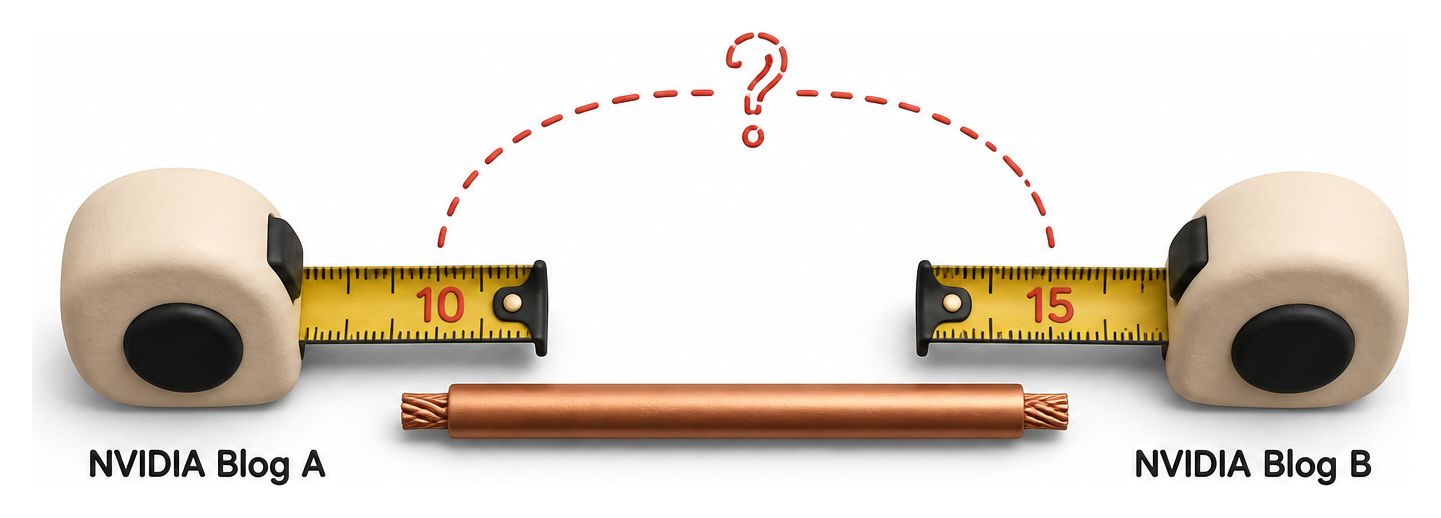
Direct, independently audited efficiency benchmarks comparing 415V AC, NVIDIA's 800 VDC architecture, and the OCP Mt Diablo +/-400 VDC approach at matched rack densities do not yet exist in the public record as of July 2026; the available figures are vendor-reported engineering targets rather than third-party measurements, a distinction this report treats carefully throughout. With that caveat, the directional evidence is consistent across independent sources. NVIDIA's own accounting states that "using 800 V busways and switching from 415 VAC to 800 VDC in electrical distribution enables 85% more power to be transmitted through the same conductor size" [1], while NVIDIA's separate corporate blog states the figure differently as "over 150% more power is transmitted through the same copper with 800 VDC" [16], a discrepancy this report notes rather than resolves, since both figures originate from NVIDIA but are not reconciled in either publication. What is consistent across NVIDIA's materials is the 45 percent copper reduction figure and the 5 percent end-to-end efficiency improvement, both of which recur across the developer blog, the Vertiv partnership write-up, and Schneider Electric's independent summary of the same reference design.
Independent, non-vendor benchmarking is scarcer but points the same direction. LBNL's 2008 field demonstration, run with more than 25 participating companies including Sun Microsystems, Intel, and Cisco, found that facility-level DC distribution "achieved the highest efficiency improvement, 7 percent, compared to 'best-in-class' AC distribution systems, and up to 28 percent compared to typical AC systems" [3], while its rack-level DC configuration "results in a 5 percent efficiency gain compared to traditional AC distribution" [3]. These figures, produced nearly two decades before the current 800 VDC push and at a much lower voltage (380V facility DC), are strikingly close in magnitude to NVIDIA's modern 5 percent claim, lending some independent credibility to the general order of magnitude even though the underlying voltage, load profile, and hardware generation differ substantially. LBNL also quantified the baseline problem the whole industry is responding to: "for every watt of power used to process data, an average of about 0.9 watts is required to support power conversion and between about 0.6 watts and 1 watt is needed to cool the power conversion equipment" [3], meaning every unit of conversion loss is effectively doubled once cooling overhead is included, a magnifying effect that both 800V camps cite as their strongest efficiency argument.
At the conversion-stage level, independent analysis modeling a Heron Power-style solid-state transformer reference architecture found the legacy 480VAC chain running at "four conversion stages and ~6.4% distribution loss" against an 800VDC chain that "replaces the entire electrical room with a single solid-state transformer at the facility perimeter" for "one conversion stage and ~3.0% distribution loss" [4], roughly a halving of distribution loss. At the semiconductor level, TI's 800V-to-6V isolated bus converter reaches "97.6% peak efficiency with >2000W/in3 power density" [17], and Data Center Knowledge quotes Current/OS Foundation president Yannick Neyret's estimate that "on a 1 GW campus, a 1% efficiency improvement avoids roughly 10 MW of losses" [11], which puts the scale of these single-digit percentage gains in concrete megawatt terms for a gigawatt-class AI campus.
Data Analysis and Evidence
The financial and physical scale behind this transition is documented across independent market-research and physics-based sources. Dell'Oro Group, a specialist telecommunications and data center market research firm, forecasts that "worldwide data center capex is projected to surpass $1 trillion by 2029," growing at a "CAGR of 21 percent by 2029," with the "Top 4 US-based cloud service providers, Amazon, Google, Meta, and Microsoft, accounting for nearly half of global data center capex in 2025" [7]. ABB, citing the same Dell'Oro research, states that "global data center demand is forecast to rise from 80 GW in 2024 to reach around 220GW by 2030," and that "AI workloads are expected to account for around 70 percent of this growth" [8]. ABB further discloses that "approximately 40% of ABB's scientific research in electrification is in areas critical to next gen data centers such as electrical architectures, protection devices, DC distribution and cooling" [8], a proxy for how large an engineering bet the incumbent electrical supply chain is placing on this transition.
Copper is the physical constraint tying all of this spending together, and its cost has moved sharply in the same window this transition has accelerated. The London Metal Exchange (LME), the global benchmark venue where "over 170,000 lots were traded on average every day" in 2025 [21], has seen copper prices climb sharply: market tracker Tacto records a 12-month change of "+36.8 %" against "the July 2025 monthly average of 9,778 USD/t" [22]. The International Energy Agency (IEA) reported copper prices "briefly exceeding USD 14 500 per tonne (intraday) in January 2026," underpinned in part by "the anticipation of strong demand growth from electrification and artificial intelligence" [23]. Against that price backdrop, NVIDIA's arithmetic that a single 1 MW rack on legacy 54 VDC distribution needs "up to 200 kg of copper busbar," scaling to roughly 200,000 kg for the rack busbars alone in a 1 GW campus [1], translates into a material cost exposure in the millions of dollars per gigawatt campus purely for in-rack busbar, before any facility-level conductor is counted, which is precisely the line item both 800V topologies are engineered to cut.
The safety and standards dimension of the transition is quantifiable in a different way: it is currently a schedule risk rather than a technology risk. Two European standards bodies, the Current/OS Foundation and the Open Direct Current Alliance (ODCA), "signed a memorandum of understanding (MoU) to align their technical work on DC power distribution and present coordinated positions to international standards bodies" in March 2026 [11]. Current/OS president Yannick Neyret described the underlying obstacle bluntly: electrical codes are "ruled by national rules or national standards ... very, very difficult to change, because they have been polished for more than 100 years" [11]. ODCA board chair Hartwig Stammberger frames the physical case in similar terms: DC distribution is "more efficient to get the power to the chip," with "fewer losses on the way there," and it needs "less effort, less wiring, and fewer components" [11]. Both groups are now working with the U.S. National Fire Protection Association (NFPA) "toward updates in the 2029 National Electrical Code revision cycle" [11], while a parallel International Electrotechnical Commission (IEC) standard for semiconductor-based DC circuit breakers is "expected to be published within months" of March 2026. Taken together, the market-size data, copper-price data, and standards timeline indicate a strong case for evaluating 800V-class DC at high rack densities, but they do not settle the procurement decision. NVIDIA identifies facility-level VDC challenges involving safety, standards, workforce training, CapEx, OpEx, fault detection, serviceability, and overcurrent-protection reliability; these remain material engineering and commercial variables alongside code adoption [1].
industry commentary notes that "DC arcs do not self-extinguish at a zero-crossing" the way AC arcs do, a genuine safety engineering problem that is still being solved
Case Studies and Real-World Examples
Microsoft Fairwater, Wisconsin: Frontier AI Scale
Microsoft’s Fairwater datacenter campus in Mount Pleasant, Wisconsin, illustrates frontier AI infrastructure at scale, but Microsoft’s published overview does not identify its facility-to-rack power-distribution topology. The facility spans "315 acres and housing three massive buildings with a combined 1.2 million square feet under roofs," and required "46.6 miles of deep foundation piles, 26.5 million pounds of structural steel, 120 miles of medium-voltage underground cable and 72.6 miles of mechanical piping" to build [20]. Each of its NVIDIA GB200-based racks "packs 72 NVIDIA Blackwell GPUs, tied together in a single NVLink domain that delivers 1.8 terabytes of GPU-to-GPU bandwidth," and the cluster is "capable of processing an astonishing 865,000 tokens per second, the highest throughput of any cloud platform available today" [20]. Microsoft’s published overview documents the site’s scale, GB200 racks, cooling infrastructure, and medium-voltage cabling, but it does not specify Fairwater’s facility-to-rack power-distribution topology. It therefore cannot establish whether the site uses a conventional AC-to-54V chain or an 800 VDC bus.
Foxconn Kaohsiung K-1, Taiwan: The First Production 800 VDC Site
Foxconn's Kaohsiung K-1 facility is the clearest named, dated example of monopolar 800 VDC moving from reference design to physical construction. Hon Hai Technology Group (Foxconn) announced it is "collaborating with NVIDIA to implement the 800 VDC power architecture for AI factories," confirming that the design will "first be implemented in the Kaohsiung K-1 artificial intelligence data center project, which serves as a demonstration site for the Group's capabilities in AI servers, data centers and renewable-energy integration" [9]. NVIDIA independently describes the same facility as "its 40-megawatt Taiwan data center, Kaohsiung-1, being built for 800 VDC," corroborating the project's scale from the customer side of the relationship [16]. Foxconn frames the underlying value proposition in terms nearly identical to NVIDIA's own: a design that "significantly reduces current and resistive losses, minimizes conductor usage, and simplifies power distribution, while improving energy-conversion efficiency and system safety" [9]. As the world's largest electronics manufacturing services provider by NVIDIA's own supply chain reckoning, Foxconn's commitment to build K-1 as a live 800 VDC demonstration site is a meaningful signal that the monopolar topology is not merely a slide deck concept but an active construction project as of 2026.
Heron Power: Financing the Grid-to-800V Conversion Layer
If NVIDIA and Foxconn represent the demand side of the 800 VDC transition, Heron Power represents a bet on the supply side of the conversion hardware itself. Founded by Drew Baglino, Tesla's former powertrain and energy senior vice president, Heron Power builds solid-state transformers, branded Heron Link, that "convert medium-voltage electricity to the 800-volt power needed by Nvidia's reference rack designs," with each unit "capable of handling 5 megawatts apiece" [10]. In February 2026 the company "raised $140 million to build gigawatts' worth of solid-state transformers for data centers and the grid" in a round "led by Andreessen Horowitz's American Dynamism Fund and Breakthrough Energy Ventures" [10], following customer interest in "more than 40 gigawatts of solid-state transformers." Baglino's central pitch is architectural simplification: "we can remove 70% of the gear involved" by replacing the century-old iron-core transformer, switchgear cabinet, and rectifier stack with a single power-electronics unit [10]. The company plans a factory "capable of producing 40 gigawatts of Heron Link transformers annually," representing "about 10% to 15% of annual production outside of China," with "pilot production" targeted for "early 2027" [10], a timeline that lines up almost exactly with NVIDIA's own 2027 Kyber production target.
Google's Decade-Long Voltage Migration: From 12V to 48V to Diablo 400
Google's own infrastructure history is a useful case study precisely because it shows this is the company's second major rack-voltage migration, not its first. Google's 2016 Open Rack v2.0 proposal, developed jointly with Facebook, aimed to bring "a 48V power architecture with a modular, shallow-depth form factor" to the Open Compute Project, building on the fact that Google had "developed a 48V ecosystem with payloads utilizing 48V to Point-of-Load technology" and "extensively deployed these high-efficiency, high-availability systems since 2010" [13]. At the time, this required reconciling Google's 660mm-deep, 48V rack with Facebook's 800mm-deep, 12V design, a genuine mechanical and electrical standardization exercise between two of the industry's largest infrastructure buyers [14]. A decade later, Google is a lead technical co-author of the very different Diablo 400 specification, whose documented output options are implementation-specific, explicitly because "ML will require more than 500 kW per IT rack before 2030" [5], a density its own 48V standard, which scaled cleanly "from 10 kilowatts to 100 kilowatts IT racks" [5], simply cannot reach. The pattern across both migrations is consistent: Google adopts a new voltage roughly once per decade, each time in response to a roughly ten-fold increase in target rack density, and each time in close coordination with at least one other hyperscaler through OCP rather than unilaterally.
NVIDIA exhibited an 800V sidecar to power 576 Rubin Ultra GPUs in a single Kyber rack.
Eaton delivered a new 800 VDC reference architecture, calling it a critical milestone in its grid-to-chip strategy.
Foxconn's 40-megawatt Taiwan data center, Kaohsiung-1, is being built for 800 VDC as the first production site.
Heron Power raised $140 million to build gigawatts' worth of solid-state transformers for data centers and the grid.
Vertiv says it is on track for readiness by late 2026 on its own 800 VDC portfolio.
Full-scale 800VDC data centers are timed to land with Kyber in 2027.
NEC updates for DC fault interruption are targeted for the 2029 revision cycle.
Implications and Future Directions
The near-term implication for data center operators and colocation providers is that procurement decisions made in 2026 and 2027 may need to account for legacy 415V AC, NVIDIA’s 800 VDC reference design, and Mt Diablo deployments. Google describes an initial ±400 VDC sidecar approach, while Microsoft describes 400 VDC HVDC as monopolar or bipolar; the applicable implementation determines the output arrangement [5] [19]. Vertiv's explicit strategy of supporting both DC topologies simultaneously, rather than choosing one, is a signal that vendors expect this multi-standard period to last years rather than months. Independent analysts frame the practical question for 2026 to 2028 as not "whether to go high-voltage DC," which they consider "settled," but "which topology to standardize on, how much energy storage to integrate with the bus, and how much field-proven track record to require before committing to a new conversion technology at scale" [4].
Energy storage architecture is shifting in lockstep with voltage. NVIDIA states that "energy storage solutions to help data center infrastructure handle load spikes, and subsecond scale GPU power fluctuations, is part of the 800 VDC architecture," rather than a bolt-on afterthought, and its Vera Rubin NVL72 rack design already features "20x more energy storage to keep power steady" compared with prior generations [16]. This reflects a broader industry recognition that tens of thousands of GPUs stepping load in near-perfect synchrony during training create power transients that a purely reactive UPS response cannot smooth quickly enough, making battery and supercapacitor banks integrated directly onto the 800V bus a structural requirement rather than a backup contingency.
The standards gap remains the single largest source of schedule risk identified across every source in this report. With National Electrical Code updates targeted for the 2029 revision cycle and adoption proceeding "state by state" thereafter in the United States [11], operators in some jurisdictions may be able to move faster than others; Germany's approach, where "utilities and insurers have accepted technically documented DC installations as 'state of the art'" ahead of a published standard, suggests early movers may not need to wait for formal codification everywhere. Solid-state transformer suppliers such as Heron Power, DG Matrix, and Amperesand represent the most technically ambitious wing of the transition, betting that wide-bandgap power electronics can eventually replace the iron-core transformer entirely at the medium-voltage front end; incumbents including ABB, Eaton, and Vertiv are simultaneously betting that conventional, decades-proven rectifier and switchgear technology remains the safer procurement choice for the first wave of gigawatt-scale deployments. Both bets are being placed concurrently rather than sequentially, which is itself the clearest evidence that no single vendor, including NVIDIA, currently controls the entire outcome of this transition.
Frequently Asked Questions (FAQs)
What is 800 VDC power architecture in an AI data center? It is a direct current (DC) power distribution scheme that converts utility AC to 800 volts DC once, near the facility perimeter or in a rack-adjacent "sidecar," and distributes that DC voltage to IT racks instead of using 415V or 480V AC. NVIDIA's version converts "13.8 kV AC grid power directly to 800 VDC at the data center perimeter using industrial-grade rectifiers" [1].
Why is NVIDIA moving to 800 VDC? Because its Kyber rack, targeting 576 Rubin Ultra GPUs by 2027, exceeds the physical limits of 54 VDC in-rack distribution, which would otherwise consume "up to 64 U of rack space for Kyber at MW scale, leaving no room for compute" [1].
How does HVDC compare to AC power distribution in a data center? High-voltage direct current (HVDC) removes at least one AC/DC conversion stage from the power chain. Independent modeling puts a legacy four-stage 480VAC chain at roughly 6.4 percent distribution loss against roughly 3.0 percent for a single-conversion 800VDC chain [4], while LBNL's independent 2008 field trial measured 5 to 7 percent total system efficiency gains for facility-level DC versus the best AC systems of that era [3].
What is 415V AC data center power distribution, and is it going away? It is the standard three-phase low-voltage AC distribution stepped down from medium-voltage utility feeds, typically 415V in Europe and 480V in North America, that has powered data center equipment rows for decades. It is not disappearing; Microsoft's Fairwater campus, one of the world's most powerful AI datacenters as of 2026, still runs on this model [20], but it is being bypassed for new gigawatt-scale AI-specific capacity.
What is the difference between 800 VDC and 400 VDC power loss? Both are part of the same "800V-class" voltage tier; the difference is topology, not raw loss physics. NVIDIA's monopolar 800V design runs the full 800V potential across a single rail, while the OCP Diablo specification splits the same class into "±400V" bipolar rails so that "any single conductor is only 400V to ground" [4], which changes insulation and protection requirements more than it changes the underlying resistive loss, since both ultimately move the same power at roughly the same effective voltage differential.
Is 800 VDC based on electric vehicle technology? Partly. NVIDIA's own corporate blog notes that "the electric vehicle and solar industries have already adopted 800 VDC infrastructure for similar benefits" [16], and the OCP Diablo bipolar specification more directly reuses EV-grade 400V connectors and switchgear to gain manufacturing scale.
What is high-density AI datacenter power design, in practice? It combines a high-voltage DC (or, in the interim, high-density AC) backbone with disaggregated power racks or "sidecars," rack-level or bus-level battery and supercapacitor storage for millisecond transients, and liquid cooling, since Google notes "water can transport approximately 4000 times more heat per unit volume than air" [5], meaning voltage architecture and thermal architecture are now designed as a single system rather than sequentially.
Conclusion
The transition from 415V AC distribution to high-voltage DC is driven by the need to reduce current, copper use, and conversion losses at higher rack densities. The central questions are implementation, timing, supply-chain availability, protection design, and standards compliance. NVIDIA’s 800 VDC architecture and OCP’s Mt Diablo work should not be treated as two universally fixed, exclusive wiring topologies: Microsoft describes Mt Diablo’s 400 VDC HVDC approach as monopolar or bipolar, with the applicable design determining the details [19]. Mature AC systems will continue alongside emerging HVDC deployments, whose technical configurations and timelines remain vendor- and project-specific.
External Sources (23)
About
GPUSmith
Plan and build private AI compute with GPU Smith. We connect workload requirements with GPU hardware, networking, deployment and operating decisions so your infrastructure fits the work it must perform.
GPU Smith provides independent engineering and research for private AI infrastructure. We help technical buyers and operators reason about GPU workload sizing, hardware selection, procurement, deployment and inference operations, from the compute system to the networking, power and cooling requirements around it.
Start with the workload
Useful infrastructure decisions begin with the models, data, throughput, latency and operating constraints a team actually has. GPU Smith helps connect those requirements with system design and deployment choices. The goal is a privately controlled AI environment whose capacity and operational demands are understood before a purchasing decision.
Hardware and supplier research
Our public reference library covers GPUs, complete systems and networking components. The server-vendor directory and manufacturing research help teams investigate suppliers, compare options and follow sources behind technical claims. We distinguish manufacturer specifications from measured benchmarks and advertised capabilities from tested configurations. Reference pages are research resources, not a live inventory listing or a binding equipment quote.
Deployment and operations
GPU Smith's engineering scope includes infrastructure integration, networking, power, cooling and the practical operation of inference workloads. Our published articles explain the tradeoffs behind deployment, procurement and ongoing operations so teams can ask better questions and document decisions.
Work with GPU Smith
Explore the hardware library, GPU references, networking references and vendor research. Contact GPU Smith with your workloads and deployment constraints to discuss a project and confirm current scope, pricing and availability.
Inclusion of a manufacturer or product in our research does not imply a partnership, certification or endorsement.
Disclaimer
This document is provided for informational purposes only. No representations or warranties are made regarding the accuracy, completeness, or reliability of its contents. Any use of this information is at your own risk. GPUSmith shall not be liable for any damages arising from the use of this document. This content was generated with assistance from artificial intelligence tools, which may contain errors or inaccuracies. Readers should verify critical information independently. All product names, trademarks, and registered trademarks mentioned are property of their respective owners and are used for identification purposes only. Use of these names does not imply endorsement. This document does not constitute professional or legal advice. For specific guidance related to your needs, please consult qualified professionals.