GPUSmith Article
Why 800 VDC Data Center Power Delivery Is Replacing 48V
Inside this article
- 01Why 800 VDC Data Center Power Delivery Is Replacing 48V
- 02Introduction and Background
- 03What Is 800 VDC Power Delivery? Definitions and Taxonomy
- 04Why AI Racks Are Outgrowing 48V and 54V Distribution
- 05Inside the 800 VDC Power Chain, From Grid to GPU
- 06Energy Storage, Grid Interaction, and Workload Volatility
- 07Safety, Standards, and the Deployment Path
- 08The Vendor and Semiconductor Ecosystem
- 09Data Analysis and Evidence
- 10Case Studies and Real-World Examples
- 11Implications and Future Directions
- 12Frequently Asked Questions (FAQs)
- 13Conclusion
Why 800 VDC Data Center Power Delivery Is Replacing 48V
Executive Summary
Artificial intelligence (AI) accelerator racks have outgrown the electrical architecture that has powered data centers for the last decade, and the industry's answer is 800 volts direct current (800 VDC). Traditional server racks distribute power at 415 or 480 volts alternating current (VAC) from the facility and step it down to 54 VDC or 48 VDC busbars inside the rack, a design that NVIDIA now describes as a bottleneck: "the legacy 54 V standard has become a bottleneck" as AI factories scale [1]. Schneider Electric's research finds that AI-driven rack densities beyond roughly $400 kilowatts (kW) already exceed the practical limits of both traditional AC and 48 VDC designs [2]. NVIDIA's current GB200 NVL72 rack already draws approximately 120 kilowatts (kW) [3], and the company is leading a transition to 800 VDC infrastructure explicitly to support 1 megawatt (MW) racks and beyond, starting in 2027 with the Kyber rack architecture [4].
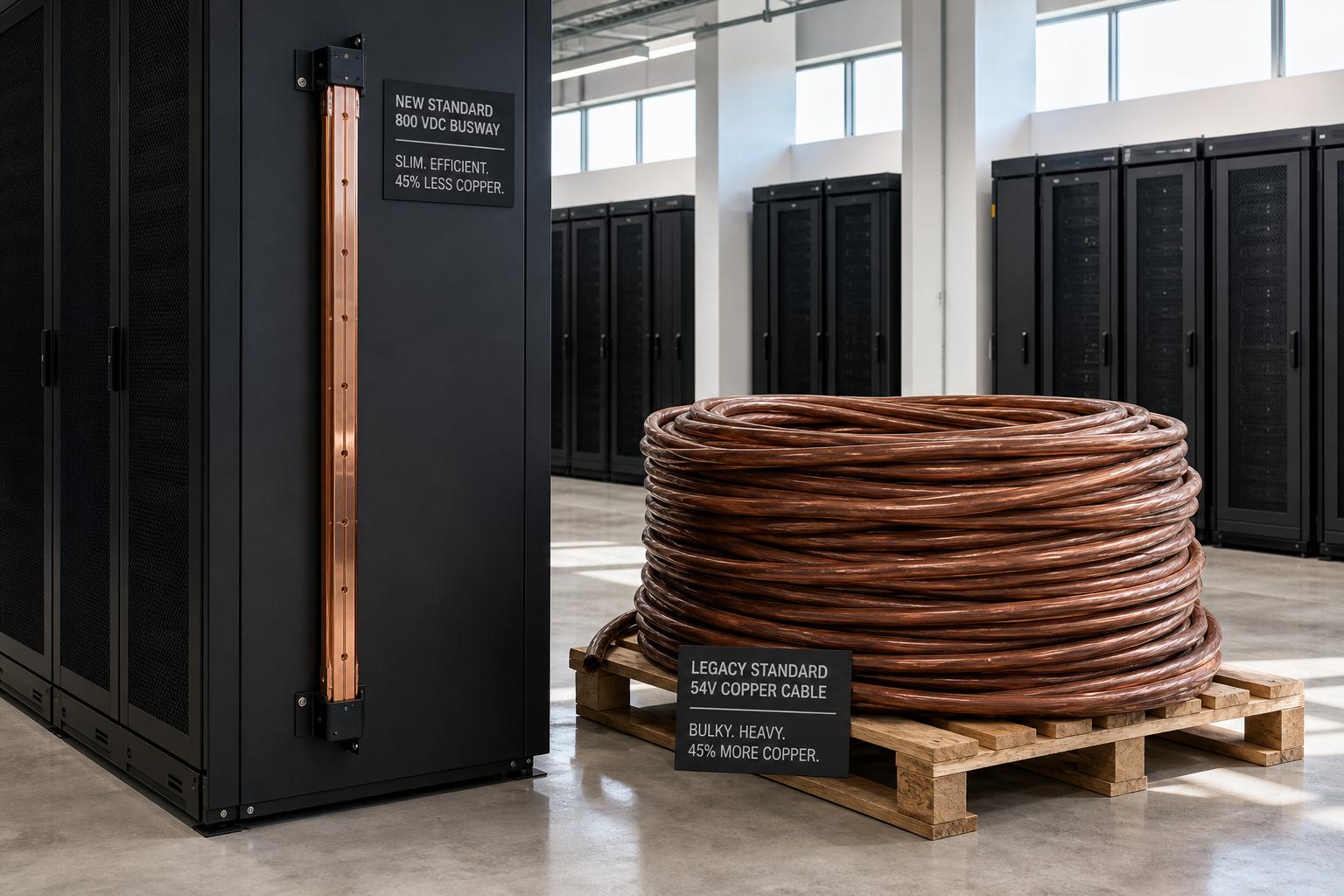
The physics driving this shift are straightforward: doubling distribution voltage roughly halves current for the same power, cutting resistive (I-squared-R) losses by a factor of four [5]. NVIDIA reports that 800 VDC busways carry 85% more power through the same conductor cross-section than 415 VAC distribution [4] and cuts copper requirements by 45% [6] [7], while a 1 MW rack running on legacy 54 VDC busbars can require up to 200 kilograms (kg) of copper, scaling to roughly 200,000 kg in a single 1 gigawatt (GW) data center [4]. NVIDIA claims end-to-end efficiency gains of up to 5%, maintenance-cost reductions of up to 70%, and total-cost-of-ownership (TCO) reductions of up to 30% from the architecture [4].
The transition is already visible in named deployments. Foxconn's Kaohsiung K-1 facility in Taiwan, a 40-megawatt demonstration site built with NVIDIA, is being constructed for 800 VDC operation [8], while CoreWeave, Lambda, Nebius, Oracle Cloud Infrastructure, and Together AI are all designing facilities around 800-volt distribution [8]. Vertiv, Eaton, Schneider Electric, and Delta have all announced commercial 800 VDC power systems, with Vertiv targeting release in the second half of 2026 to align with the 2027 Rubin Ultra platform rollout [9]. This build-out is unfolding against a backdrop of surging data center electricity demand: the International Energy Agency (IEA) finds data centers consumed 415 terawatt-hours (TWh) of electricity in 2024, about 1.5% of world consumption [10], and projects this will more than double to around 945 TWh by 2030 [10].
This report explains what 800 VDC is, why AI racks are outgrowing 48V and 54V distribution, how the power chain is restructured from grid to graphics processing unit (GPU), what the safety and standards implications are, which vendors are shipping products, and what the data on power density, copper markets, and grid interconnection queues reveals about the pace of adoption. It also examines four named deployments, from Foxconn's Taiwanese demonstration site to Microsoft's multi-gigawatt Fairwater campus in Wisconsin, to ground the analysis in real infrastructure rather than vendor roadmaps alone. The overall finding is that 800 VDC is not a universal replacement for AC data center power, but a targeted response to a specific problem: AI training and inference racks that are approaching, and in some designs exceeding, 1 MW, a density regime where conventional 48V and 54V busbar distribution runs out of physical headroom [6].
Introduction and Background
For roughly twenty years, the electrical design of a data center followed a predictable pattern: utility alternating current (AC) entered the building at medium voltage, stepped down through transformers and switchgear to 415 or 480 VAC, passed through an uninterruptible power supply (UPS) and power distribution units (PDUs), and was finally converted to low-voltage direct current (DC), historically 12 volts and later 48 or 54 volts, inside the rack [6]. That architecture was adequate when racks drew 10, 20, or even 50 kW [6]. Google helped popularize the 48 VDC rack standard: the company began developing it in 2010 after finding it was at least 30% more energy efficient and more cost-effective than the 12 VDC designs it had used since 2006 [11], and contributed the design to the Open Compute Project (OCP), the hardware consortium co-founded by Meta (then Facebook) to share data center and rack designs across the industry [11]. That 48V architecture scaled comfortably from roughly 10 kW to 100 kW per rack [12].
Generative AI changed the arithmetic. Training and inference workloads for large language models require packing as many GPUs as possible into a single, tightly interconnected domain to minimize chip-to-chip communication latency, which concentrates enormous power draw into a single rack rather than spreading it across a row [5]. A general-purpose central processing unit (CPU) rack supports up to about 12 kW, and air-cooled Hopper-generation (H100) racks reached only about 40 kW, but NVIDIA's current GB200 NVL72 rack requires approximately 120 kW [13] [3]. Google's own infrastructure team now projects that machine-learning workloads will require more than 500 kW per IT rack before 2030 [12], and industry roadmaps published in trade press now target 600 kW to 1 MW-plus racks between 2027 and 2029 [7]. Texas Instruments summarizes the resulting design problem succinctly: "IT rack power is expected to eclipse 1MW in the next two to three years," which has "led to a shift from a 48V or 54V bus to a higher-voltage DC bus of 800 VDC" [14].
This report examines the technical, economic, and operational dimensions of the 800 VDC transition: what the architecture actually is, why the industry has converged on this specific voltage rather than an alternative, how power moves from the grid to the GPU under the new design, what changes for safety and standards, which vendors and semiconductor suppliers are positioned to benefit, and what the data on rack density, copper markets, and grid capacity says about how quickly the shift can happen. NVIDIA is the central actor driving standardization, but the report also covers the parallel efforts by Google, Meta, and Microsoft inside the Open Compute Project, and it treats vendor claims about efficiency and cost savings as claims to be weighed against independent data wherever such data exists.
What Is 800 VDC Power Delivery? Definitions and Taxonomy
800 VDC refers to a data center power distribution scheme in which alternating current (AC) from the electrical grid is converted to a nominal 800-volt direct current (DC) bus close to the building's electrical entrance, and that DC voltage is then carried, largely unconverted, to the compute rack itself. NVIDIA's technical description defines the concept as decreasing "conversion and routing volumes in the compute space while minimizing data center distribution losses and total end-to-end conversion stages" relative to both rack-level 54 VDC systems and facility-level 480 VAC systems [1]. The category sits within the broader classification of low-voltage direct current (LVDC), which industry publications define as any DC distribution scheme up to 1,500 volts [7].
Two implementation forms coexist in the emerging standard, and the distinction matters for anyone specifying equipment. A differential (+800 VDC, two-wire) form delivers a full 800-volt potential difference across two conductors and is the form used in NVIDIA-led platforms. A bipolar (±400 VDC, three-wire) form instead splits the bus into a positive 400-volt rail, a negative 400-volt rail, and a neutral-like midpoint conductor. Google, developing this bipolar form jointly with Meta and Microsoft inside OCP under the "Mt Diablo" project, describes introducing "+/-400 VDC power delivery that can support up to 1 MW per rack" while drawing on the supply chain built for electric-vehicle (EV) charging equipment [12].
The taxonomy of where AC-to-DC conversion happens is equally important. NAND Research describes the near-term reference architecture as a phased chain: grid connection, where medium-voltage AC, typically 13.8 kilovolts (kV), is converted to 800 VDC at the facility perimeter using a solid-state transformer (SST) or a transformer-rectifier unit (TRU); distribution, where liquid-cooled busbars and conductors carry the 800 VDC to each rack; rack-level conversion, where server boards perform local DC-to-DC conversion to GPU core voltages; and, for near-term deployments, a sidecar model in which "a dedicated power rack adjacent to each compute rack houses the AC-to-800VDC conversion equipment" [6]. Schneider Electric's research frames this sidecar model, a dedicated power rack physically adjacent to the compute rack, as "the most feasible near-term approach today" because it minimizes disruption to existing AC-based facility electrical systems, benefits from a supply chain already built for EV-scale power electronics, and confines the blast radius of any early-lifecycle failures to a single rack [2]. Longer term, conversion is expected to migrate upstream to the pod, hall, or facility level as standards, supply chains, and operational experience mature.
Why AI Racks Are Outgrowing 48V and 54V Distribution
The case for 800 VDC rests on a well-established electrical principle. Power equals voltage multiplied by current (P = V x I), and resistive losses in a conductor scale with the square of current (P_loss = R x I-squared). Doubling voltage for a fixed power delivery halves the current required, and because losses scale with the square of current, halving current cuts resistive losses by a factor of four [5]. This is the same principle that pushed high-voltage transmission lines to hundreds of kilovolts a century ago, and it is why the electric-vehicle industry moved from 400-volt to 800-volt battery architectures to support faster charging.
Practical thresholds mark where each distribution approach breaks down. Traditional server power-supply units running on 415 or 240 VAC feeds hit their limit around 170 kW per rack; consolidating power supplies into shared power shelves that convert 480 VAC to a 48 VDC busbar, the "open rack" design used across most hyperscale AI deployments today, pushes that ceiling to roughly 400 kW per rack. Beyond that point, Schneider Electric's research finds that "incremental improvements such as higher-capacity power shelves or higher-ampacity liquid-cooled busbars yield diminishing returns due to a lack of space for more IT equipment" [2]. NVIDIA's own analysis puts the breaking point even lower in practice: "as racks exceed 200 kilowatts, this approach begins to hit physical limits" of space, copper mass, and conversion efficiency [4].
Copper mass is the most tangible constraint. Both NVIDIA and NAND Research independently cite the same figure: a single 1 MW rack running on 54 VDC busbars can require up to 200 kg of copper busbar [6], a figure that scales to roughly 200,000 kg of copper across an entire 1 GW facility. NVIDIA states that moving to 800 VDC busways from 415 VAC distribution transmits significantly more power through the same conductor cross-section, a figure the company describes elsewhere as "over 150%" more power through the same copper for the rack-to-facility comparison [8], and which trade press has also reported as up to 157% depending on the specific comparison baseline [7]. Regardless of which specific percentage applies to a given comparison, the underlying claim of a 45% reduction in copper mass for a given power level is consistent across independent trade coverage: NAND Research reports "the copper wire cross-section is reduced by up to 45 percent compared with low-voltage DC configurations" [6], and Power Electronics News independently confirms "NVIDIA reports that 800 VDC can reduce copper requirements by 45%" [7].
Space is the second constraint. In today's 54 VDC GB200 NVL72 and GB300 NVL72 racks, power shelves and their air-cooled 5.5 kW power-supply units already occupy up to eight power shelves per rack, delivering N+N redundancy for a total draw of approximately 120 kW [3]. By moving power conversion out of the compute rack and into a sidecar or upstream location, 800 VDC frees rack volume for additional GPUs: NAND Research notes that "power shelves are eliminated from the compute rack, freeing 64U or more of usable rack space" [6]. Taken together, the copper and space constraints explain why current levels and copper requirements become much harder to justify under the old architecture as rack density keeps climbing toward the 1 MW mark.
Inside the 800 VDC Power Chain, From Grid to GPU
Under the emerging reference architecture, next-generation AI factories "will have a centralized primary AC-to-DC conversion outside the IT data hall, capable of converting MVAC directly to a regulated 800-VDC bus voltage" [5], eliminating most of the intermediate AC-to-AC and AC-to-DC conversion stages found in legacy designs. That 800 VDC bus is distributed through the data hall to equipment rows and finally to the IT rack itself over a simplified busway. Inside the rack, a single-stage, high-ratio DC-to-DC conversion steps 800 VDC down to the voltages GPUs actually consume, often using highly efficient LLC resonant converter topologies [5].
There is no single agreed intermediate voltage for that final conversion stage. Texas Instruments describes one common option as an 800V-to-50V intermediate bus converter (IBC) followed by a 50V-to-12.5V or 50V-to-6.25V IBC, with a higher-voltage hot-swap circuit at the tray input to manage inrush current and safe connection to the live bus [14]. STMicroelectronics has commercialized parallel 800V-to-50V, 800V-to-12V, and 800V-to-6V conversion stages, noting that "the 50V, 12V, and 6V intermediate DC buses will all coexist in AI data centers depending on rack density, GPU configuration, and cooling strategy" [15]. The company's newest 800V-to-6V stage is designed to move the low-voltage bus closer to the GPU itself, which it says "reduces copper usage, minimizes resistive losses, and improves transient performance" for large training clusters [15].
Wide-bandgap semiconductors underpin every stage of this chain, because ordinary silicon MOSFETs used in 54 VDC power supplies cannot handle 800-volt bus voltages [6]. Silicon carbide (SiC) devices, typically rated 1,200 volts or higher, dominate the front-end AC-to-800 VDC conversion stage and hot-swap controllers because of their higher breakdown voltage and lower conduction losses [5]. Gallium nitride (GaN) devices dominate the high-frequency, high-density DC-to-DC stages closer to the GPU, where higher electron mobility and lower on-resistance permit switching frequencies into the megahertz range and correspondingly smaller passive components [5]. Infineon has demonstrated GaN converters with power densities exceeding 4.2 kilowatts per liter (kW/l) [5], Efficient Power Conversion (EPC) has released a compact GaN-based 6 kW converter, the EPC91123 evaluation board, that steps 800 VDC down to 12.5 VDC and occupies under 5,000 square millimeters at a height of 8 millimeters [5], and STMicroelectronics' NVIDIA-validated 12 kW GaN power-delivery board achieves a power density of 2,500 watts per cubic inch (W/in3) [6]. In October 2025, STMicroelectronics separately demonstrated a prototype GaN-based LLC converter operating directly from 800 volts at 1 megahertz with over 98% efficiency in a footprint exceeding 2,600 W/in3 [15].
Table 1 below summarizes the three server power distribution approaches currently in commercial use, synthesizing the density thresholds and architectural detail discussed above.
| Distribution Approach | Typical Density Ceiling | Conversion Path | Copper and Space Impact |
|---|---|---|---|
| Traditional AC PSUs (415/240 VAC) | Approximately 170 kW per rack | AC to 12 VDC inside every server | High per-server PSU count; congestion from PDUs, connectors, and liquid-cooling manifolds |
| Open Rack 48 VDC (480 VAC to busbar) | Approximately 400 kW per rack | 480 VAC to consolidated 48 VDC power shelves, then to each server | Up to 200 kg copper busbar per 1 MW rack; power shelves can consume up to 64U of rack space at scale |
| 800 VDC (differential or bipolar) | 100 kW to over 1 MW per rack on the same infrastructure [5] | 13.8 kV AC to 800 VDC at perimeter, then a single DC/DC stage to 50V/12V/6V rails | 45% less copper for a given power level [7]; frees power-shelf volume for compute |
The table illustrates a stepwise progression rather than a single cutover: each approach remains appropriate at its own density band, and the "open rack" tier that most hyperscale AI deployments use today already represents the practical ceiling for 48 VDC before density forces a move to 800 VDC. Most enterprise data centers running virtualized workloads, storage arrays, or general-purpose private cloud have no near-term reason to move beyond the 48 VDC open-rack tier, since their per-rack densities remain well under the 400 kW threshold where that architecture starts to strain [6].
Energy Storage, Grid Interaction, and Workload Volatility
AI training workloads do not draw power smoothly. NVIDIA's engineering team explains that "while 800 VDC solves the efficiency-at-scale problem, it doesn't address workload volatility," which is why energy storage must be treated as "an essential, active component of the power architecture, not just a backup system" that creates a buffer decoupling the chaotic power demands of the GPUs from the stability requirements of the utility grid [16]. NVIDIA proposes a "dual-pronged approach" pairing 800 VDC distribution with integrated, multi-timescale energy storage [16], spanning short-duration storage, in which "high-power capacitors and supercapacitors are placed close to the compute racks" to absorb high-frequency power spikes and fill brief valleys, and long-duration storage, in which "large, facility-level battery energy storage systems (BESS) are located at the utility interconnection" to manage slower, larger-scale power shifts and provide ride-through capability during transfers to backup generators [16].
Schneider Electric's independent analysis quantifies exactly why this buffering matters: because large language model training runs execute synchronized operations across thousands of GPUs simultaneously, the aggregate power draw can spike to roughly 150% of nominal load and fall to as low as 40% of nominal load within fractions of a second, and without adequate fault ride-through (FRT) capacity, a short grid disturbance lasting less than 150 milliseconds can cause a 1 GW-class data center to transfer immediately to onsite sources, an event that, if not resolved quickly, "can drive temporary overvoltage and over-frequency conditions" capable of cascading into wider blackouts [2]. NVIDIA's Vera Rubin NVL72 rack, part of the platform generation that precedes full Kyber deployment, is engineered to carry 20 times more onboard energy storage than prior rack generations specifically to keep power steady under these swings [8].
Vendors are beginning to embed this storage directly into commercial power hardware rather than treating it as a separate system. Delta's new 800 VDC in-row 660 kW power racks, unveiled at NVIDIA's GTC conference in March 2026, embed a total of 480 kW of battery backup units (BBU) across six 110 kW power shelves, alongside AC-DC power-supply units rated at up to 98% efficiency [17]. Delta has separately introduced a solid-state transformer that it says can convert medium-voltage AC directly to 800 VDC at up to 98.5% efficiency, paired with a microgrid solution combining solid oxide fuel cells and all-in-one energy storage systems that respond to step-load changes at millisecond scale [17]. Onsite generation of this kind matters because it can shrink a facility's path to power: Delta describes its solid oxide fuel cell option as capable of "reducing 'time-to-power' from years to just months" [17], a claim consistent with the broader industry pressure to bring gigawatt-scale capacity online faster than traditional grid interconnection timelines allow, discussed further in the data section below.
Safety, Standards, and the Deployment Path
Moving from AC to high-voltage DC distribution is not merely a component swap; it changes how electrical faults behave and how technicians must be trained to work safely around live equipment. Trade press coverage of the transition frames this explicitly against the historical "war of the currents" between Nikola Tesla and Thomas Edison, noting that AC power has "remained the preferred" choice for data centers precisely because DC systems raise new questions of standards and code compliance that the industry has not needed to answer at this scale before [7].
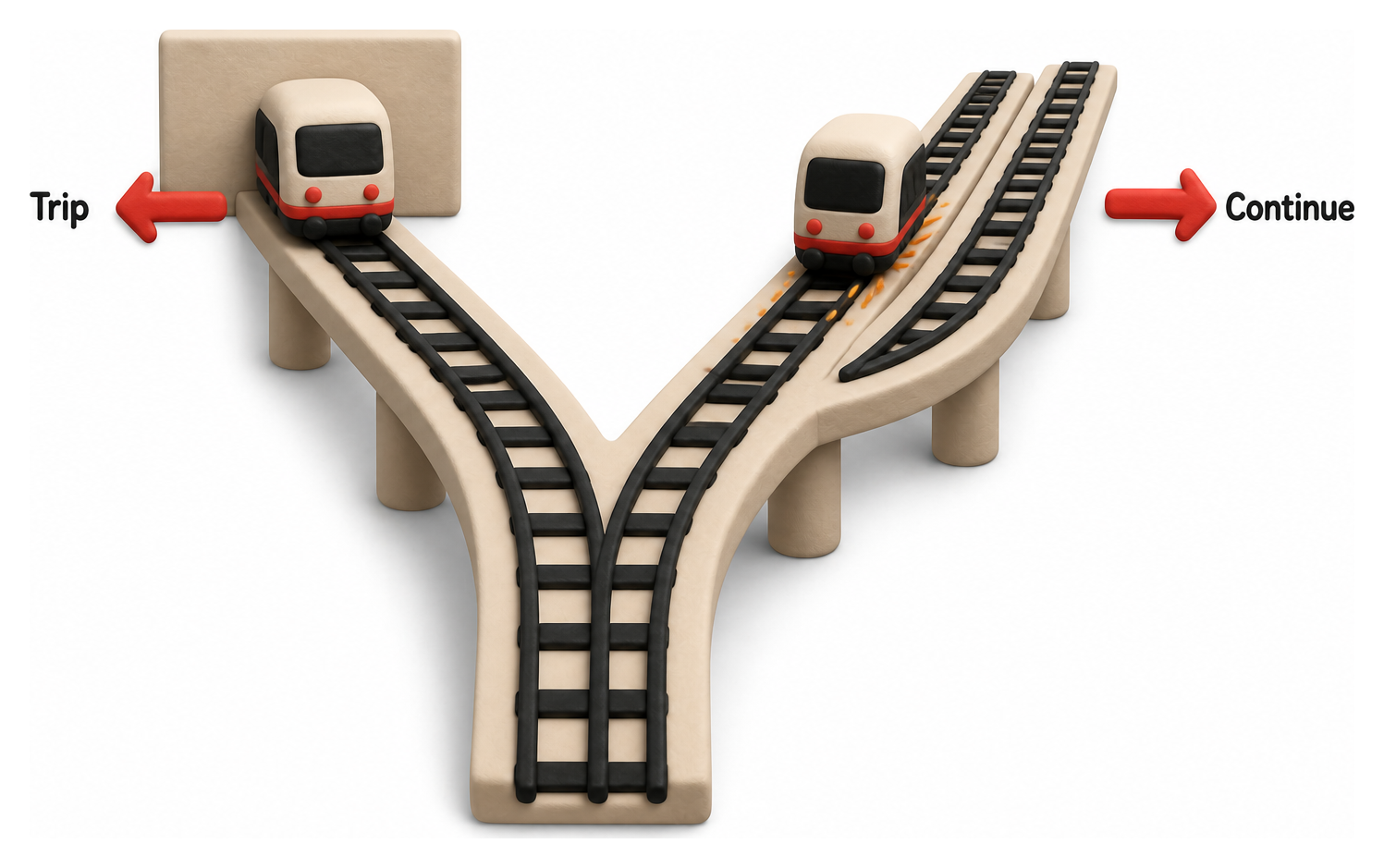
Grounding strategy is one of the central open design questions. Schneider Electric identifies three grounding philosophies available to 800 VDC system designers: solidly grounded systems, in which a ground fault trips the circuit protection device immediately, offering simplicity at the cost of potential downtime; high-resistance grounded (HRG) systems, which allow the critical load to continue operating through a first fault while requiring mandatory ground-fault detection; and floating (ungrounded) systems, which behave similarly to HRG but are less commonly used because the first fault risks damaging IT equipment before it is detected [2].
The industry's answer to workforce and supply-chain immaturity has been to concentrate initial deployment risk inside the sidecar model rather than attempting a wholesale facility redesign on day one. NAND Research frames the operator's-eye view of the underlying risk bluntly: "high-voltage DC requires new protection schemes, safety practices, maintenance procedures, and workforce training. DC arcs behave differently from AC arcs, making serviceability a major design consideration" [6].
Serviceability under live 800 VDC power is a particularly acute concern given the capital intensity of modern AI hardware. NAND Research notes that at "a 30x cost premium over traditional server hardware," minimizing maintenance downtime becomes a total-cost-of-ownership requirement, not merely a convenience, which is why Infineon's CoolSiC junction-gate field-effect transistor (JFET)-based hot-swap technology, enabling a board to be exchanged while adjacent servers in the same rack remain energized and operational, has emerged as a differentiating capability among semiconductor suppliers [6]. Vertiv, for its part, is positioning its existing services organization, which it describes as more than 4,000 field service engineers with experience across both AC and DC systems, as a core differentiator for safely commissioning and maintaining 800 VDC environments at scale [9].
Standardization efforts are proceeding on multiple, partially overlapping tracks. NVIDIA continues to drive the 800 VDC differential specification through its MGX and Kyber rack ecosystems within the Open Compute Project. Google, Meta, and Microsoft are jointly developing the competing bipolar ±400 VDC "Mt Diablo" specification inside the same OCP forum, with a draft specification opened for industry feedback in 2025 [12]. Until these efforts converge on shared safety codes and connector standards, the sidecar model gives operators a way to gain hands-on high-voltage DC experience without exposing an entire facility to unproven procedures.
The Vendor and Semiconductor Ecosystem
The 800 VDC transition has assembled one of the broadest cross-industry supplier coalitions in recent data center history. NVIDIA states it "is collaborating with key industry partners across the data center electrical ecosystem" [1], spanning silicon providers such as Analog Devices, Infineon, Navitas, onsemi, Renesas, STMicroelectronics, and Texas Instruments; power system component makers such as Delta, Flex, and Megmeet; and data center power system integrators such as ABB, Eaton, Hitachi Energy, Schneider Electric, Siemens, and Vertiv.
NAND Research's competitive analysis distinguishes vendor strategies within this coalition. Vertiv and Schneider Electric are positioned as full-ecosystem providers offering integrated power-and-cooling reference architectures rather than point products, leveraging existing hyperscale account relationships for initial deployments [6]. Eaton has focused on the medium-voltage solid-state transformer, positioning itself at the facility perimeter for the longer-term, fully centralized conversion phase rather than the near-term rack-level sidecar market [6], branding this effort a "grid-to-chip strategy" [18] that also includes a collaboration with Siemens Energy "to support fast construction of modular data centers with integrated on-site power generation" [18]. Delta's strategy embeds battery backup directly inside its power rack, addressing energy storage and power continuity in a single product line rather than as separate systems [6].
Among semiconductor suppliers, NAND Research finds that GaN and SiC are largely complementary rather than directly competitive, since GaN excels in high-frequency, high-density conversion and SiC excels in high-voltage, high-reliability applications such as hot-swap and medium-voltage conversion, with vendors carrying both portfolios, notably Infineon and Navitas, addressing the broadest opportunity [6]. onsemi describes its role as spanning "every stage of the power journey, from high-voltage AC/DC conversion at the substation to precise voltage regulation at the processor level," leveraging what it calls decades of innovation in silicon and silicon carbide [19]. NAND Research also flags a geographic dimension to competitive dynamics: "higher-voltage DC data centers have already emerged in China," which the firm says gives some Chinese hyperscalers a head start on DC architecture adoption relative to Western operators and creates a favorable reference base for Chinese component vendors [6]. EDN's review of the supply chain adds further names to this readiness list, reporting that Renesas Electronics, Innoscience, and onsemi are among the semiconductor companies that have "announced their readiness to support the transition to 800-VDC power architecture" [5].
Table 2 below compares the publicly disclosed commercialization timelines of four major data center power infrastructure vendors in the NVIDIA-aligned ecosystem.
| Vendor | Product Focus | Disclosed Timeline | Notable Detail |
|---|---|---|---|
| Vertiv | Centralized rectifiers, DC busways, rack-level DC/DC converters | Portfolio release H2 2026, aligned to 2027 Rubin Ultra rollout [9] | Full-ecosystem provider strategy, per independent analyst coverage |
| Eaton | Medium-voltage solid-state transformer (MVSST), busbar, hot-aisle containment | Reference architecture unveiled October 2025 [18] | Revenues of nearly $25 billion in 2024, serving customers in more than 160 countries [18] |
| Schneider Electric | Rack-level sidecar architectures, grounding and protection guidance | Guidance paper frames sidecar racks as the near-term standard | Frames 800 VDC power racks as the "most feasible near-term approach" |
| Delta | In-row power racks with embedded battery backup, liquid-to-liquid CDUs, solid-state transformers | Products showcased at NVIDIA GTC, March 2026 [17] | 660 kW power rack with 480 kW embedded BBU at up to 98% AC-DC efficiency; 2.4 MW liquid-to-liquid CDU |
As the table shows, 800 VDC designs and products were publicly unveiled from late 2025 through the first half of 2026. Vertiv has said its 800 VDC portfolio is planned for release in the second half of 2026, aligned with NVIDIA's 2027 Rubin Ultra rollout. NAND Research cautions that incumbent AC UPS and PDU vendors without 800 VDC roadmaps face a displacement risk as greenfield AI factory construction standardizes on DC distribution, though the transition timeline gives those incumbents an estimated 18 to 24 months to introduce competitive products before the AI factory build cycle accelerates further [6].
Data Analysis and Evidence
The scale of the underlying demand driving this architectural shift is documented by the IEA's dedicated "Energy and AI" analysis, which built a new global model of data center electricity demand. The report finds that data centers consumed approximately 415 TWh of electricity in 2024, roughly 1.5% of global electricity consumption, with the United States accounting for the largest share at 45%, followed by China at 25% and Europe at 15% [10]. Consumption has grown at approximately 12% per year since 2017, more than four times the growth rate of total global electricity consumption [10], and the IEA's base case projects consumption will more than double to approximately 945 TWh by 2030, rising further to roughly 1,200 TWh by 2035 [10]. The scale of individual facilities has grown alongside aggregate demand: the IEA notes that "a typical AI-focused data centre consumes as much electricity as 100,000 households, but the largest ones under construction today will consume 20 times as much" [10], a claim reinforced by global data center investment that the IEA says "nearly doubled since 2022 and amounted to half a trillion dollars in 2024" [10]. In the United States specifically, the IEA projects that data centers will account for nearly half of electricity demand growth between now and 2030, with the country set to consume more electricity for data centers than for the production of aluminum, steel, cement, chemicals, and all other energy-intensive goods combined by decade's end [10].
This demand is colliding with a constrained transmission grid. Lawrence Berkeley National Laboratory's (LBNL) interconnection queue tracking finds that, as of the end of 2025, more than 2,060 GW of total generation and storage capacity was actively seeking connection to the United States grid [20]. The same research shows how unreliable that queue is as a predictor of built capacity: of the projects that submitted interconnection requests between 2000 and 2019, only 13% had reached commercial operations by the end of 2024, while 77% had been withdrawn entirely [20]. This gap between announced power ambitions and deliverable grid capacity is precisely the pressure pushing AI operators toward architectures, including 800 VDC combined with onsite storage and generation, that extract more usable compute from every megawatt they can actually secure.
Copper markets provide a second, independently verifiable data point on why the industry is racing to cut conductor mass. Reuters reported in mid-2025 that "some analysts predict copper prices will hit records above $12,000 a ton before the end of the decade, an increase of 23% from current levels around $9,700 a ton," a forecast driven substantially by data center and grid-modernization demand [21]. Consultancy CRU told Reuters it expects copper demand specifically attributable to data centers to reach 260,000 metric tons in 2025, up from 78,000 tons in 2020, and to exceed 650,000 tons by 2030 [21]. Consultancy BMI separately forecasts that copper demand for upgrading global power generation and transmission networks will rise to 14.87 million metric tons by 2030, up from 12.52 million tons this year, underscoring how much of the world's copper supply is now bound up in electrical infrastructure broadly, not data centers alone [21]. Those forecasts proved conservative: by late January 2026, Reuters reported that benchmark copper on the London Metal Exchange had spiked to a record high above $14,000 a metric ton, with traders explicitly citing "more global spending on data centres, robotics and power infrastructure" as a driver of the rally [22]. Against that price trajectory, an industry-reported 45% reduction in copper mass per unit of delivered power translates directly into a material line-item cost avoidance for any operator building at gigawatt scale, independent of whatever efficiency or reliability benefits the architecture may or may not fully deliver in production.
Table 3 below tracks how per-rack power density has moved across successive NVIDIA GPU platform generations, illustrating the trajectory that makes 800 VDC necessary rather than merely convenient.
| Rack Platform | Approximate Power Draw | Distribution Voltage | Source |
|---|---|---|---|
| General-purpose CPU rack | Up to approximately 12 kW | 415/480 VAC | [13] |
| H100 air-cooled rack | Approximately 40 kW | 415/480 VAC to 54 VDC | [13] |
| GB200 NVL72 | Approximately 120 kW | 480 VAC to 54 VDC | [3] |
| Kyber (Rubin Ultra, 576 GPUs) | Designed for 1 MW-class racks by 2027 | 800 VDC | [16] |
The progression from roughly 12 kW to a targeted 1 MW-plus in the span of a single hardware generation cycle is, by itself, the strongest empirical justification for the architectural change: no incremental improvement to 48V or 54V busbar engineering closes a gap of that magnitude without consuming the entire volume of the rack in copper and power shelves.
Case Studies and Real-World Examples
Foxconn Kaohsiung K-1, Taiwan
Foxconn's subsidiary Ingrasys Technology is building the Kaohsiung K-1 facility in southern Taiwan as what NVIDIA describes as a 40-megawatt demonstration site for 800 VDC infrastructure. Foxconn Chairman Young Liu described the project's power targets in phased terms at Computex 2025: "This AI data center is targeted to have 100 megawatts of power... We'll start with 20 megawatts... then add another 40" [23]. In October 2025, Foxconn formally announced it was collaborating with NVIDIA "to implement the 800 VDC power architecture for AI factories," with the new architecture "first implemented in the Kaohsiung K-1 artificial intelligence data center project," which the company describes as its demonstration site for AI servers, data centers, and renewable-energy integration [24]. By May 2026, NAND Research characterized the facility as "operational on 800 VDC," suggesting the demonstration site had progressed from construction to live operation within roughly seven months of the initial announcement [6], though readers should note the exact commissioning date has not been independently confirmed outside vendor and trade-press statements. Ingrasys separately showcased an NVIDIA GB300 NVL72 platform integrated with an in-row coolant distribution unit (CDU) at the same event, illustrating how power and liquid-cooling upgrades are being deployed together rather than sequentially [24].
NVIDIA Kyber and the OCP Vera Rubin Ecosystem
At the OCP Global Summit in October 2025, NVIDIA and more than 20 industry partners jointly previewed the electrical and mechanical standards intended to support "gigawatt AI factories," anchored by the Vera Rubin NVL72 rack and the forthcoming Kyber rack that will connect 576 Rubin Ultra GPUs. Vertiv used the same event to unveil what it called a "space-, cost- and energy-efficient 800 VDC MGX reference architecture," a complete integrated power and cooling design built specifically for the Kyber generation [8]. In parallel, and running on a competing but interoperable track inside the same OCP forum, Google, Meta, and Microsoft advanced the "Mt Diablo" ±400 VDC bipolar standard aimed at the same 1 MW-per-rack density target, with Google framing the effort as a direct sequel to the 48 VDC rack design it originated in 2010 [12]. This dual-track standardization, differential 800 VDC led by NVIDIA and bipolar ±400 VDC led by Google, Meta, and Microsoft, illustrates that the industry has converged on the underlying voltage class while leaving the specific electrical topology open for competitive and technical resolution over the next several years.
Microsoft Fairwater, Mount Pleasant, Wisconsin
Microsoft's Fairwater campus in Mount Pleasant, Wisconsin illustrates the scale of power demand that is driving the search for architectures like 800 VDC, even though Microsoft has not publicly confirmed the facility's internal rack-level distribution voltage. CRN's reporting, based on filed county documents describing a 545,620-square-foot data hall building and a second, 293,420-square-foot building, describes the combined facility as "the most powerful AI data center in the world, with 337.6 megawatts of capacity" [25]. Microsoft has committed $3.3 billion to complete the initial facility and a further $4 billion for a second campus of similar scale, bringing total Wisconsin investment to more than $7 billion [26]. Independent analysis from Epoch AI projects the full multi-building Fairwater campus will consume 3.3 GW of power by late 2027, once its fourth building becomes operational, with each individual building drawing approximately a gigawatt on its own [27], a scale Epoch AI equates to "the equivalent of 3-4 large nuclear reactors" of generating capacity [27]. CRN's reporting on the buildout cites 26.5 million pounds of structural steel and 120 miles of medium-voltage underground piping among the project's physical statistics [25]. To help offset the added grid load, Microsoft financed a new 250 MW solar project in Portage County alongside a commitment to match every kilowatt-hour it consumes from fossil sources with carbon-free energy returned to the grid [25]. Fairwater is included here not as a confirmed 800 VDC site but as a real-world illustration of the multi-gigawatt density trajectory that NVIDIA, Vertiv, Eaton, Delta, and Google explicitly cite as the reason 48V and 54V busbar architectures need to be replaced.
Vendor Commercialization at NVIDIA GTC, March 2026
NVIDIA's GTC conference in March 2026 provided further evidence of ecosystem development, with Delta, STMicroelectronics, Vertiv, and other partners presenting 800 VDC equipment and related infrastructure. Delta showcased its 660 kW in-row power racks with embedded battery backup, its 2.4 MW and 3 MW liquid-to-liquid coolant distribution units, and a solid-state transformer converting medium-voltage AC to 800 VDC at up to 98.5% efficiency, describing the showcase as proof that its solutions are "designed for how future AI factories are actually built, powered, cooled, and operated efficiently" [17]. STMicroelectronics simultaneously announced it now provides "a complete portfolio for the 800 VDC power distribution inside gigawatt-scale compute infrastructure," spanning 50V, 12V, and 6V conversion stages, with company executive Marco Cassis stating that AI infrastructure's expanding compute scale "requires higher voltage distribution and greater density, which can only be achieved with system-level innovation for each of the different AI server form factors" [15]. Vertiv's own account of its role echoes this shift, describing the company as "actively engaged in the early design phases of several large AI factory projects" where its 800 VDC reference architecture serves as the basis of design for gigawatt-scale facilities [9]. Taken together, these announcements mark the transition of 800 VDC from a 2025 concept demonstration into a 2026 procurement decision facing real data center operators.
Implications and Future Directions
The near-term implication for data center operators is that 800 VDC adoption will be selective rather than universal. NAND Research's assessment is explicit on this point: "conventional enterprise data centers do not require 800VDC for typical virtualized workloads, SaaS infrastructure, storage arrays, or general-purpose private cloud," and it expects the strongest adoption to concentrate in AI training clusters, large-scale inference platforms, neoclouds, hyperscale AI campuses, sovereign AI infrastructure, and new-build facilities where power and cooling can be co-engineered from the start [6]. For those environments, however, the shift is described as effectively structural rather than optional, since the report concludes that "power architecture is becoming a first-order determinant of AI capacity, cost, reliability, and time-to-deployment" [6].
Retrofit economics will likely favor the sidecar model for existing facilities well beyond the initial deployment window. NAND Research expects operators to prefer modular, rack-adjacent power systems that introduce 800 VDC without a full rebuild of the electrical chain, describing this as directly analogous to how the industry introduced liquid cooling into air-cooled facilities incrementally rather than all at once [6]. Operators who commit heavily to traditional UPS and PDU infrastructure over the near term face what NAND Research calls "stranded-cost exposure" as the industry transitions to DC UPS and solid-state transformer topologies, a risk the firm suggests modular sidecar deployment can partially hedge against while preserving optionality for a fuller DC transition later [6]. NVIDIA's own long-term roadmap already anticipates the endpoint of this convergence, describing a future in which "medium-voltage AC is directly converted to 800 VDC by large, high-capacity power conversion systems" to establish what the company calls a native DC data center [16].
The competitive landscape is also likely to shift the basis on which AI infrastructure buyers evaluate vendors. NAND Research argues buyers will increasingly assess suppliers "not only on accelerator performance but also on power-path efficiency, rack-level serviceability, cooling integration, deployment repeatability, and ecosystem maturity," which the firm frames as a genuine change in how the buying conversation is structured, since "in the AI data center, power architecture becomes part of the compute architecture" [6]. Grid interaction is likely to grow in strategic importance alongside rack-level design, since gigawatt-scale fault ride-through and demand-flexibility capabilities embedded in the 800 VDC energy storage layer give operators a mechanism to negotiate faster interconnection or more flexible tariffs with utilities that are themselves managing over 2,060 GW of queued generation and storage requests they cannot all serve on a normal timeline [20]. Standardization convergence between NVIDIA's differential 800 VDC track and the Google, Meta, and Microsoft-led bipolar ±400 VDC "Mt Diablo" track remains the largest unresolved variable, and until the industry settles on shared connectors, grounding conventions, and safety codes, operators building today must choose a topology without a guarantee that it will remain the industry default in five years.
Frequently Asked Questions (FAQs)
What is 800 VDC and how is it different from 48V or 54V data center power? 800 VDC is a data center power distribution scheme in which AC from the grid is converted to a nominal 800-volt DC bus close to the building's electrical entrance and carried largely unconverted to the rack, replacing the legacy approach of stepping AC down to a 48 or 54-volt DC busbar inside or adjacent to each rack [1]. The higher voltage lets the same conductor carry more power at lower current, which is the source of nearly all of the architecture's claimed benefits [5].
Why do AI data centers need so much more power than traditional data centers? AI training and inference require packing large numbers of GPUs into a single, tightly interconnected rack to minimize communication latency between chips, which concentrates power draw that used to be spread across many racks into one, pushing per-rack density from roughly 12 kW for general-purpose compute to well over 100 kW today and toward 1 MW-plus in coming rack generations, a shift Texas Instruments frames plainly: rack power is "expected to eclipse 1MW in the next two to three years" [13] [14].
What are NVIDIA's GB200 NVL72 power requirements today? NVIDIA's own documentation states GB200 NVL72 rack power consumption is approximately 120 kW, delivered through eight power shelves using redundant 5.5 kW air-cooled power-supply units [3].
When will 800 VDC data centers be widely available? Vertiv, Eaton, Schneider Electric, and Delta have all announced commercial 800 VDC products, with Vertiv specifically targeting a portfolio release in the second half of 2026 to align with the 2027 rollout of NVIDIA's Rubin Ultra and Kyber platforms [9]. Foxconn has said the architecture will first be implemented at its Kaohsiung K-1 project, but its announcement does not say that the site is operating on the architecture [24].
Is 800 VDC safe compared to AC distribution? NVIDIA and its partners state 800 VDC "remains safe and scalable" when properly engineered [1], but industry sources are candid that DC arcs behave differently from AC arcs and that grounding, protection, and workforce training all require new standards and practices that are still maturing, which is why the sidecar model, confining new equipment and new procedures to a small, replicable footprint, is the dominant near-term deployment path [6].
Does every data center need to switch to 800 VDC? No. NAND Research states plainly that "conventional enterprise data centers do not require 800VDC for typical virtualized workloads, SaaS infrastructure, storage arrays, or general-purpose private cloud," and expects most facilities outside AI training, inference, and hyperscale campuses to continue using existing AC and lower-voltage rack architectures for the foreseeable future.
Conclusion
The shift to 800 VDC power delivery is best understood as a response to a specific, measurable engineering constraint rather than a general-purpose upgrade to data center electrical design. Rack power densities that have moved from roughly 12 kW for general-purpose compute to approximately 120 kW for today's GB200 NVL72 and toward a targeted 1 MW-plus for NVIDIA's 2027 Kyber platform have outrun what 48V and 54V busbar distribution can physically deliver without consuming the entire rack in copper and power shelves. The industry's near-unanimous convergence on 800 volts, backed by a coalition spanning NVIDIA, Google, Meta, Microsoft, Vertiv, Eaton, Schneider Electric, Delta, and more than a dozen semiconductor suppliers, reflects genuine physical necessity as much as competitive positioning: halving current at double the voltage is a fixed law of resistive loss, not a marketing claim.
That said, the evidence gathered here also supports a more measured framing than some vendor marketing implies. The sidecar model, not a wholesale facility rebuild, is the dominant deployment path today because the safety standards, workforce training, and supply chain for facility-scale high-voltage DC remain immature. Two competing electrical topologies, NVIDIA's differential form and the Google, Meta, and Microsoft bipolar form, remain unreconciled, and copper markets, grid interconnection queues, and semiconductor supply chains all impose real-world limits on how fast even a technically superior architecture can scale. Enterprise data centers running conventional workloads have little reason to follow this transition at all. For the AI training clusters, large-scale inference platforms, and hyperscale campuses where rack density has become the binding constraint on capacity, however, the data reviewed in this report indicates that 800 VDC has progressed beyond a speculative roadmap: Foxconn has announced that the architecture will first be implemented at its Kaohsiung K-1 project, while vendors are announcing, demonstrating, and planning products for a 2026 to 2027 commercialization window.
External Sources (27)
About
GPUSmith
Plan and build private AI compute with GPU Smith. We connect workload requirements with GPU hardware, networking, deployment and operating decisions so your infrastructure fits the work it must perform.
GPU Smith provides independent engineering and research for private AI infrastructure. We help technical buyers and operators reason about GPU workload sizing, hardware selection, procurement, deployment and inference operations, from the compute system to the networking, power and cooling requirements around it.
Start with the workload
Useful infrastructure decisions begin with the models, data, throughput, latency and operating constraints a team actually has. GPU Smith helps connect those requirements with system design and deployment choices. The goal is a privately controlled AI environment whose capacity and operational demands are understood before a purchasing decision.
Hardware and supplier research
Our public reference library covers GPUs, complete systems and networking components. The server-vendor directory and manufacturing research help teams investigate suppliers, compare options and follow sources behind technical claims. We distinguish manufacturer specifications from measured benchmarks and advertised capabilities from tested configurations. Reference pages are research resources, not a live inventory listing or a binding equipment quote.
Deployment and operations
GPU Smith's engineering scope includes infrastructure integration, networking, power, cooling and the practical operation of inference workloads. Our published articles explain the tradeoffs behind deployment, procurement and ongoing operations so teams can ask better questions and document decisions.
Work with GPU Smith
Explore the hardware library, GPU references, networking references and vendor research. Contact GPU Smith with your workloads and deployment constraints to discuss a project and confirm current scope, pricing and availability.
Inclusion of a manufacturer or product in our research does not imply a partnership, certification or endorsement.
Disclaimer
This document is provided for informational purposes only. No representations or warranties are made regarding the accuracy, completeness, or reliability of its contents. Any use of this information is at your own risk. GPUSmith shall not be liable for any damages arising from the use of this document. This content was generated with assistance from artificial intelligence tools, which may contain errors or inaccuracies. Readers should verify critical information independently. All product names, trademarks, and registered trademarks mentioned are property of their respective owners and are used for identification purposes only. Use of these names does not imply endorsement. This document does not constitute professional or legal advice. For specific guidance related to your needs, please consult qualified professionals.