GPUSmith Article
800 VDC Datacenter Power: Why AI Racks Are Going High-Voltage DC
Summary
- 01The industry is converging on 800 volts direct current (800 VDC) as the reference voltage for AI data center power, replacing the legacy chain of 415 or 480 VAC stepped down to 54 VDC at the rack.
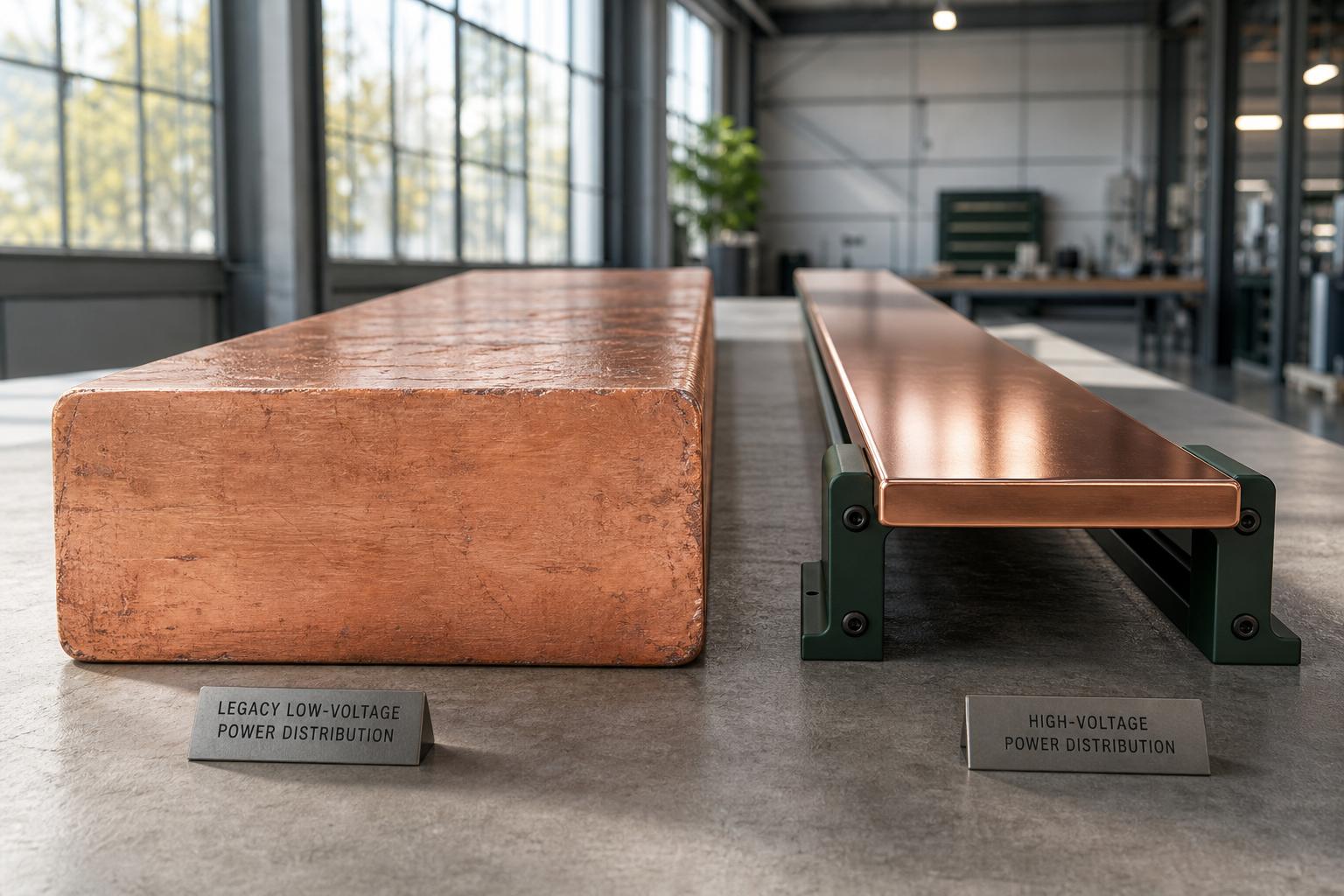
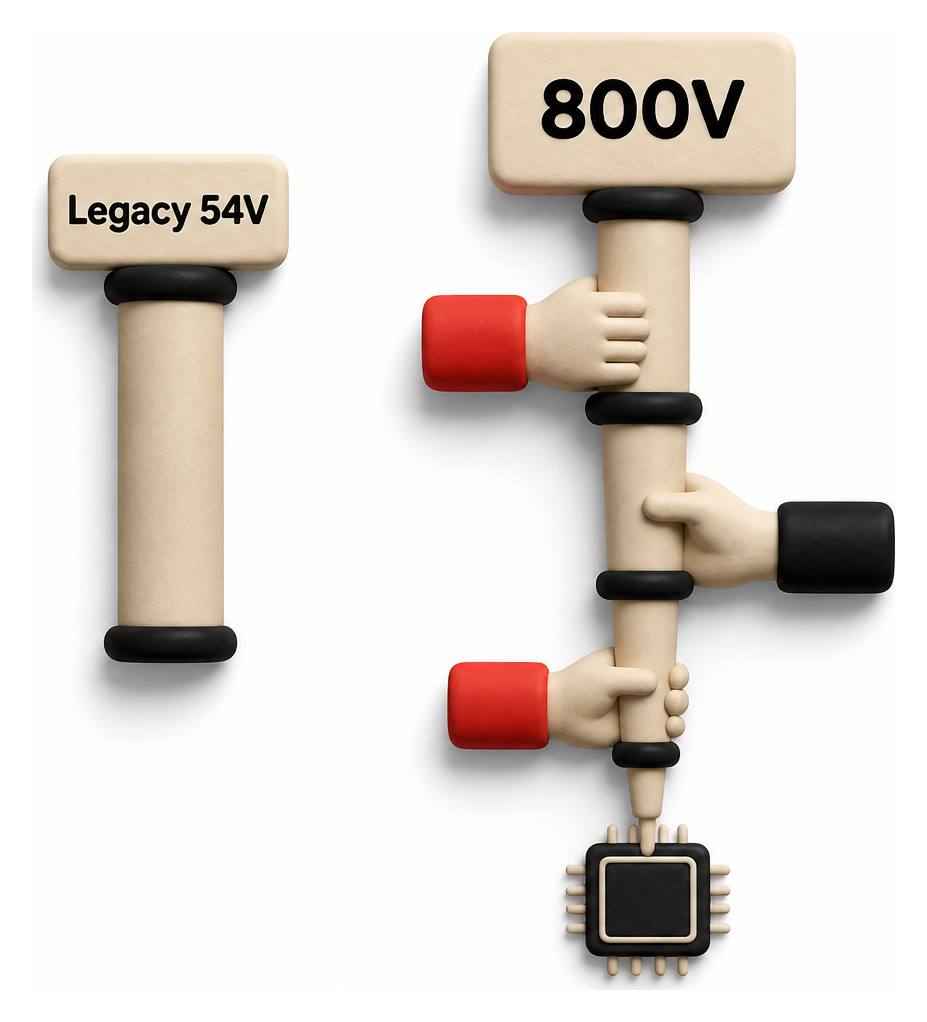
- 02NVIDIA states 800VDC transmits over 150 percent more power through the same copper compared to legacy AC, while a 1 MW rack on 54 VDC can require up to 200 kilograms of copper busbar.
- 03800 VDC is not one standard but two competing topologies, NVIDIA's monopolar two-wire design and the OCP-backed Diablo 400 bipolar plus/minus 400 VDC design, expected to coexist in the same data halls for years.
- 04NVIDIA's efficiency and cost claims, including up to 5 percent efficiency gains and up to 30 percent lower total cost of ownership, are vendor-supplied figures that should be read as directional rather than independently audited.
- 05The biggest remaining obstacle is regulatory: no standardized method yet exists to evaluate DC arc-flash incident energy, and the National Electrical Code is not expected to address 800 VDC voltages until its 2029 revision cycle.
Inside this article
- 01Executive Summary
- 02Introduction and Background
- 03What Is 800 VDC Power Architecture?
- 04Why AC and Low-Voltage DC Power Distribution Break Down at Megawatt Scale
- 05Inside the NVIDIA 800 VDC Reference Architecture
- 06The Competing Topology: OCP's Bipolar Diablo Standard
- 07The Supply Chain: Semiconductors, Power Systems, and Solid-State Transformers
- 08Implementation Considerations: Standards, Safety, and the Sidecar Path
- 09Data Analysis and Evidence
- 10Case Studies and Real-World Examples
- 11Foxconn's Kaohsiung K-1 AI Factory, Taiwan
- 12Heron Power's Solid-State Transformer Factory
- 13NVIDIA, Microsoft, and OpenAI's Joint Power Stabilization Research
- 14The 2025 Iberian Peninsula Blackout and Grid Resilience Context
- 15Implications and Future Directions
- 16Frequently Asked Questions (FAQs)
- 17Conclusion
800 VDC Datacenter Power: Why AI Racks Are Going High-Voltage DC
Executive Summary
Artificial intelligence data centers are abandoning a century-old electrical convention. As of July 2026, the industry is converging on 800 volts direct current (800 VDC) as the reference voltage for power distribution inside AI-optimized data centers, commonly branded "AI factories," replacing the legacy chain of 415 or 480 volt alternating current (VAC) stepped down to 54 VDC at the rack [1]. The driver is physics, not preference: a single 1 megawatt (MW) rack running on 54 VDC requires up to 200 kilograms of copper busbar, and a 1 gigawatt (GW) campus built the same way could need roughly 200,000 kilograms of copper in rack busbars alone [1]. NVIDIA Corporation is the architect and loudest advocate of this shift, targeting full-scale 800 VDC data centers to coincide with its Kyber rack-scale system in 2027, which is designed to house 576 Rubin Ultra graphics processing units (GPUs) per rack [2].
The case for high-voltage DC rests on measurable engineering gains. NVIDIA states that switching a data center's backbone from 415 or 480 VAC to 800VDC transmits "over 150 percent more power...through the same copper," eliminating the need for the roughly 200-kilogram copper busbars a single legacy 1 MW rack requires [2]. Independent analysis corroborates the efficiency case: NAND Research reports that NVIDIA "claims the architecture improves end-to-end power efficiency by up to 5 percent compared to 54VDC systems" [3], while NVIDIA separately projects up to 70% lower maintenance costs and up to 30% reduction in total cost of ownership compared with 54 VDC systems [1]. These are vendor-supplied figures and should be read as directional targets rather than independently audited results, but the underlying resistive-loss physics (power loss scales with the square of current, so raising voltage lowers current and loss for a given power level) is not in dispute.
Critically, "800 VDC" is not one architecture but at least two competing, coexisting topologies. NVIDIA distributes monopolar 800 VDC over two conductors in a closed reference design [4], while a hyperscaler coalition of Google, Meta, and Microsoft, working through the Open Compute Project (OCP) under the "Mount Diablo" and "Diablo 400" specifications, is standardizing on bipolar ±400 VDC distribution derived from electric-vehicle (EV) supply chains, with an explicit design option for an 800 VDC two-wire output [5] [6]. Both topologies are expected to coexist in the same data halls for years [4].
More than two dozen companies, spanning power semiconductors (Texas Instruments, Infineon, Navitas, STMicroelectronics), power system integrators (Eaton, ABB, Vertiv, Schneider Electric, Siemens), and cloud operators (CoreWeave, Lambda, Nebius, Oracle Cloud Infrastructure, Together AI), have publicly aligned with NVIDIA's 800 VDC push since October 2025 [2]. Foxconn has already implemented the architecture at its 40 MW Kaohsiung K-1 facility in Taiwan [2] [7]. The stakes are macroeconomic: the International Energy Agency (IEA) projects global data center electricity consumption will roughly double from 415 terawatt-hours (TWh) in 2024 to about 945 TWh by 2030 [8], while Dell'Oro Group forecasts global data center capacity growing from 80 gigawatts (GW) in 2024 to roughly 220 GW by 2030 with cumulative capital expenditure exceeding $1 trillion [9]. The remaining obstacle is not silicon but regulation: electrical codes built around AC over more than a century must be rewritten for DC, since DC arcs do not self-extinguish at a zero-crossing the way AC arcs do, and no standardized method yet exists to model DC arc-flash incident energy [4] [10]. This report examines why the shift is happening, how the competing standards differ, what the data shows about costs and timelines, and what operators need to plan for.
Introduction and Background
For roughly two decades, data center electrical design followed a stable template: utility alternating current (AC) enters the building at medium voltage, steps down through transformers and uninterruptible power supply (UPS) systems to 415 or 480 VAC, and is distributed to racks where power supply units (PSUs) convert it to 54 or 48 volts direct current (VDC) for delivery to servers [3]. That template was adequate when racks drew 10, 20, or even 50 kilowatts (kW). It is failing as artificial intelligence (AI) infrastructure pushes rack densities toward hundreds of kilowatts and, in leading-edge designs, past 1 megawatt (MW) per rack [3].
The proximate cause is NVIDIA's own hardware roadmap. The jump from the Hopper to the Blackwell GPU architecture increased individual GPU thermal design power (TDP) by roughly 75%, and because NVIDIA's NVLink interconnect scaled the coherent GPU domain to 72 chips, rack power density rose 3.4 times for what the company describes as "a staggering 50x increase in performance" [11]. Delivering that much current at 54 VDC is a losing proposition: resistive power loss rises with the square of current, so the copper needed to carry it without unacceptable losses becomes physically and economically absurd at scale. NVIDIA's own accounting puts the copper burden at up to 200 kg per 1 MW rack, and up to 200,000 kg across the rack-level busbars of a single 1 GW campus [1].
Raising the distribution voltage is the standard engineering answer to this problem, and it is why the industry has largely converged on the same number: 800 volts. That number is not arbitrary. It mirrors the voltage class already mass-produced for electric vehicle (EV) traction batteries and DC fast charging, giving data center vendors access to an EV-scale supply chain of power semiconductors, connectors, and protection devices rather than having to build one from nothing. Schneider Electric's Data Center Research and Strategy group describes the industry as having "increasingly aligned around 800 VDC for these next-generation AI rack densities," identifying rack-adjacent "sidecar" power racks as the near-term enabler of that shift [12].
This report examines the mechanics, the competing standards, the vendor ecosystem, and the data behind the 800 VDC transition. It draws on primary technical publications from NVIDIA, Schneider Electric, the Open Compute Project ecosystem, power semiconductor manufacturers, and independent research from the International Energy Agency, arXiv, and standards bodies including UL Solutions and the National Fire Protection Association (NFPA), current as of July 2026.
What Is 800 VDC Power Architecture?
800 VDC power architecture refers to the practice of converting utility AC power to a stable 800-volt direct current bus at or near the data center perimeter, then distributing that DC power through the facility to compute racks with minimal further conversion, rather than distributing AC and converting to low-voltage DC only at the rack. NVIDIA describes the shift as moving from a legacy chain, where 415 V AC is conducted through data halls to power shelves that finally deliver 54 V and 12 V DC at the rack, to an architecture where medium-voltage AC is converted directly to high-voltage DC at the perimeter and delivered as DC all the way to the row and rack level. Independent engineering analysis confirms the grid-facing half of that chain in more general terms: "medium-voltage AC (typically 13.8 kV) is converted to 800 VDC at the facility perimeter using a solid-state transformer (SST) or a transformer-rectifier unit (TRU)," which eliminates most of the intermediate conversion steps found in legacy designs [3].
Three structural attributes distinguish 800 VDC designs from legacy architectures, and data center designers must choose a position on each:
- Conversion location. Conversion from AC to 800 VDC can happen inside the server, inside the IT rack, inside an adjacent "power rack" or sidecar, upstream at the pod or data hall level, or at the facility entrance. Schneider Electric's white paper identifies the power-rack (sidecar) location as "the immediate enabler" of 800 VDC because it minimizes disruption to existing AC-based facility systems while offering a mature EV-derived supply chain.
- Polarity (form). Systems can run differential (a single +800 VDC rail and a return, two conductors) or bipolar (+400 VDC and -400 VDC around a shared reference, three conductors). Schneider Electric's white paper notes that differential designs are used in NVIDIA-led platforms, while bipolar implementations appear in the Open Compute Project's high power rack V4 design [12].
- Grounding and isolation. Solidly grounded, high-resistance grounded, or floating (ungrounded) schemes each trade off simplicity against operational reliability during a first fault, and each requires dedicated ground-fault detection under DC, since a persistent first fault does not automatically clear the way it often does under AC.
Microsoft's own description of the underlying rack-level shift, published through its Mt Diablo initiative, frames the change as disaggregation: separating a single high-density rack into a dedicated server rack and a dedicated power rack, each optimized for its own function, which the company says enables up to 35% more AI accelerators in each server rack because power hardware no longer competes with GPUs for chassis space [13]. The same logic holds on NVIDIA's side of the ecosystem: eliminating rack-level AC-to-DC conversion and accepting 800 V input directly frees the chassis space that power hardware used to occupy. Independent teardown analysis of the resulting Kyber-class design confirms that "power shelves are eliminated from the compute rack, freeing 64U or more of usable rack space" [3].
Both camps agree the architecture must scale from roughly 100 kW racks today to well over 1 MW without a redesign, moving well past the range where "traditional data center racks may draw around 10kW, while AI racks are beginning to approach 1MW" [3], and independent industry group Current/OS and the Open Direct Current Alliance (ODCA) describe the Open Compute Project's Mt. Diablo initiative as already "demonstrating ±400 VDC rack distribution derived from electric vehicle infrastructure, supporting 1 MW racks with reduced conversion losses" [5].
Why AC and Low-Voltage DC Power Distribution Break Down at Megawatt Scale
Schneider Electric's research group quantifies the breakdown points precisely. Traditional server power distribution, where each server's own PSU converts 240 VAC to 12 VDC, hits practical limits around 170 kW per rack, assuming triple 100-amp rack power distribution units (rPDUs) with no redundancy on 100% liquid-cooled IT equipment. "Open rack" designs, which consolidate PSUs into shared power shelves converting 480 VAC to a 48 VDC busbar, push that ceiling to roughly 400 kW per rack, but beyond that point the limitations compound as congestion from AC feeds and connectors, chassis space consumed by power shelves and batteries, and the low voltage itself all combine to limit how much power the busbar can practically carry [12].
The physical arithmetic is stark. NVIDIA notes that using its legacy 54 VDC architecture at Kyber-class megawatt density would require up to 64U of power shelves per rack, leaving no room for compute [1]. Repeated AC-to-DC and DC-to-DC conversions compound the problem further; independent engineering analysis attributes much of the loss directly to the conversion chain itself, noting simply that "each conversion stage introduces power losses that limit overall efficiency" [14]. EDN's engineering analysis frames the underlying physics simply: resistive power loss equals current squared multiplied by resistance, so doubling the distribution voltage from an industry-standard high end of roughly 400 VDC to 800 VDC allows the same power to be delivered at half the current, quartering resistive losses for a given conductor [14].
Workload behavior compounds the density problem with a volatility problem. AI training is not a steady load: thousands of GPUs execute synchronized bursts of computation followed by synchronized communication phases, and the resulting power draw at a rack can swing "from an 'idle' state of around 30% to 100% utilization and back again in milliseconds" [11]. Joint research published on arXiv by engineers at Microsoft, OpenAI, and NVIDIA documents that "a single training job can span more than a hundred thousand GPUs" operating in lockstep, and that the resulting "aggregate power consumption can oscillate by tens of megawatts within a single datacenter" [15]. At the server level, GPUs "contribute more than 50% of the provisioned power," so those swings propagate directly into facility-level and grid-level oscillations [15]. Utility grid specifications increasingly cap the harmonic energy such loads may inject "at 20% of total harmonic energy" within critical frequency bands, and the same researchers note that "multiple utility providers have now documented the impact of harmonics induced by synchronized computing loads" [15]. Schneider Electric documents comparable swings, with spikes and troughs severe enough that an unmitigated grid disturbance lasting less than 150 milliseconds can, absent fault ride-through capability, cause a large data center (for example, 1 GW) to transfer immediately to onsite backup sources, an abrupt loss of load that can itself destabilize the grid [12]. Higher-voltage DC architecture does not, on its own, resolve this volatility; it must be paired with integrated energy storage, discussed later in this report.
Inside the NVIDIA 800 VDC Reference Architecture
NVIDIA's reference design converts medium-voltage AC grid power directly to a regulated 800 VDC bus at the data center perimeter using industrial-grade rectifiers, largely eliminating the intermediate transformer, switchgear, and AC UPS stages of the legacy chain. From there, 800 VDC busways carry power through the data hall, through row-level overcurrent protection, and into compute racks over a two-conductor feed. NVIDIA's own overview page states the architecture "decreases conversion and routing volumes in the compute space while minimizing data center distribution losses and total end-to-end conversion stages" [16].
Inside the rack, the design forgoes a separate 54 VDC intermediate bus in the most aggressive implementations. EDN's independent engineering coverage describes the result: "power conversion within the rack is reduced to a single-stage, high-ratio DC-to-DC conversion (800 VDC to the 12-VDC rail used by the GPU complex), often employing highly efficient LLC resonant converters" [14]. NVIDIA's own Kyber rack architecture, previewed at NVIDIA GTC 2025 as an 800 V sidecar powering 576 Rubin Ultra GPUs, distributes 800 V directly to each compute node, where "a late-stage, high-ratio 64:1 LLC converter efficiently steps it down to 12 VDC immediately adjacent to the GPU" [11]. NVIDIA states this single-stage, late conversion "occupies 26% less area than traditional multi-stage approaches," freeing chassis volume for compute rather than power hardware [11]. At the wire level, the architecture's simpler two-conductor arrangement reduces connector count relative to AC: EDN describes the resulting distribution as flowing "directly to the compute racks via a simpler, two-conductor DC busway (positive and return)" once it leaves the perimeter conversion stage [14].
The headline hardware target is the Vera Rubin NVL144 rack, unveiled with specifications including 45 degrees Celsius (113 degrees Fahrenheit) liquid cooling, a new liquid-cooled busbar, a central printed circuit board midplane replacing cable-based connections, and, notably, roughly 20 times more energy storage than earlier generations to keep power steady during synchronized load swings [2]. Kyber, the architecture's successor to the Oberon rack family, is designed to house 576 Rubin Ultra GPUs organized as 18 compute blades "rotated vertically, like books on a shelf," and is timed for full-scale production alongside NVIDIA's 800 VDC rollout, with the Kyber system designed to "house 576 Rubin Ultra GPUs by 2027" [2].
NVIDIA frames its projected benefits in four buckets: scalability, supporting racks from 100 kW to well over 1 MW on shared infrastructure; efficiency, an up-to-5% end-to-end gain over 54 V systems, as noted above; copper reduction, from eliminating redundant conversion stages and lowering current; and reliability, from centralizing power conversion outside the rack rather than relying on overprovisioned, failure-prone in-rack PSUs. NVIDIA has also acknowledged the architecture is unproven at scale in one respect: protection engineering for 800 VDC fault conditions is still catching up to the power electronics, an implementation gap the company itself has flagged as a priority area rather than a solved problem.
The Competing Topology: OCP's Bipolar Diablo Standard
While NVIDIA controls a closed, vertically integrated 800 VDC reference design, the largest cloud operators are pursuing an open, community-governed alternative through the Open Compute Project. Microsoft first outlined the rationale in an October 2024 blog post describing its Mt Diablo project, developed jointly with Meta: separate the power hardware into its own rack so the compute rack can be filled entirely with accelerators and switches, right-sizing the power shelf count for each configuration [13]. The proposal targets conversion to "400Vdc (High Voltage Direct Current or HVDC), monopolar or bipolar," explicitly keeping both polarity options on the table pending industry alignment on connectors, form factors, and safety standards [13].
By May 2025, Google had joined Meta and Microsoft on stage at the OCP EMEA Summit in Dublin to detail the resulting Diablo 400 specification, an AC-to-DC sidecar power rack converting AC inputs to 400 V DC. Google's own principal engineer, Madhusudan Iyengar, told the summit that the incumbent 48 V DC architecture "served us very well between 10kW and 100kW a rack," but that the company expects rack densities "greater than 500kW in a rack by 2030," a threshold the existing busbar cannot cross without a voltage increase [6]. Meta detailed its own parallel high-powered rack (HPR) roadmap at the same event: the then-current HPRv2 spec supported up to 190 kW per rack, HPRv3 introduces a liquid-cooled busbar supporting up to 700 kW, and "Version 4 of the HPR rack will utilize 400V DC power and will aim to support rack densities up to 800kW with plans to expand to 1MW in the future" [6].
The choice of 400 V per rail rather than a single 800 V rail is deliberate. In a bipolar (±400 VDC, three-wire) system, no single conductor exceeds 400 V relative to ground, allowing insulation and clearances to be de-rated relative to a full 800 V system and letting designers draw directly on the mature, high-volume EV charging component ecosystem, at the cost of a third, balancing conductor [12]. NVIDIA's monopolar (+800 VDC, two-wire) system, by contrast, simplifies cabling and protection at the cost of requiring every insulation system in the chain to be rated for the full 800 V [4]. Independent trade analysis summarizes the practical outcome bluntly: "the industry has converged on 800VDC, but not on the same 800VDC," and "both topologies will coexist in the same data halls" for the foreseeable future [4]. Notably, the Diablo specification hedges by design: Data Center Knowledge's reporting on the standards landscape confirms that OCP's Mt. Diablo work is "demonstrating ±400 VDC rack distribution derived from electric vehicle infrastructure, supporting 1 MW racks with reduced conversion losses," while leaving an 800 VDC two-wire output as an explicit configuration option so hyperscaler infrastructure can still power NVIDIA-dense zones [5].
AMD has taken a third position: rather than commit to a proprietary power path, its Helios rack platform builds on Meta's Open Rack Wide (ORW) form factor and OCP standards, betting that openness and the EV-derived component base will win on cost and multi-vendor supply rather than backing either camp exclusively.
- Distributes power to compute racks via a simple two-conductor DC busway (positive and return)
- Closed, vertically integrated reference design controlled by NVIDIA
- Every insulation system in the chain must be rated for the full 800 V
- Designed to scale from 100 kW to well over 1 MW per rack
- Uses three conductors: +400V, -400V, and a shared reference
- No single conductor exceeds 400 V relative to ground, easing insulation and enabling EV-derived components
- Open Compute Project specification, co-authored by Google, Meta, and Microsoft
- Diablo 400 rack targets 800 kW today, expanding to 1 MW
Both topologies are expected to coexist in the same data halls for years.
the industry has converged on 800VDC, but not on the same 800VDC," and "both topologies will coexist in the same data halls" for the foreseeable future
The Supply Chain: Semiconductors, Power Systems, and Solid-State Transformers
The 800 VDC transition depends on a supply chain that splits into distinct layers, and no single company owns the whole stack. At the power semiconductor layer, silicon MOSFETs used in legacy 54 VDC supplies cannot handle 800 V bus voltages, forcing a shift to wide-bandgap materials: silicon carbide (SiC) for high-voltage front-end conversion and hot-swap controllers, and gallium nitride (GaN) for high-frequency, high-density DC-to-DC conversion close to the GPU [14]. GaN-based converters have demonstrated power densities exceeding 4.2 kW per liter, allowing the smaller passive components needed to fit power conversion into the tight physical space near a GPU die [14].
Texas Instruments (TI) unveiled what it calls a complete 800 VDC power solution at NVIDIA GTC 2026, "requiring only two conversion stages from 800V to processor power": an 800 V-to-6 V isolated bus converter and a 6 V-to-sub-1V multiphase buck stage, alongside a 30 kW 800 V AC/DC power supply unit for AI servers and an 800 V capacitor bank using electric double-layer capacitor (EDLC) supercapacitor cells [17]. TI states its bus converter delivers "97.6% peak efficiency with >2000W/in3 power density," an industry-leading specification for the compute-tray stage [17]. Efficient Power Conversion's EPC91123 evaluation board, another GaN-based reference design, "steps 800 VDC down to 12.5 VDC using an LLC topology" in a compact form factor suited to tightly packed server boards [14].
Table 1 below compares the two dominant rack-level topologies against the legacy architecture they are replacing.
Table 1. Comparison of data center power distribution architectures
| Attribute | Legacy 415/480 VAC to 54 VDC | NVIDIA 800 VDC (monopolar) | OCP Diablo 400 (bipolar +/-400 VDC) |
|---|---|---|---|
| Governance | De facto industry norm, no single standards body | Closed NVIDIA reference design, opened to partners via GTC and whitepapers [2] | Open Compute Project specification, co-authored by Google, Meta, and Microsoft [5] |
| Conductors | Three or four AC phase conductors plus neutral/ground | Two conductors, positive and return, delivered via a simple DC busway [14] | Three conductors: +400V, -400V, and shared reference [13] |
| Practical rack density ceiling | Roughly 170 kW (discrete PSUs) to 400 kW (open rack, 48 VDC busbar), as detailed above | Designed for 100 kW to over 1 MW, well beyond the range where "AI racks are beginning to approach 1MW" today [3] | Diablo 400 rack targets 800 kW today, expanding to 1 MW [6] |
| Copper at 1 MW rack | Up to roughly 200 kg of busbar per rack at 54 VDC [3] | Copper cut by roughly 45%, since "the copper wire cross-section is reduced by up to 45 percent compared with low-voltage DC configurations" [3] | Similar order-of-magnitude reduction; exact figures vary by reference design |
| Primary backers | Legacy hyperscale and enterprise builds | NVIDIA, plus Eaton, ABB, Vertiv, Schneider, TI, Infineon and other GTC ecosystem partners [2] | Google, Meta, Microsoft, with Amazon also engaged via OCP [5] |
| Target timeline | Deployed today | Full-scale rollout timed to Kyber, "aligning to support the 2027 rollout of NVIDIA Rubin Ultra platforms" [18] | HPRv4 and Diablo commercial designs targeted for H2 2026 through 2027 [3] |
As the table shows, both camps are converging on the same physical class of solution, roughly halving current and dramatically cutting copper relative to legacy 54 VDC, while disagreeing on governance and wire count. The practical consequence for operators is that data halls built after 2026 may need to support both a monopolar and a bipolar bus depending on which compute vendor occupies which row, at least until the industry consolidates around a single approach.
Beyond semiconductors and rack hardware, a new category of entrant is targeting the highest-value, longest-cycle layer of the stack: the medium-voltage conversion point where AC first becomes DC. Solid-state transformers (SSTs) use wide-bandgap power electronics to replace the century-old iron-core transformer, offering precise voltage regulation, bidirectional power flow, and native DC integration in a fraction of the physical footprint. The most closely watched entrant is Heron Power, founded in 2025 by former Tesla powertrain and energy senior vice president Drew Baglino. Heron's modular converter, branded Heron Link, is "capable of handling 5 megawatts apiece" and converts medium-voltage electricity to the 800-volt power required by NVIDIA's reference rack designs [19]. Baglino claims the design can "remove 70% of the gear involved" relative to a conventional transformer-and-switchgear chain [19]. In February 2026 Heron Power closed a $140 million Series B funding round co-led by Andreessen Horowitz's American Dynamism Fund and Breakthrough Energy Ventures, following a $38 million Series A the prior May, after customer demand for "more than 40 gigawatts of solid-state transformers" outstripped the company's original production plans [19]. The company intends its new factory to produce 40 gigawatts of Heron Link transformers annually, roughly 10% to 15% of annual transformer production outside China, with pilot production targeted to begin in early 2027 before ramping over the following two years [19].
Incumbent power infrastructure vendors are responding with their own reference architectures rather than ceding the layer to entrants. Eaton's October 2025 reference architecture, built for NVIDIA's 800 VDC specification, incorporates supercapacitors for fast-cycle power backup and busbar distribution within the ORV3 rack design [20], while the company (with reported 2024 revenue of nearly $25 billion) frames the work as part of a "grid-to-chip" strategy [20]. ABB is co-developing modular medium-voltage-to-800V power blocks and integrated DC protection schemes with NVIDIA, drawing on technology including its HiPerGuard solid-state medium-voltage UPS and SACE Infinitus solid-state circuit breaker, which the company says is "designed to provide the speed and controllability needed to make direct current distribution viable" [9]. Vertiv plans to release its 800 VDC power portfolio "in the second half of 2026, aligning to support the 2027 rollout of NVIDIA Rubin Ultra platforms," and is leaning on more than two decades of DC telecom experience backed by "4,000+ field service engineers" to service the new architecture at scale [18].
Implementation Considerations: Standards, Safety, and the Sidecar Path
For operators planning deployments today, the practical entry point into 800 VDC is not a full facility rebuild but the sidecar model: a dedicated power rack, physically adjacent to the compute rack, that houses AC-to-800VDC conversion, protection, and optional energy storage. This modular approach carries the lowest near-term risk because it minimizes disruption to existing AC-based infrastructure, lets operators keep a standard centralized AC UPS rather than redesigning around a DC UPS, draws on an EV-scale component supply chain, and confines the failure zone of an unproven technology to a single rack rather than an entire pod. A publicly documented sidecar teardown of a Schneider/APC design shown at NVIDIA GTC 2026 illustrates the anatomy in practice: banks of redundant power shelves, DC-output power distribution units providing "circuit protection on the 800V outputs to the compute rack," and five lithium-ion battery backup units integrated directly into the sidecar [4].
The gating constraint on the whole transition, however, is not conversion hardware but electrical code. UL Solutions, which is organizing industry-wide safety research on the topic, notes that as "many data centers are advancing toward 800V DC architectures, with even higher voltages planned in the future," these "emerging DC systems and technologies may introduce significant arc-flash risks, necessitating the urgent evaluation and management of incident energy levels" [10]. The central hazard is that direct current does not behave like alternating current at the point of a fault: AC arcs self-extinguish at each zero-crossing of the waveform roughly 100 or 120 times per second, while "DC arcs do not self-extinguish at a zero-crossing," which means a DC fault can sustain a continuous, high-energy arc until a protection device actively interrupts it [4]. Flex's data center power leadership underscores the point from an operational-safety standpoint: "in a grid-fed 800 VDC system, fault currents do not decay quickly as they do in battery-based systems," so "protection schemes, isolation devices, and grounding strategies must therefore be designed for continuous, high-energy DC rather than transient battery discharge" [21].
Formal standards are catching up. UL Solutions has organized a Direct Current Safety Research Consortium (DCSRC) explicitly because "today, no standardized method exists to evaluate incident energy in DC systems, limiting hazard assessment capabilities while potentially increasing exposure risk for workers" [10]. Regulatory movement is underway on multiple fronts: an International Electrotechnical Commission (IEC) standard for semiconductor-based circuit breakers, enabling DC fault interruption through power electronics rather than mechanical contacts, is expected within months as of the current writing [5], and two European industry alliances, the Current/OS Foundation and the Open Direct Current Alliance (ODCA), signed a memorandum of understanding in March 2026 to align technical work and are engaging the National Fire Protection Association (NFPA) "toward updates in the 2029 National Electrical Code revision cycle," which would then need state-by-state adoption in the United States [5]. Both groups estimate the first DC-native data centers are being planned for completion around the end of 2027 [5].
Flex's power leadership also flags a regulatory quirk operators should know: the National Electrical Code and Occupational Safety and Health Administration (OSHA) treat 600 V as "a key regulatory threshold, above which systems are subject to more stringent installation, analysis, and safety requirements," which is why most 800 VDC equipment is engineered with insulation ratings compliant to that lower 600 V benchmark even though the operating voltage sits well above it [21]. Workforce readiness is a parallel concern: Flex notes that companies are "asking experienced tradespeople to stay on beyond their intended retirement dates" simply because the pipeline of technicians certified for high-voltage DC work has not caught up with deployment plans, and that in a mixed AC/DC data hall, non-electrical staff such as plumbers and IT technicians also need hazard training because "electricity is invisible" and racks running different voltages can look identical from the aisle [21].
- 01Sidecar phase
Deploy 800 VDC compute infrastructure via a dedicated sidecar rack without replacing upstream AC switchgear or UPS systems
- 02Perimeter conversion phase
Convert medium-voltage grid power directly to 800 VDC at the facility perimeter, a longer-term step requiring multi-year redesign lead times
Data Analysis and Evidence
The scale of the underlying power problem is documented independently of any vendor's marketing claims. The IEA, in its dedicated energy-and-AI analysis, states that "electricity consumption from data centres is estimated to amount to around 415 terawatt hours (TWh), or about 1.5% of global electricity consumption in 2024," having grown at roughly 12% per year over the preceding five years [8]. Under its Base Case, the IEA projects "global electricity consumption for data centres is projected to double to reach around 945 TWh by 2030," with electricity consumption specifically in AI-driving accelerated servers "projected to grow by 30% annually" [8]. The IEA's more aggressive "Lift-Off" sensitivity case, which assumes stronger AI adoption and more flexible siting and power sourcing, sees global data center electricity demand by 2035 "exceeding the 1 700 TWh mark and reaching around 4.4% of global electricity demand" [8]. The IEA also notes a stark geographic concentration effect: "the United States has the highest per-capita data centre consumption, at around 540 kWh in 2024," a figure the agency expects to more than double by the end of the decade [8].
Table 2 summarizes the IEA's own scenario range for the growth this power architecture debate is ultimately trying to accommodate.
Table 2. IEA global data center electricity consumption scenarios
| Scenario | 2024 (TWh) | 2030 (TWh) | 2035 (TWh) | Key driver |
|---|---|---|---|---|
| Base Case | ~415 [8] | ~945 [8] | Not separately stated | Central industry projections for server shipments and efficiency |
| Lift-Off Case | ~415 | Higher than Base Case | Over 1,700, ~4.4% of global demand [8] | Stronger AI adoption, resilient supply chain, flexible siting |
| High Efficiency Case | ~415 | Lower than Base Case | ~970, ~2.6% of global demand | Faster efficiency gains in software, hardware, infrastructure |
| Headwinds Case | ~415 | Lower than Base Case | Plateau near 700 | Slower AI adoption, tighter supply chain, local bottlenecks |
The table underscores that even the IEA's most conservative "Headwinds" scenario shows data center demand plateauing well above today's level rather than declining, meaning some version of the power-density problem this report describes persists across the entire plausible outlook. Data center capacity build-out figures corroborate the same trajectory from a capital-expenditure angle: Dell'Oro Group forecasts that "global data center demand is forecast to rise from 80 GW in 2024 to reach around 220GW by 2030, with capital expenditure projected to exceed $1 trillion," and estimates "AI workloads are expected to account for around 70 percent of this growth" [9].
The efficiency case for moving the AC-to-DC conversion point closer to the utility grid is more than a rack-level argument once this scale is considered. Current/OS Foundation president Yannick Neyret, discussing the economics of centralized DC conversion, observes that "on a 1 GW campus, a 1% efficiency improvement avoids roughly 10 MW of losses" [5]; at gigawatt-plus campus scale, which is now the unit of planning for frontier AI training clusters, single-digit efficiency percentages translate into tens of megawatts of avoided generation, transmission, and cooling capacity. That is the economic logic underpinning nearly every claim in this report, from NVIDIA's up-to-5%-efficiency figure to Schneider's, Eaton's, and ABB's competing reference architectures.
Case Studies and Real-World Examples
Foxconn's Kaohsiung K-1 AI Factory, Taiwan
Foxconn's subsidiary Hon Hai Technology Group announced in October 2025 that it was collaborating with NVIDIA to implement the 800 VDC architecture unveiled at Computex 2025, stating that "the new architecture will first be implemented in the Kaohsiung K-1 artificial intelligence data center project," which the company describes as a demonstration site for its AI server, data center, and renewable-energy integration capabilities [7]. Foxconn describes the architecture's purpose plainly: it "significantly reduces current and resistive losses, minimizes conductor usage, and simplifies power distribution" while improving conversion efficiency and system safety [7]. Independent reporting confirmed the facility is operational, describing "Foxconn's 40MW Kaohsiung-1 data center in Taiwan" as already using 800VDC [2]. Foxconn's subsidiary Ingrasys Technology showcased the NVIDIA GB300 NVL72 platform integrated with in-row coolant distribution unit (CDU) technology at the announcement, positioning Taiwan, in the company's framing, at the center of the global AI hardware supply chain.
AC arcs self-extinguish at each zero-crossing of the waveform roughly 100 or 120 times per second, while "DC arcs do not self-extinguish at a zero-crossing," which means a DC fault can sustain a continuous, high-energy arc until a protection device actively interrupts it
Heron Power's Solid-State Transformer Factory
Heron Power represents the clearest case of new capital entering the 800 VDC ecosystem at the medium-voltage conversion layer rather than at the rack. Founded in 2025 by former Tesla powertrain and energy executive Drew Baglino, the company's Heron Link converters are designed to convert medium-voltage electricity to the 800-volt power needed by NVIDIA's reference rack designs [19]. The pace of the company's fundraising is itself a market signal: after a $38 million Series A in May 2025, customer demand for more than 40 GW of solid-state transformers pushed Heron to close a $140 million Series B just nine months later, in February 2026, co-led by Andreessen Horowitz's American Dynamism Fund and Breakthrough Energy Ventures [19]. The company's stated ambition, a factory producing 40 GW of transformers annually, would represent 10% to 15% of transformer production outside China, illustrating how directly the 800 VDC transition is reshaping capital allocation in an industrial category (power transformers) that had seen little disruptive investment in decades [19].
NVIDIA, Microsoft, and OpenAI's Joint Power Stabilization Research
Rather than a deployment, this case is a research collaboration that illustrates how deeply the 800 VDC conversation is entangled with grid stability. Engineers from Microsoft, OpenAI, and NVIDIA co-authored a technical paper, published on arXiv in August 2025, documenting production telemetry from AI training clusters and proposing mitigations across software, GPU firmware, and datacenter infrastructure [15]. The paper documents that power readings from at-scale training jobs on DGX-H100 racks show swings large enough that "aggregate power consumption can oscillate by tens of megawatts within a single datacenter," and that these oscillations concentrate in a frequency band, roughly 0.2 to 3 Hz, close to the resonant modes of turbine-generator shafts and long transmission lines [15]. The researchers note that "multiple utility providers have now documented the impact of harmonics induced by synchronized computing loads," and reference a January 2019 incident in Florida where an unstable generator produced sustained oscillations from a driving load of approximately 200 MW, far smaller than a single modern hyperscale training cluster [15]. The collaboration underscores why NVIDIA's 800 VDC architecture is being paired with integrated, multi-timescale energy storage rather than shipped as a pure power-distribution upgrade.
The 2025 Iberian Peninsula Blackout and Grid Resilience Context
While not caused by AI data centers, the April 28, 2025 blackout across continental Spain and Portugal is frequently cited in 800 VDC industry discussions as the reference case for why grid-stability engineering, including fault ride-through capability in high-density facilities, has become urgent. The European Network of Transmission System Operators for Electricity (ENTSO-E) empaneled 49 experts to investigate, and its final report, published March 20, 2026, concludes that "the blackout resulted from a combination of many interacting factors, including oscillations, gaps in voltage and reactive power control, differences in voltage regulation practices, rapid output reductions and generator disconnections in Spain, and uneven stabilisation capabilities" (Source: entsoe.eu). ENTSO-E describes it as "the most severe blackout incident on the European power system in over 20 years" (Source: entsoe.eu). Industry analysts have drawn a direct line from this incident to the design requirements now written into 800 VDC reference architectures, particularly grid fault ride-through energy storage, on the reasoning that a large, synchronized AI campus behaves like a single very large, very fast-changing load or generator from the grid's perspective, and must be engineered not to replicate the oscillation dynamics implicated in the Iberian event.
Implications and Future Directions
Foxconn implements the 800 VDC architecture at its 40 MW Kaohsiung K-1 AI data center in Taiwan
Heron Power closes a $38 million Series A funding round the prior May before its larger Series B
More than two dozen companies across power semiconductors, power systems, and cloud operators publicly align with NVIDIA's 800 VDC push
Heron Power closes a $140 million Series B round co-led by Andreessen Horowitz's American Dynamism Fund and Breakthrough Energy Ventures
Vertiv plans to release its 800 VDC power portfolio in the second half of 2026, timed to the 2027 Rubin Ultra rollout
NVIDIA's full-scale 800 VDC rollout is timed to the 2027 production ramp of its Kyber rack-scale system
Industry groups estimate the first DC-native data centers are being planned for completion around the end of 2027
The National Electrical Code is not expected to formally address 800 VDC-class data center voltages until its 2029 revision cycle
The near-term trajectory is reasonably well defined by vendor roadmaps: NVIDIA's full-scale 800 VDC rollout is timed to the 2027 production ramp of its Kyber rack-scale system, and the majority of named power-system vendors, including Vertiv and multiple silicon suppliers, have targeted commercial product availability in the second half of 2026 specifically to be ready ahead of that ramp, with Vertiv explicitly "aligning to support the 2027 rollout of NVIDIA Rubin Ultra platforms" [18]. Independent analysis frames the medium term as a two-phase transition: a near-term "sidecar" phase that lets operators deploy 800 VDC compute infrastructure without replacing upstream AC switchgear or UPS systems, followed by a longer-term phase converting medium-voltage grid power directly to 800 VDC at the facility perimeter, which requires multi-year facility redesign lead times [3].
Three forces will determine how quickly and evenly this transition spreads. First, standards convergence: whether NVIDIA's monopolar reference design and OCP's bipolar Diablo specification eventually merge into a single interoperable standard, or whether operators are simply expected to run both indefinitely, will materially affect training and procurement costs across the industry. Second, workforce capacity: with UL Solutions still building the physics models needed to standardize DC arc-flash hazard assessment, and the NEC not expected to formally address 800 VDC-class data center voltages until its 2029 revision cycle, the pace of qualified electrician and safety-technician training may become as binding a constraint as hardware supply [10] [5]. Third, grid interconnection: as the joint Microsoft/OpenAI/NVIDIA research demonstrates, the volatility of synchronized AI training loads is a grid-stability issue independent of distribution voltage, meaning even a fully mature 800 VDC rollout does not eliminate the need for facility-level and rack-level energy storage to buffer multi-hundred-megawatt load swings from reaching the utility interconnect [15].
For enterprise and colocation operators outside the frontier AI training segment, the practical message from multiple analysts is that 800 VDC is not, and will not soon be, a universal requirement. Conventional enterprise workloads, software-as-a-service infrastructure, and general-purpose private cloud do not require the density that justifies an 800 VDC redesign, and most such facilities will continue on existing AC and lower-voltage DC architectures for the foreseeable future [3]. The relevant planning question for most operators is therefore not whether to convert existing facilities, but how to avoid stranding capital in traditional UPS and power distribution unit (PDU) infrastructure that will not scale to the rack densities AI-focused tenants increasingly demand, and whether a modular sidecar deployment can preserve future optionality without a premature full-facility DC conversion.
Frequently Asked Questions (FAQs)
What is 800 VDC power architecture in a data center? It is a power distribution design that converts utility AC power to a stable 800-volt direct current bus near the data center perimeter and distributes that DC power through the facility to compute racks, minimizing the number of AC-to-DC and DC-to-DC conversion stages between the grid and the GPU compared with the legacy chain of 415/480 VAC stepped down to 54 VDC at the rack [3].
Why is NVIDIA moving to 800 VDC power? Because its own GPU roadmap has outrun the physical limits of 54 VDC in-rack distribution, and because the resulting infrastructure gains are large enough to justify the disruption. NVIDIA states that moving to 800VDC infrastructure "offers increased scalability, improved energy efficiency, reduced materials usage, and higher capacity for performance in data centers" compared with traditional 415 or 480 VAC three-phase systems [2], a case made concrete by the Hopper-to-Blackwell generational jump, which drove a 3.4-times increase in rack power density for a 50-fold performance gain and pushed copper and chassis-space requirements past what 54 VDC can support.
How is high-voltage DC different from AC power distribution in data centers? AC systems require multiple voltage-conversion stages (medium-voltage AC to low-voltage AC, AC UPS conditioning, and rack-level AC-to-DC conversion), each of which loses energy and adds points of failure, and AC arcs self-extinguish naturally at each waveform zero-crossing. High-voltage DC systems collapse the conversion chain to as few as two stages and eliminate AC-specific losses like skin effect and reactive power, but DC arcs do not self-extinguish, requiring different protection engineering. As one standards leader puts it, the efficiency case is straightforward because "it is more efficient to get the power to the chip" when conversion happens once at high voltage rather than repeatedly at low voltage [5] [4].
What is the 800 VDC power supply setup for GPU racks? In NVIDIA's Kyber-class reference design, an 800 VDC feed reaches each compute rack over two conductors, and a late-stage, high-ratio (64:1) LLC resonant converter steps that voltage down to 12 VDC immediately adjacent to the GPU, replacing the multiple discrete PSU-and-busbar stages used in 54 VDC racks, in an approach EDN describes as "a single-stage, high-ratio DC-to-DC conversion...often employing highly efficient LLC resonant converters" [14].
Are there official 800 VDC power infrastructure standards yet? Not fully. The Open Compute Project's Diablo 400 specification is the leading open standard effort, co-authored by Google, Meta, and Microsoft, and covers rack and power-shelf design, but a formal DC arc-flash hazard model does not yet exist, an IEC standard for solid-state DC circuit breakers is still pending, and the U.S. National Electrical Code is not expected to fully address these voltages until its 2029 revision cycle [10] [5].
Does every data center need to switch to 800 VDC? No. Analysts are explicit that conventional enterprise, SaaS, storage, and general-purpose cloud workloads do not require the density that justifies an 800 VDC redesign; the strongest adoption case is limited to AI training clusters, large-scale inference platforms, neoclouds, and sovereign or hyperscale AI campuses [3].
What is the future of data center electrical design for AI? Nearly every credible reference architecture now treats energy storage as core infrastructure rather than backup, integrating supercapacitors and lithium-ion batteries directly onto the 800 VDC bus to absorb millisecond-to-second GPU load swings, alongside a longer-term push toward solid-state transformers that collapse medium-voltage conversion into a single, software-controlled block [11] [19].
Conclusion
The move to 800 VDC power architecture is not a marketing exercise; it is a direct engineering response to a physical limit that 54 VDC and legacy AC distribution genuinely cannot cross at megawatt-class rack densities. The numbers involved, up to 200 kilograms of copper per rack under the old model, over 150% more power through the same conductor under the new one, and up to 30% total-cost-of-ownership improvement claimed by the architecture's principal author, are large enough to explain why more than two dozen companies across silicon, power systems, and cloud infrastructure have aligned behind some version of high-voltage DC within roughly a year of NVIDIA's original announcement. What the evidence does not support is the idea of a single, settled "800 VDC standard." NVIDIA's monopolar reference design and the Open Compute Project's bipolar Diablo specification represent two different bets on governance, insulation strategy, and supply chain, and both are backed by companies with every incentive and the capital to make their version win. Operators building capacity for delivery in 2026 and 2027 should plan for both to coexist, potentially within the same data hall, rather than betting on early convergence.
The genuinely unresolved risk sits outside the power electronics entirely: safety and standards infrastructure, from DC arc-flash hazard modeling to the National Electrical Code's 2029 revision cycle, is running behind the pace of hardware deployment, and workforce training for high-voltage DC has not scaled to match either. Grid-level volatility, documented in independent research from Microsoft, OpenAI, and NVIDIA and illustrated starkly by the 2025 Iberian Peninsula blackout, means that voltage architecture alone cannot solve the AI industry's power problem; it must be paired with facility- and rack-level energy storage engineered specifically for synchronized, sub-second GPU load swings. Readers evaluating vendor claims in this space should treat efficiency and cost figures from any single company, NVIDIA included, as directional rather than audited, cross-check them against the independent IEA demand data and standards-body timelines cited throughout this report, and expect the practical rollout to proceed unevenly, sidecar by sidecar, campus by campus, through at least 2028.
External Sources (21)
About
GPUSmith
Plan and build private AI compute with GPU Smith. We connect workload requirements with GPU hardware, networking, deployment and operating decisions so your infrastructure fits the work it must perform.
GPU Smith provides independent engineering and research for private AI infrastructure. We help technical buyers and operators reason about GPU workload sizing, hardware selection, procurement, deployment and inference operations, from the compute system to the networking, power and cooling requirements around it.
Start with the workload
Useful infrastructure decisions begin with the models, data, throughput, latency and operating constraints a team actually has. GPU Smith helps connect those requirements with system design and deployment choices. The goal is a privately controlled AI environment whose capacity and operational demands are understood before a purchasing decision.
Hardware and supplier research
Our public reference library covers GPUs, complete systems and networking components. The server-vendor directory and manufacturing research help teams investigate suppliers, compare options and follow sources behind technical claims. We distinguish manufacturer specifications from measured benchmarks and advertised capabilities from tested configurations. Reference pages are research resources, not a live inventory listing or a binding equipment quote.
Deployment and operations
GPU Smith's engineering scope includes infrastructure integration, networking, power, cooling and the practical operation of inference workloads. Our published articles explain the tradeoffs behind deployment, procurement and ongoing operations so teams can ask better questions and document decisions.
Work with GPU Smith
Explore the hardware library, GPU references, networking references and vendor research. Contact GPU Smith with your workloads and deployment constraints to discuss a project and confirm current scope, pricing and availability.
Inclusion of a manufacturer or product in our research does not imply a partnership, certification or endorsement.
Disclaimer
This document is provided for informational purposes only. No representations or warranties are made regarding the accuracy, completeness, or reliability of its contents. Any use of this information is at your own risk. GPUSmith shall not be liable for any damages arising from the use of this document. This content was generated with assistance from artificial intelligence tools, which may contain errors or inaccuracies. Readers should verify critical information independently. All product names, trademarks, and registered trademarks mentioned are property of their respective owners and are used for identification purposes only. Use of these names does not imply endorsement. This document does not constitute professional or legal advice. For specific guidance related to your needs, please consult qualified professionals.