GPUSmith Article
Eviden Bull: French State Ownership Explained for AI Buyers
Inside this article
- 01Executive Summary
- 02Introduction and Background
- 03What Is Bull, Eviden, and Atos: A Corporate Taxonomy
- 04The Deal: Price, Perimeter, and Timeline
- 05Why the French State Bought Bull: The Sovereignty Rationale
- 06What Bull Builds: HPC, Quantum, and AI Compute for Buyers
- 07Implementation Considerations for AI and HPC Buyers
- 08Data Analysis and Evidence
- 09Case Studies and Real-World Examples
- 10Implications and Future Directions
- 11Frequently Asked Questions (FAQs)
- 12Conclusion
Executive Summary
The French State completed its acquisition of Bull, the advanced computing arm formerly branded as part of Eviden, from Atos Group on March 31, 2026, closing a deal first signed on July 31, 2025 [1] [2]. The transaction values the business at an enterprise value of up to $468 million, described by the French finance ministry as "une valeur d'entreprise pouvant aller jusqu'à 404 millions d'euros" [3], including contingent earn-outs of €104 million tied to 2025 and 2026 profitability. The final price came in below the €410 million confirmatory offer struck in June 2025 because Atos excluded zData, its Big Data consulting unit, from the final perimeter, and well below the up to €625 million floated in November 2024 before Atos separately carved out its Vision AI unit [4] [5].
Bull now comprises the High-Performance Computing (HPC) & Quantum division and the Business Computing & Artificial Intelligence division that were previously bundled inside Eviden, Atos Group's products-and-systems brand [1]. Crucially, cybersecurity products, mission-critical systems, and Vision AI did not transfer to the French State; that trio remained inside Eviden, which Atos itself describes as comprising "advanced computing, cybersecurity products, mission-critical systems and vision AI" as four business units before the carve-out [6]. Bull generated an estimated €720 million in 2025 revenue, employs more than 3,000 professionals (half based in France), and operates the only supercomputer manufacturing plant in Europe, in Angers [7] [8].
The purchase is best understood as the culmination of a multi-year sovereignty campaign, not a single transaction. French lawmakers first floated a "temporary state takeover" of Atos in October 2023 amid nationalization calls in the National Assembly [9], then the government tabled a formal letter of intent in April 2024 valuing the wider Big Data & Security perimeter at $750 million to $1.07 billion [10]. Atos, weighed down by roughly €4.8 billion in accumulated debt and a chaotic run of seven CEOs in three years, needed the cash to execute its four-year Genesis turnaround plan [11] [12].
Bull's significance to buyers of AI and HPC compute lies less in the price paid than in what the ownership change signals: France and the European Union now treat frontier compute, the systems that model nuclear deterrence, train large language models, and run early hybrid quantum workloads, as strategic infrastructure comparable to energy or telecoms [13]. Bull's BullSequana XH3000 architecture already underpins JUPITER, Europe's first exascale supercomputer in Jülich, Germany (Source: eurohpc-ju.europa.eu), and a next-generation BullSequana XH3500 platform will power Alice Recoque, France's first exascale system, co-funded by the EuroHPC Joint Undertaking together with France, the Netherlands, and Greece (Source: eurohpc-ju.europa.eu). For enterprise, government, and defense buyers evaluating sovereign AI compute options, Bull now sits alongside Mistral Compute, OVHcloud, and Scaleway as one of a small number of vendors that can credibly claim end-to-end European ownership of hardware, software, and jurisdiction, at a moment when the European Commission has earmarked €200 billion to boost AI development and €20 billion specifically for AI gigafactories (Source: commission.europa.eu) [14].
Introduction and Background
Few corporate carve-outs of 2026 carry as much symbolic weight as the transfer of Bull from a struggling private group to full French State ownership. The transaction did not appear from nowhere. It is the endpoint of roughly three years of political maneuvering that began when Atos SE, once a European tech champion, saw its stock lose 97 percent of its value since late 2017 amid mounting debt and management turmoil [9]. As Atos's finances deteriorated, French lawmakers grew alarmed that the systems underpinning the country's nuclear deterrent, defense integration, and supercomputing capability could pass into foreign hands through a distress sale [15].
This report answers the query at the center of that anxiety: what actually happened to Bull, what the French State bought, what it paid, and what it means for organizations evaluating European sovereign compute. It also untangles a naming puzzle that trips up many searchers: Bull is not a new company. It is a historic brand, founded in 1931, that Atos revived in January 2026 to describe the Advanced Computing perimeter as it was carved out of Eviden, Atos Group's products-and-systems brand, ahead of the French State's takeover [8] [16].
The deal is relevant well beyond France's borders. It arrives as the European Union pursues its AI Continent Action Plan, an initiative to mobilize €200 billion for AI investment and stand up as many as five "AI gigafactories" across the bloc (Source: commission.europa.eu), and as national governments increasingly treat compute capacity the way they treat energy grids or semiconductor fabs: as critical infrastructure that cannot be allowed to depend entirely on foreign-controlled suppliers. Bull's systems already anchor two of Europe's flagship exascale projects, JUPITER in Germany and the forthcoming Alice Recoque in France, making the ownership question directly relevant to any enterprise, research institution, or government agency planning multi-year compute procurement in Europe (Source: eurohpc-ju.europa.eu).
This report traces the ownership history from Bull's 1931 founding through its 2014 absorption into Atos, its 2022 rebranding as Eviden, and its 2026 rebirth as an independent, state-owned company. It lays out exactly what the French State bought and, just as importantly, what it did not buy (cybersecurity products and mission-critical systems remain with Eviden and Atos). It quantifies the deal's price evolution across four separate valuations between 2024 and 2026, examines the sovereignty rationale driving the purchase, and situates Bull within the broader landscape of European sovereign AI compute providers that buyers now must evaluate alongside American hyperscalers.
What Is Bull, Eviden, and Atos: A Corporate Taxonomy
Understanding the ownership change requires separating three names that are frequently, and understandably, conflated: Bull, Eviden, and Atos.
Bull began in 1931 as H.W. Egli-Bull, a French subsidiary manufacturing tabulators and punched-card equipment based on patents from Norwegian engineer Fredrik Rosing Bull [16]. By 1948, the company had overtaken IBM in the French market [16], and its 1960s Gamma 60 became one of the first multi-processor, multi-task computers. The company passed through several ownership structures, including a partnership with General Electric in 1964 and a merger to form CII-Honeywell-Bull in 1975, before the French government nationalized CII-Honeywell-Bull outright in 1982, renaming it Bull Group [16]. That earlier nationalization is an important historical precedent: the French State's 2026 move to reclaim Bull is not the first time Paris has stepped in to keep the company's computing capability domestically controlled.
Atos acquired Bull Group in 2014 for approximately €620 million, paying €4.90 per share, a 22 percent premium over Bull's prior closing price [17]. At the time, Bull employed around 9,200 people in more than 50 countries and generated €1.3 billion in revenue [17]. Then-Atos CEO Thierry Breton framed the acquisition as anchoring "European leadership in Cloud, Big Data, and Cybersecurity" [17]. Bull's HPC business went on to drive Atos's exascale ambitions over the following decade, culminating in a family of BullSequana supercomputer architectures designed and manufactured in Angers.
Eviden emerged in 2022 when Atos split into two entities: Atos Tech Foundations, keeping legacy managed services, datacenter, and outsourcing lines, and Eviden, keeping the cyber, big data, and cloud units [12]. Eviden became a formal commercial brand in 2023, absorbing Bull's historical Advanced Computing activities alongside cybersecurity products, mission-critical systems, and, later, Vision AI. This is the source of much of the naming confusion behind the "what is Bull formerly Eviden" search query: Bull was never wholly equivalent to Eviden. Eviden was always the larger umbrella brand, and Bull is the resurrected name for only the Advanced Computing slice of it, specifically the HPC & Quantum division and the Business Computing & Artificial Intelligence division [18].
Following the March 2026 completion, Eviden retained cybersecurity products, mission-critical systems, and Vision AI as part of Atos Group, an entity Atos itself described a few months earlier, at the time of the Alice Recoque contract, as a hardware-and-software brand of roughly €1 billion in revenue with those three lines plus advanced computing as its four business units, before the Advanced Computing carve-out. Atos Group, the parent, now operates under two brands, Atos for services and Eviden for products, and reported preliminary fiscal-year 2025 group revenue of €8,001 million with an operating margin of €351 million (4.4 percent of revenue) before the Bull sale closed [19].
The Deal: Price, Perimeter, and Timeline
The Bull transaction unfolded over roughly two years and four distinct valuations, each one narrower in scope than the last as Atos peeled off adjacent businesses. Tracking that evolution matters because press coverage referencing "€625 million," "€410 million," and "€404 million" is not contradictory; each figure describes a different, shrinking perimeter.
The process began in earnest in April 2024, when Atos disclosed a non-binding letter of intent from the French State to acquire its Advanced Computing, Mission-Critical Systems, and Cybersecurity Products activities, then grouped under the Big Data & Security (BDS) division [10], with an indicative valuation between $750 million and $1.07 billion. France's finance minister at the time, Bruno Le Maire, said he had "submitted this weekend a letter of intent with a view to acquiring all the sovereign activities of Atos" to prevent them from "passing into the hands of foreign players" [10]. That broad offer expired without agreement.
By November 2024, the scope had narrowed to Advanced Computing alone, HPC & Quantum plus Business Computing & AI, with a non-binding offer of up to €625 million, including an initial payment of €150 million upon signature [4]. At that point, the business employed 2,500 people and generated approximately €570 million in 2023 revenue [4]. Atos simultaneously put its Mission Critical Systems and Cybersecurity Products sale process on hold [4].
The scope narrowed again in June 2025, when Atos received a confirmatory offer from the French State of €410 million enterprise value, this time explicitly excluding Vision AI, which Atos repositioned within Eviden as a standalone business unit [20] [5]. Atos noted that Vision AI had contributed more than one third of the operating margin of the previously considered perimeter, which explains much of the price reduction from the November 2024 figure, and that the retained Advanced Computing perimeter was expected to generate revenue of circa €0.8 billion in 2025 [5]. The parties said they aimed "to sign a binding agreement in the coming weeks, with a closing of the transaction expected in 2026" [20].
That binding share purchase agreement was signed on July 31, 2025 [8]. Atos then relaunched the Advanced Computing business publicly as Bull in January 2026, ahead of carve-out completion, using a brand name Atos had put back to work months before the money changed hands. The transaction closed on March 31, 2026 (with completion reported by Atos on that date and by the market analysis site Capital.com as finalizing on April 6, 2026), with the perimeter adjusted one final time to exclude zData, Atos's Big Data consulting unit, trimming the contingent earn-outs from €110 million to €104 million and the headline enterprise value from up to €410 million to up to €404 million [1] [21]. Table 1 below summarizes this four-stage valuation history.
Table 1 traces how the deal's headline price fell as its scope narrowed, from an indicative $750 million to $1.07 billion for a broad security-and-computing bundle down to a completed €404 million for a tightly defined HPC, quantum, and AI perimeter.
| Date | Milestone | Perimeter | Valuation |
|---|---|---|---|
| April 29, 2024 | Non-binding letter of intent | Advanced Computing, Mission-Critical Systems, and Cybersecurity Products (BDS) | $750 million to $1.07 billion indicative |
| November 25, 2024 | Non-binding offer [4] | Advanced Computing only (HPC and Quantum, Business Computing and AI) | Up to €625 million EV |
| June 2, 2025 | Confirmatory offer | Advanced Computing, excluding Vision AI | €410 million EV, €110 million earn-outs |
| July 31, 2025 | Share purchase agreement signed | Advanced Computing, excluding Vision AI and zData | €404 million EV (final) |
| March 31, 2026 | Transaction completed [2] | Bull: HPC & Quantum, Business Computing & AI | Up to €404 million, €104 million earn-outs |
As the table shows, the French State did not simply pay less over time; it bought progressively less. Each renegotiation excluded a business line, Cybersecurity Products and Mission-Critical Systems in 2024, Vision AI in mid-2025, and zData at final signing, that Atos judged more valuable to retain or that complicated the sovereignty rationale for state ownership. The result is a company, Bull, whose remaining perimeter is unusually coherent: everything inside it touches supercomputing, quantum computing, or AI-driven business computing, and nothing inside it is a generic managed-services or consulting line.
Why the French State Bought Bull: The Sovereignty Rationale
The French government's justification for buying Bull has stayed remarkably consistent since 2023: certain compute capabilities are too strategically sensitive to risk falling under foreign, or even privately distressed domestic, control. Atos builds and owns the supercomputers used for virtual nuclear tests in France, and the company has historically served as the integrator behind systems tied to national defense [11]. That is not a hypothetical concern: in October 2023, opposition lawmakers Olivier Marleix and Philippe Brun lodged budget amendments proposing a temporary state takeover of Atos, and Brun warned on social media that "we cannot allow a foreign company to take control of these activities, which are absolutely essential to our national independence" [9]. At the time, a finance ministry source, when asked by Reuters whether the government was considering nationalization, simply replied "no" [9], a denial that reads differently in hindsight once the same "sovereign activities" were purchased outright roughly two and a half years later.
Government messaging around the March 2026 completion leaned heavily on the language of technological independence rather than industrial policy in the abstract. Roland Lescure, Minister for the Economy, Finance and Industrial, Energy and Digital Sovereignty, called the closing "a decisive milestone for France's technological sovereignty" [7]. Anne Le Hénanff, Minister Delegate for Artificial Intelligence and Digital Affairs, went further, framing the purchase as strategic independence: "By supporting the emergence of Bull, we are choosing strategic independence. It is a strong signal: that of a country that invests, that protects its expertise, and that is determined to remain sovereign in the technologies that will shape the world of tomorrow" [8]. The same minister had made a similar point a few months earlier at the signing of the Alice Recoque contract, calling Eviden's selection "a concrete example of Europe acting collectively to make digital sovereignty a reality" [22].
Independent analysts have offered a more measured reading. Roy Illsley, chief analyst at Omdia, told The Register the move looks like "a plan to make tech more sovereign" and drew a comparison to France's nuclear-heavy electricity mix, noting the country is roughly 80 to 90 percent nuclear powered, which supports the energy demands of large-scale AI infrastructure [13] [10]. TechMarketView's Georgina O'Toole offered a complementary financial read, noting that "the proceeds from the Bull sale provide welcome financial headroom, reducing leverage and supporting the investment case for Genesis," Atos's turnaround plan, while adding that the practical impact for Atos's remaining UK business is minimal because most of its HPC and quantum contracts sit outside the UK [13].
Sébastien Martin, Minister Delegate for Industry, tied the rationale explicitly to defense-industrial continuity, and France's Minister for Higher Education, Research and Space, Philippe Baptiste, described the parallel Alice Recoque selection as embodying "our shared ambition in the field of high-performance computing, AI, and quantum technologies, while reinforcing our technological leadership" [22]. CEA's General Administrator, Anne-Isabelle Etienvre, welcomed the parallel Alice Recoque award as recognition that European components, including Eviden's network and SiPearl's processor, had "long been supported by the CEA" [22]. Taken together, the rationale rests on three legs: protecting dual-use defense compute from foreign acquisition risk, keeping a domestic manufacturing base (the Angers factory) intact as a supply-chain hedge, and positioning France as the anchor state within the EU's broader push for AI compute sovereignty.
What Bull Builds: HPC, Quantum, and AI Compute for Buyers
For technology buyers, Bull's relevance is not primarily about French politics; it is about what the company actually manufactures and sells. Bull's portfolio spans three technical layers that increasingly converge in real deployments: high-performance computing hardware, quantum computing software and emulation, and AI-oriented business computing.
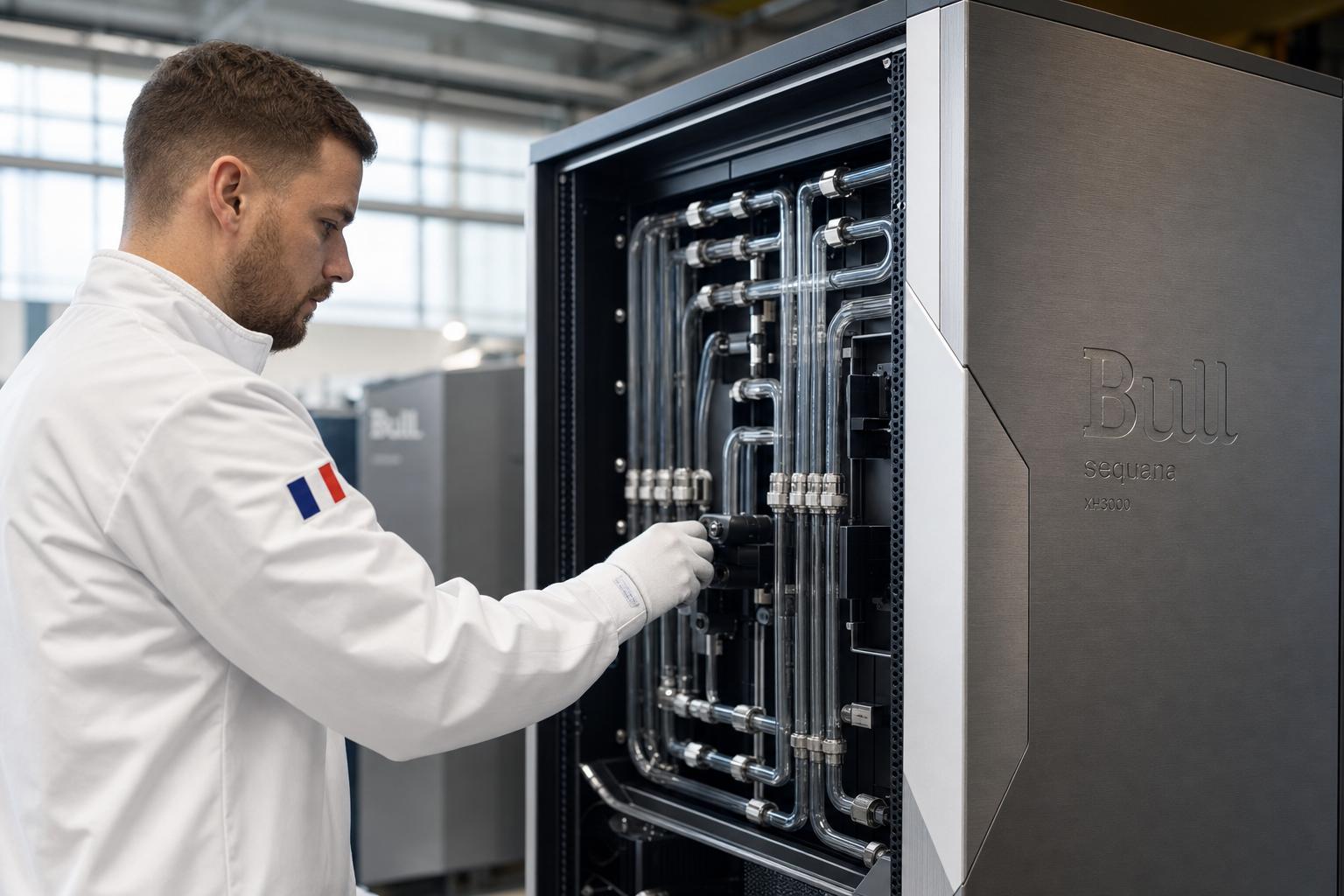
On the hardware side, Bull's flagship line is BullSequana, a family of liquid-cooled supercomputer architectures manufactured at the company's Angers facility, described by the French finance ministry as "la seule usine de supercalculateurs d'Europe" (the only supercomputer factory in Europe) [3] and, in English-language coverage, as forming "the basis for a number of the world's most powerful supercomputers" [8]. The current generation, BullSequana XH3000, forms the basis of JUPITER, Europe's first exascale supercomputer, which achieves up to 80 exaflops of AI performance at 8-bit precision using roughly 24,000 NVIDIA GH200 Grace Hopper Superchips (Source: eurohpc-ju.europa.eu). A newer platform, BullSequana XH3500, will power Alice Recoque, integrating next-generation AMD EPYC "Venice" CPUs and AMD Instinct MI430X GPUs alongside a scalar partition built on European SiPearl RHEA2 ARM processors, connected via a Bull BXI v3 interconnect (Source: eurohpc-ju.europa.eu). GENCI CEO Philippe Lavocat called Alice Recoque part of a journey to propel Europe "Beyond HPC," federating high-performance computing, artificial intelligence, and quantum technologies in a single environment (Source: eurohpc-ju.europa.eu).
Bull's quantum computing line operates under the Qaptiva brand, a "full-stack quantum solution" that includes on-premises emulation appliances, a programming platform, HPC-cluster emulation software, and a free starter toolkit called myQLM [23]. Bull describes seven years of pioneering quantum work and holds 137 quantum computing patents, with emulation appliances capable of modeling up to 50,000 spins [23]. Because Qaptiva is hardware-agnostic, buyers evaluating quantum readiness can run it on their existing HPC clusters rather than acquiring dedicated quantum hardware, which the company's Hyperion Research analyst partner has described as a practical bridge for organizations mitigating the uncertainties and errors inherent in current-generation noisy intermediate-scale quantum (NISQ) systems [23].
The third layer, Business Computing & Artificial Intelligence, is the segment least visible in press coverage but is the one likeliest to interact directly with commercial AI buyers. Bull retains roughly 300 data scientists deploying AI use cases for clients, an integrated pipeline the company describes as running "from design to manufacturing" [3]. This vertical integration, spanning chip-level design decisions through to deployed AI applications, is precisely what one trade analysis identified as Bull's structural advantage: "Bull is not a legacy name in the nostalgic sense; it is a legacy name in the industrial sense," combining HPC, AI, and quantum "under a single strategic umbrella" in a market where most vendors specialize in only one layer [18].
Implementation Considerations for AI and HPC Buyers
Organizations evaluating whether Bull is a viable vendor for sovereign compute, quantum emulation, or AI deployment should weigh several practical factors that the ownership change introduces.
- Ownership stability versus commercial agility. A sole state shareholder gives Bull unusual continuity of funding and long-term strategic backing [3]. Buyers should expect procurement and governance processes influenced by public-sector norms rather than pure commercial speed.
- Jurisdictional clarity for regulated workloads. Because Bull is now wholly state-owned and headquartered in France, it offers an unambiguous answer to data-residency and export-control questions that arise with U.S. hyperscalers. This matters most for banking, healthcare, defense, and government buyers.
- Cybersecurity products stay with a different owner. Buyers researching "bull hpc quantum cybersecurity french state" should note explicitly that cybersecurity products did not move to the French State alongside HPC and quantum; they remain inside Eviden and Atos, a separate corporate entity organized around four product lines that include cybersecurity products, advanced computing (now sold), mission-critical systems, and Vision AI [24], which matters for procurement contracts that bundle compute and security services.
- Manufacturing lead times and capacity. With the Angers factory described as Europe's only supercomputer manufacturing plant, buyers should factor in the physical production constraints of a single-site manufacturing model, compared with hyperscalers who diversify across multiple global fabrication and assembly partners [13].
- Quantum roadmap integration. Buyers with hybrid HPC-quantum ambitions can evaluate Qaptiva's hardware-agnostic emulation approach as a lower-risk entry point before committing capital to physical quantum processing units, particularly since Qaptiva already runs successful deployments such as ColibriTD's algorithm development work on OVHcloud infrastructure [23].
- Financial due diligence on the parent history. Bull's predecessor entity operated inside a group that had accumulated approximately €4.8 billion in debt before its 2024 restructuring [11], and even after restructuring the wider Atos Group has no debt maturing before the end of 2029 [24]. Although Bull is now separately capitalized under a state shareholder, buyers running multi-year contracts should independently verify the standalone entity's post-carve-out balance sheet rather than assuming Atos's turbulent recent history is fully behind the new corporate structure.
- Comparative benchmarking against sovereign peers. Bull is not the only sovereign option; Mistral Compute, OVHcloud, and Scaleway offer alternative or complementary sovereign stacks, and buyers should benchmark price, GPU generation access, and certification status across providers before committing (see Table 3 below).
Data Analysis and Evidence
The scale of the numbers behind the Bull transaction is best understood against the backdrop of Atos Group's broader financial turmoil and Europe's parallel push to fund sovereign AI infrastructure at a much larger order of magnitude.
Atos's crisis was severe by any measure. Shares in Atos had already fallen by more than 90 percent over the three years leading up to October 2023, when nationalization amendments briefly pushed the stock even lower [15]. By April 2024, Atos disclosed it would need €1.1 billion to fund operations through 2024 to 2025, nearly double its earlier €600 million estimate [10]. The company completed a debt restructuring in 2024 that included a 1-for-1,000 reverse stock split executed in December 2024 [21], followed by the four-year Genesis transformation plan unveiled in May 2025, targeting €9 to 10 billion in 2028 revenue and roughly 10 percent operating margin, with the Data and AI business line growing from 2,000 to 10,000 employees by 2028 [24]. As part of Genesis, Atos Group also committed to invest €500 million in research and development over the next four years and €100 million in start-ups and new ecosystem players, with a target that 100 percent of the workforce will be AI-certified by 2026 [24]. By January 2026, Atos reported that 88 percent of Genesis's three-year savings target had already been completed in under a year, alongside preliminary fiscal-year 2025 revenue of €8,001 million [19]. By early April 2026, market analysts reported Atos trading at €35.24, roughly 30.1 percent down year to date, with a five-analyst consensus price target clustering around €46 to €47 [21].
Set against this backdrop, the sums involved in France's broader AI sovereignty strategy dwarf the Bull deal itself. President Emmanuel Macron said France would receive some €109 billion in private-sector AI investment commitments around the February 2025 AI Action Summit in Paris [25], including plans by Canadian investment firm Brookfield to invest €20 billion in French AI projects and potential financing from the United Arab Emirates that could reach €50 billion [25]. At the EU level, the European Commission's AI Continent Action Plan seeks to mobilize €200 billion for AI development across the bloc and €20 billion specifically to finance up to five AI gigafactories, alongside 19 planned AI factories to support startups, industry, and research (Source: commission.europa.eu). The Commission notes that currently only 13.5 percent of EU companies use AI, underscoring the adoption gap the gigafactory strategy is designed to close (Source: commission.europa.eu).
Within that context, the specific infrastructure figures behind Bull's flagship systems illustrate the capital intensity of frontier compute, and also illustrate how even official sources can disagree on cost. Alice Recoque carries a total acquisition, delivery, installation, and maintenance budget of €354.8 million according to EuroHPC JU, split evenly between the Digital Europe Programme and the Jules Verne consortium of France, the Netherlands, and Greece (Source: eurohpc-ju.europa.eu), while AMD's own press release put the "overall cost" of the project at €544 million [6], and GENCI's own release described "a total investment of €554 million over five years of operations" [22]. None of the three official or vendor sources reconcile the discrepancy, which likely reflects differing treatment of operations-and-maintenance costs across the system's five-year service life versus its upfront acquisition budget alone, and buyers modeling comparable EuroHPC programs should request a like-for-like cost breakdown rather than relying on a single headline figure.
Table 2 below lays out the post-divestiture corporate structure, showing how Atos Group's products businesses split into two separately owned entities after the Bull carve-out.
Table 2 summarizes how Atos Group's product businesses divided between the newly independent, state-owned Bull and the remaining Eviden brand still inside Atos Group, clarifying which capabilities transferred to French State ownership and which did not.
| Entity | Businesses Included | Revenue | Ownership |
|---|---|---|---|
| Bull | HPC and Quantum; Business Computing and Artificial Intelligence | c. €720 million, FY2025 [7] | 100% French State [2] |
| Eviden (remaining) | Cybersecurity products; Mission-Critical Systems; Vision AI | c. €0.3 billion pro forma, FY2025 [1] | Atos Group (Euronext Paris listed) |
| Atos Group (overall) | Atos (services) and Eviden (products) brands | c. €8.0 billion, FY2025 preliminary [19] | Publicly traded, Euronext Paris |
This split clarifies a point that frequently confuses searchers: buyers looking for cybersecurity products under the Bull name will not find them there. Cybersecurity, mission-critical systems, and Vision AI all remain squarely inside Eviden and Atos, a separate, still privately and publicly traded corporate structure, while Bull is now dedicated entirely to HPC, quantum, and AI-oriented business computing under sole French State ownership. Note also that the Atos Group total in the table reflects preliminary FY2025 group revenue reported in January 2026, before the Bull sale closed and before the group's later, smaller pro forma figures took effect.
Case Studies and Real-World Examples
JUPITER: Europe's First Exascale Supercomputer
JUPITER is the clearest existing proof point for Bull's (formerly Eviden's) hardware. Inaugurated on September 5, 2025 in Jülich, Germany, by German Chancellor Friedrich Merz and European Commissioner Ekaterina Zaharieva, JUPITER became Europe's first system capable of performing one exaflop, or one billion times one billion calculations per second (Source: eurohpc-ju.europa.eu). It ranks fourth among the world's most powerful supercomputers, alongside Finland's LUMI (ninth) and Italy's Leonardo (tenth), the only three EuroHPC systems in the global top ten (Source: eurohpc-ju.europa.eu). JUPITER is fully owned and co-funded equally by the EuroHPC Joint Undertaking and Germany's federal and North Rhine-Westphalia state ministries, and it uses warm-water direct-liquid cooling that reuses waste heat to warm buildings on the Jülich campus (Source: eurohpc-ju.europa.eu).
Alice Recoque: France's Answer to JUPITER
Alice Recoque, named for a pioneering French computer scientist and one of the first women engineers in artificial intelligence, will be hosted at the CEA's TGCC facility in Bruyères-le-Châtel and operated by GENCI and the CEA under the Jules Verne consortium with the Netherlands and Greece (Source: eurohpc-ju.europa.eu). The procurement contract was signed with Eviden (Bull's predecessor brand for this contract) on November 18, 2025, following a call for tender launched in September 2024, and installation is scheduled to begin in 2026 (Source: eurohpc-ju.europa.eu). EuroHPC JU Executive Director Anders Jensen called it a system that will "elevate scientific discovery, industrial innovation, and technological sovereignty to the next level, while ensuring exceptional energy efficiency" [22]. AMD's Dan McNamara called it "a major step forward for European sovereign AI, uniting national ambition, regional collaboration" [6], and the finished machine, composed of 94 racks, is expected to rank among Europe's top systems for double-precision HPC workloads while using 25 percent fewer racks and up to 50 percent better energy efficiency per GPU than other exascale systems [6].
The 2023 to 2024 Nationalization Push
Before any deal existed on paper, Atos's near-collapse produced an unusual episode of open parliamentary debate about state ownership of a private technology company. In October 2023, lawmakers proposing "temporary nationalization" of Atos's sovereign activities briefly knocked Atos shares down further, even as the stock was already trading at its lowest level in more than two decades [15]. That episode also revealed how close Atos came to falling into private-equity hands entirely: the company was simultaneously negotiating to sell its Tech Foundations unit to EP Equity Investment, controlled by Czech energy billionaire Daniel Křetínský, a deal that would also have given him a stake in Eviden [15]. The specific amendments proposed in that budget fight put a number on the alternative path not taken: the conservative Les Republicains amendment suggested earmarking €500 million for outright nationalization, while a narrower socialist amendment targeting only two Atos units was costed at €390 million [9]. This case demonstrates that the eventual French State purchase of Bull, at up to €404 million, landed almost squarely between those two 2023 legislative proposals, and was one of several possible outcomes considered during Atos's crisis years rather than the only path that was ever seriously on the table.
The 2014 Atos-Bull Merger: A Precedent for Consolidation
Bull's 2014 absorption into Atos offers a useful historical comparison for how the company's HPC assets were valued and integrated the first time around. Atos paid €4.90 per Bull share, a 22 percent premium to the prior close, valuing Bull Group at approximately €620 million and targeting €80 million in annual cost synergies within 24 months [17]. Then-Bull chairman Philippe Vannier stayed on to lead the combined HPC business [17], and Bull's HPC line went on to deliver "almost one machine per year" between 2015 and 2020, including the BullSequana platform in 2016 and JUWELS in 2020, which reached 25 and 44.1 petaflops respectively [16]. The 12-year arc from that 2014 private acquisition to the 2026 state buyout illustrates how thoroughly ownership of frontier compute assets in Europe has shifted from purely commercial consolidation toward state-backed strategic control.
Mistral Compute: The Parallel Private-Sector Sovereignty Bet
While Bull represents state-owned sovereign compute, France is simultaneously betting on privately funded sovereignty through Mistral AI. Mistral launched "Mistral Compute" with 18,000 NVIDIA Grace Blackwell Superchips across a 40 megawatt data center in Essonne, a project financed in part by a September 2025 Series C funding round of €1.7 billion at an €11.7 billion post-money valuation led by ASML, whose CEO Christophe Fouquet said the deal would "generate clear benefits for ASML customers through innovative products and solutions enabled by AI" [26]. Mistral CEO Arthur Mensch framed the tie-up as bridging "the full semiconductor and AI value chain" [26], and the round also drew participation from DST Global, Andreessen Horowitz, Bpifrance, General Catalyst, Index Ventures, Lightspeed, and NVIDIA [26]. President Macron characterized the broader strategy as a "third way" in AI development, one that builds strategic alliances among European and non-European nations rather than going it alone. Mistral's anchor enterprise customers include BNP Paribas, Orange, SNCF, and Thales, demonstrating that Bull is only one part of a broader, multi-pronged French sovereignty strategy that spans state-owned hardware manufacturing (Bull), privately funded model training infrastructure (Mistral Compute), and sovereign cloud services (OVHcloud, Scaleway).
Implications and Future Directions
The Bull transaction is likely to shape European technology procurement in several durable ways. First, it establishes a template other EU member states may follow: identify a domestically headquartered vendor whose products touch defense, energy, or critical research infrastructure, and use state acquisition rather than regulatory blocking to secure control, an approach that avoids the diplomatic friction of blocking a foreign buyer outright while achieving the same sovereignty outcome. Given that EuroHPC JU has already procured 11 supercomputers across Europe and is simultaneously overseeing 19 AI factories and up to 13 AI Factory Antennas (Source: eurohpc-ju.europa.eu), Bull's ownership structure could become a reference case for how other national HPC vendors are treated as EuroHPC's gigafactory build-out accelerates.
Second, the deal sharpens the competitive dynamic between state-owned and privately funded sovereign compute models. Bull's approach prioritizes continuity and defense-grade trust; Mistral Compute's approach prioritizes speed and private capital markets access, evidenced by ASML's strategic investment alongside NVIDIA and other venture investors. Enterprise and government buyers should expect both models to coexist rather than converge, since they serve different risk appetites: Bull for defense-adjacent and highly regulated workloads, Mistral Compute and its cloud partners for commercial AI training and inference at scale.
Third, Atos's own trajectory bears watching. Chairman and CEO Philippe Salle described fiscal 2025 as "a decisive turning point" for the group, with the Genesis plan restoring "operational foundations with a more resilient, and performance-driven operating model" even as the company continued reducing G&A costs toward 5 percent of revenue by 2028 [19] [12]. Whether Atos successfully stabilizes as a services-and-cybersecurity-focused business, rather than the diversified hardware-and-services conglomerate it once was, will determine whether Eviden's remaining cybersecurity and mission-critical systems businesses eventually attract similar state or strategic-investor interest.
Finally, the capacity question looms largest. The European Commission's plan to at least triple the EU's data center capacity within five to seven years, alongside its proposed cloud and AI development act (Source: commission.europa.eu), implies demand for exascale-class systems well beyond JUPITER and Alice Recoque. Bull, as the only vertically integrated European manufacturer capable of building such systems end to end, stands to benefit disproportionately from that expansion, provided its state ownership does not slow the commercial responsiveness that competitive AI infrastructure procurement increasingly demands.
Frequently Asked Questions (FAQs)
What is Bull, and how is it related to Eviden and Atos? Bull is the historic French computing brand, founded in 1931, that Atos Group revived in January 2026 to describe its Advanced Computing business (HPC and Quantum, plus Business Computing and AI) as it was separated from Eviden, Atos's broader products-and-systems brand, ahead of a sale to the French State, as described earlier in this report.
Was this a nationalization? Functionally, yes, in that the French State now owns 100 percent of Bull's capital, but the deal was structured as a negotiated share purchase agreement rather than an emergency nationalization decree [2]. Earlier political calls in 2023 to nationalize Atos's sovereign activities were explicitly rebuffed by a finance ministry spokesperson at the time, who denied that the government was considering nationalization [15], even though the eventual outcome closely resembles what those lawmakers proposed.
How much did the French State pay for Bull? The final enterprise value was up to €404 million, including €104 million in contingent earn-outs tied to 2025 and 2026 profitability, down from an earlier €410 million confirmatory offer after zData was excluded from the perimeter [21].
Did cybersecurity move to the French State too? No. Cybersecurity products, along with Mission-Critical Systems and Vision AI, remain with Eviden and Atos Group; they were never part of the Bull perimeter that the French State acquired [1].
Why did the price fall from €625 million to €404 million? Each renegotiation excluded a business line. The November 2024 figure of up to €625 million covered Advanced Computing broadly; the June 2025 figure of €410 million excluded Vision AI, which Atos said had contributed more than a third of the relevant operating margin [20]; and the final €404 million figure excluded zData, Atos's Big Data consulting unit, as described earlier in this report.
What does Bull actually build? Bull manufactures BullSequana supercomputers (including the systems behind JUPITER and Alice Recoque), operates the Qaptiva quantum computing platform, and deploys AI use cases through its Business Computing and Artificial Intelligence division, all designed and largely manufactured at its Angers, France facility, described by one industry outlet as forming "the basis for a number of the world's most powerful supercomputers" [8].
Who are Bull's peers among European sovereign AI compute providers? Mistral Compute, OVHcloud, Scaleway, and SiPearl are the most frequently cited alternatives or complements, each addressing a different layer of the stack: model training infrastructure, sovereign cloud hosting, and European processor design respectively (see Table 3).
Is Bull publicly traded? No. Bull is 100 percent owned by the French State following the March 2026 closing; it is not listed on Euronext Paris or any other exchange, unlike its former parent Atos SE, which remains publicly traded [2].
Table 3 below situates Bull among the handful of providers that European AI buyers now cite when discussing sovereign compute, spanning hardware manufacturing, sovereign cloud hosting, and processor design.
Table 3 compares Bull against three widely referenced European sovereign compute providers, illustrating that the market is segmented by technical layer rather than head-to-head substitutable products.
| Provider | Ownership / Model | Notable Asset or Scale | Sovereignty Angle |
|---|---|---|---|
| Bull | 100% French State | Angers manufacturing plant; JUPITER and Alice Recoque architectures (Source: eurohpc-ju.europa.eu) | State-owned hardware and full-stack HPC/AI/quantum manufacturer |
| Mistral Compute | Privately funded, ASML-led investor group [26] | 18,000 Blackwell Superchips, 40 MW Essonne data center | Private-capital sovereign AI model training platform |
| OVHcloud | Publicly traded, France-headquartered | Sovereign cloud, GDPR-compliant Mistral Large 123B reference architecture [14] | EU-jurisdiction cloud hosting for regulated workloads |
| Scaleway | Privately held, France-headquartered | First-to-market European access to NVIDIA Blackwell Ultra B300 GPUs [14] | Developer-focused sovereign GPU cloud |
The comparison shows that Bull occupies a distinct niche: it is the only entity among these four that both manufactures the physical supercomputing hardware and is wholly state-owned, whereas Mistral Compute, OVHcloud, and Scaleway operate as privately capitalized service providers that lease or resell compute built substantially on non-European silicon (chiefly NVIDIA GPUs). For buyers whose procurement criteria hinge specifically on state-backed continuity guarantees rather than commercial cloud economics, Bull remains the only option that meets that bar directly.
Conclusion
The French State's acquisition of Bull closes a chapter that began with parliamentary nationalization warnings in 2023 and ran through four separate valuations before settling at up to €404 million on March 31, 2026. The deal gives France sole ownership of a company built around the High-Performance Computing and Quantum division and the Business Computing and Artificial Intelligence division formerly housed inside Eviden, while cybersecurity products, mission-critical systems, and Vision AI remain with Eviden and Atos Group under separate, non-state ownership. For Atos, the sale reduced financial complexity and supplied liquidity to support its Genesis turnaround plan. For France and the European Union, it converted a private company's brush with insolvency into a template for keeping frontier compute manufacturing and defense-adjacent supercomputing under domestic control at precisely the moment the EU is committing €200 billion toward AI development and up to €20 billion toward AI gigafactories.
For AI and HPC buyers, the practical takeaway is threefold. First, Bull is a real, operating, revenue-generating manufacturer, not a shell created for political optics, with an estimated €720 million in 2025 revenue and existing flagship deployments in JUPITER and the forthcoming Alice Recoque. Second, the ownership change does not consolidate cybersecurity, HPC, and AI under one roof; those capabilities were deliberately split between Bull and Eviden, and procurement decisions should reflect that separation. Third, Bull is one node in a broader European sovereign compute ecosystem that includes Mistral Compute, OVHcloud, Scaleway, and SiPearl, each addressing different layers of the stack. Organizations planning multi-year European compute strategies should evaluate Bull specifically for state-backed continuity and manufacturing provenance, while turning to its private-sector peers for commercial cloud flexibility, and should expect the boundary between state-owned and privately funded sovereign infrastructure in Europe to remain an active area of policy experimentation through the rest of this decade.
External Sources (26)
About
GPUSmith
Plan and build private AI compute with GPU Smith. We connect workload requirements with GPU hardware, networking, deployment and operating decisions so your infrastructure fits the work it must perform.
GPU Smith provides independent engineering and research for private AI infrastructure. We help technical buyers and operators reason about GPU workload sizing, hardware selection, procurement, deployment and inference operations, from the compute system to the networking, power and cooling requirements around it.
Start with the workload
Useful infrastructure decisions begin with the models, data, throughput, latency and operating constraints a team actually has. GPU Smith helps connect those requirements with system design and deployment choices. The goal is a privately controlled AI environment whose capacity and operational demands are understood before a purchasing decision.
Hardware and supplier research
Our public reference library covers GPUs, complete systems and networking components. The server-vendor directory and manufacturing research help teams investigate suppliers, compare options and follow sources behind technical claims. We distinguish manufacturer specifications from measured benchmarks and advertised capabilities from tested configurations. Reference pages are research resources, not a live inventory listing or a binding equipment quote.
Deployment and operations
GPU Smith's engineering scope includes infrastructure integration, networking, power, cooling and the practical operation of inference workloads. Our published articles explain the tradeoffs behind deployment, procurement and ongoing operations so teams can ask better questions and document decisions.
Work with GPU Smith
Explore the hardware library, GPU references, networking references and vendor research. Contact GPU Smith with your workloads and deployment constraints to discuss a project and confirm current scope, pricing and availability.
Inclusion of a manufacturer or product in our research does not imply a partnership, certification or endorsement.
Disclaimer
This document is provided for informational purposes only. No representations or warranties are made regarding the accuracy, completeness, or reliability of its contents. Any use of this information is at your own risk. GPUSmith shall not be liable for any damages arising from the use of this document. This content was generated with assistance from artificial intelligence tools, which may contain errors or inaccuracies. Readers should verify critical information independently. All product names, trademarks, and registered trademarks mentioned are property of their respective owners and are used for identification purposes only. Use of these names does not imply endorsement. This document does not constitute professional or legal advice. For specific guidance related to your needs, please consult qualified professionals.