GPUSmith Article
GLM-5.2 Hardware Requirements: VRAM, Nodes, and Costs
Inside this article
- 01Executive Summary
- 02Introduction and Background
- 03Consumer and Prosumer Hardware Paths
- 04Business and Workstation Deployment Configurations
- 05API and Usage-Based Access
- 06Comparative Context and Market Positioning
- 07Data Analysis and Evidence
- 08Case Studies and Real-World Examples
- 09Implications and Future Directions
- 10Frequently Asked Questions (FAQs)
- 11Conclusion
<article_content_with_links>
Executive Summary
GLM-5.2 is a 753 billion parameter Mixture-of-Experts (MoE) large language model released by the Beijing-based lab Zhipu AI (operating internationally as Z.ai) on June 13, 2026, with open weights and a standalone API following on June 16, 2026 [1] [2] [3]. Because it is a MoE model, only roughly 40 billion of those 753 billion parameters activate on any given token, and "despite having 744B parameters, only ~40B are active during any given inference step," but every expert weight must still reside in memory at once since the router can select any expert for the next token [4]. That single fact drives the entire hardware story: full BF16 precision needs roughly 1,600 gigabytes (GB) of VRAM (Source: www.spheron.network) [1], and one independent GPU compatibility tool bluntly concludes "usable VRAM is the main blocker for this model" on every consumer card it tested [5]. The most aggressive Unsloth-published dynamic 1-bit quantization still needs roughly 223 GB of combined RAM and VRAM, ruling out any single consumer GPU on its own [6].
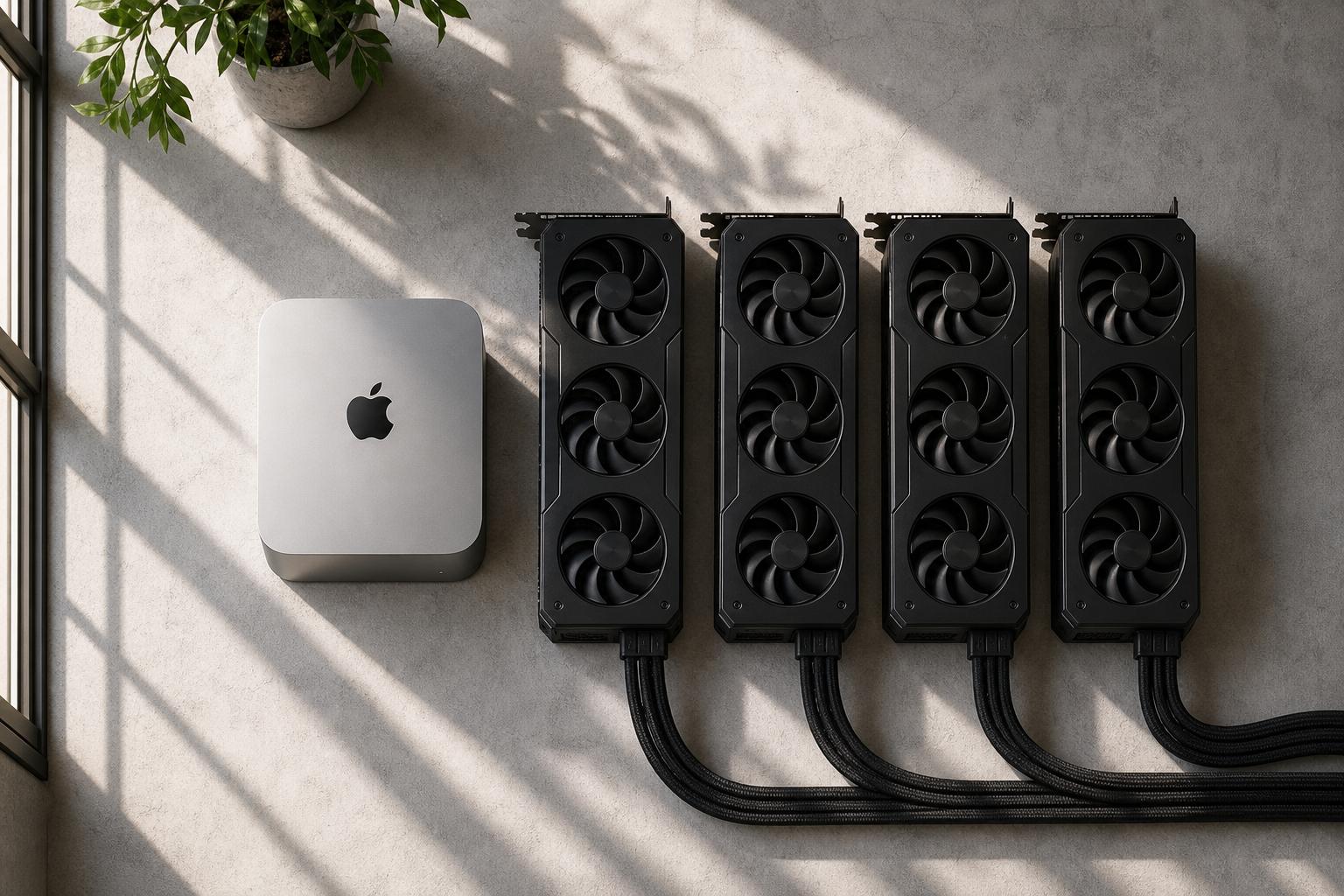
For consumer and prosumer hardware, two realistic local paths exist as of July 2026: a 256 gigabyte-class Apple Mac Studio running the 2-bit Unsloth dynamic GGUF (roughly 239 GB on disk) at an estimated 3 to 9 tokens per second, or a four-card RTX 3090 or RTX 4090 rig paired with 192 to 256 GB of system RAM using CPU and GPU hybrid offloading, at similar throughput [7]. Real-world community benchmarks confirm this range: a dual-Xeon 6248R server with 768 GB of RAM produced 4 to 5.5 tokens per second on CPU alone [8], while a Mac Studio with an M3 Ultra chip and 512 GB of unified memory reached roughly 6.5 to 9.5 tokens per second depending on speculative decoding settings [8]. For production deployment, Z.ai's own recommended configuration is an 8x NVIDIA H200-class node providing over a terabyte of aggregate VRAM at FP8, the same production layout detailed later in this report [9].
On cost, Z.ai's own API prices GLM-5.2 at $1.40 per million input tokens, $0.26 per million cached input tokens, and $4.40 per million output tokens, identical to its predecessor GLM-5.1 [10] [11]. Third-party hosts undercut that price, with OpenRouter aggregating providers as low as $0.406 per million input and $1.276 per million output tokens [12]. Renting the hardware to self-host starts at roughly $5.96 per hour for an entry 4x A100 80GB instance [13] and rises well into enterprise-cluster pricing for a full FP16 multi-GPU node, detailed further below [14]. Against its closest open-weight rival, DeepSeek-V3.2, GLM-5.2's larger 753 billion parameter count means it requires roughly 148 GB more VRAM at FP16 than DeepSeek's 685 billion parameters (Source: www.spheron.network), while independent benchmarking from Artificial Analysis places GLM-5.2 ahead of DeepSeek V4 Pro, MiniMax-M3, and Kimi K2.6 on its Intelligence Index v4.1 with a score of 51 [11]. The bottom line for anyone evaluating GLM-5.2 hardware requirements: full local ownership demands a serious, multi-thousand-dollar investment in either unified-memory Apple hardware or a multi-GPU rig, while production-grade serving requires a genuine data center node, and for most individual developers and small teams the API or the GLM Coding Plan subscription, starting at $18 per month, remains the more economical entry point [15].
Introduction and Background
Zhipu AI, a Beijing-based artificial intelligence company that operates internationally under the brand Z.ai and trades in Hong Kong as Knowledge Atlas Technology, released GLM-5.2 as its flagship model for long-horizon coding and agentic tasks [16]. The model card describes GLM-5.2 as marking "a substantial leap in long-horizon task capability over its predecessor GLM-5.1" while, for the first time in the GLM family, delivering that capability on a "solid 1M-token context that stably sustains long-horizon work" [1]. GLM-5.2 was released under the permissive MIT license, meaning the weights carry "no regional limits, technical access without borders," making them freely downloadable, fine-tunable, and usable commercially [1]. A separate developer-facing overview summarizes the release as delivering "a 744-billion-parameter Mixture-of-Experts (MoE) model with MIT-licensed open weights," positioning GLM-5.2 as a self-hostable "insurance policy" against outages or access restrictions on any single hosted API [4]).
Understanding GLM-5.2's hardware requirements starts with its architecture. GLM-5.2 is a 753 billion parameter Mixture-of-Experts model in which roughly 40 billion parameters activate for any single token via top-k expert routing [1] [2]. The architecture spans 78 transformer layers [2] and introduces a technique Zhipu calls IndexShare, which "reuses the same indexer across every four sparse attention layers, reducing per-token FLOPs by 2.9\× at a 1M context length" [1]. The model also improves its Multi-Token Prediction (MTP) layer for speculative decoding, "increasing the acceptance length by up to 20%" [1], which materially affects the real-world tokens-per-second figures discussed later in this report. </article_content_with_links>On coding benchmarks, GLM-5.2 posts a score of "81.0 on Terminal-Bench 2.1, 62.1 on SWE-bench Pro" [2], figures that "lands within a few points of Claude Opus 4.8 (85.0)" on the same test [9]. Every hardware recommendation in this report is anchored to one of those two numbers, either the 753 billion total parameters that set the memory floor or the 40 billion active parameters that set the achievable throughput, and readers should expect any credible sizing exercise to reference both explicitly rather than treating GLM-5.2 as a single undifferentiated size class [1].
This report exists because GLM-5.2's parameter count creates a specific and widely misunderstood capacity problem. A GPU-compatibility calculator summarizes the issue directly: "GLM-5.2 (753.2999877929688B parameters) requires approximately 481.6 GB of VRAM with Q4_K_M quantization. As a Mixture of Experts model with 40B active parameters, it uses less memory than its total parameter count suggests" for compute, but not for capacity [5]. As one hardware guide puts it, "MoE active size is not the same as the memory you need" [17]. The 40 billion active parameters make GLM-5.2's inference speed tractable on modest compute, but the 753 billion total parameters set a hard memory floor that no amount of MoE efficiency can shrink. This report walks through what that floor actually looks like in gigabytes, dollars, and tokens per second, across consumer rigs, workstations, data center nodes, and API alternatives, as of July 2026, and separates vendor-published specifications from independently verified, real-world community results wherever the two diverge, drawing on the same community-reported architecture figures [18].
Consumer and Prosumer Hardware Paths
For individuals evaluating how to run GLM-5.2 locally, the starting reality is blunt: "GLM 5.2 is too large for a single consumer GPU" [7]. Even the smallest published quantization, Unsloth's dynamic 1-bit GGUF, needs roughly 223 GB of combined memory, which is nearly ten times the 24 GB VRAM found on a top-tier consumer GPU like the RTX 4090. "The 2-bit dynamic quant UD-IQ2_M uses 239GB of disk space, this can directly fit on a 256GB unified memory Mac" and "works well in a 1x24GB GPU and 256GB of RAM with MoE offloading" [6]. This 2-bit tier is the practical entry point most guides converge on, and an independent VRAM calculator corroborates the figure separately, estimating "2-bit Dynamic (UD-IQ2_XXS): Requires ~241 GB VRAM/Unified Memory. Ideal for M4 Ultra Mac Studio or workstations with 256GB+ RAM" [4].
Two hardware families dominate the realistic local path. The first is Apple's unified-memory Mac Studio line, where CPU and GPU share a single memory pool with no PCIe bottleneck between them; a 256GB-class M3 Ultra or M4 Ultra configuration "holds the entire 2-bit quant in unified memory" [17]. Community testing on an M3 Ultra Mac Studio with 512 GB of unified memory found generation "without MTP: 6.5tok/s at ctx=0 that degrades to around 5tok/s at 20K tokens" and, with speculative decoding enabled, "with MTP (3): 9.5tok/s at ctx=0 that degrades to around 5.5tok/s at 20K tokens" on a code-heavy task, using "almost 430GB of VRAM/unified memory" for the IQ4_XS quant [8]. Approximate cloud-equivalent throughput for the 2-bit path is estimated at "approximate cloud cost: ~$6.40/hr via Spheron and similar providers" for a comparable 8x A100 configuration [7].
The second consumer path is a multi-card NVIDIA rig, most commonly four used RTX 3090 cards, which "give you 96GB of pooled VRAM" that can be paired with 192 to 256 GB of system RAM to offload the remaining Mixture-of-Experts layers [17]. A single RTX 3090 alone is not viable, since an independent per-card compatibility check for a 24 GB RTX 3090 lists an offload requirement of roughly 483 GB total footprint, with only 24 of that fitting in VRAM and the rest spilling to system RAM [5]. Power draw is a real constraint on the four-card path: four RTX 3090 cards together can pull close to 1,400 watts under load, which requires a substantial power supply and, ideally, a dedicated circuit. A dedicated CPU-only path also exists for those without discrete GPUs at all: a Dell PowerEdge R740 workstation with dual Xeon 6248R processors and 768 GB of RAM, isolated to a single NUMA node for 24 usable cores and 384 GB of node-local memory, produced "4 to 5.5 tok/s generation with MTP drafting turned on" running the UD-Q2-K_XL quant entirely in system RAM [8].
Beyond the 2-bit tier, higher-fidelity quantizations exist for those with more memory. "Dynamic 4-bit UD-Q4_K_XL and dynamic 5-bit UD-Q5_K_XL are mostly lossless" against the full BF16 baseline [6], while even the aggressive 1-bit quant retains meaningful capability at roughly 76 percent top-1 accuracy relative to full precision, based on Unsloth's own KL-divergence benchmarking. Consumer cards can, in principle, run GLM-5.2 in a four-card setup with system RAM offloading, but users should expect single-digit tokens per second rather than the interactive speeds a hosted API delivers [10].
Two more practical constraints shape any GLM-5.2 consumer build beyond raw memory capacity. Storage throughput matters because the 2-bit quant alone is roughly 239 GB: a fast NVMe drive is treated as close to mandatory rather than optional by hardware buying guides, since the difference between a slow SATA SSD and a fast NVMe drive is the difference between loading GLM-5.2 in a couple of minutes and waiting far longer for every cold start. Software support is also still catching up barely a month after launch: as of one deployment guide's most recent update, mainline "llama.cpp runs GLM-5.2 with a dense-attention fallback" because the model's sparse DSA and lightning-indexer attention path is not yet implemented in the main branch, meaning long-context speed and memory use lag the architecture's theoretical figures until community patches land [19]. Anyone budgeting a build today should treat published throughput figures as a moving target that should improve as attention-kernel support matures, rather than a permanent ceiling.
Business and Workstation Deployment Configurations
Organizations that need GLM-5.2 at production throughput, rather than solo developer experimentation, generally look past consumer rigs toward data center accelerators, because no single GPU can run GLM-5.2 on its own: even the most aggressive 1-bit quantization needs roughly 223 GB, more than any single card offers. The correct sizing framework treats total VRAM as three additive components, weights plus KV cache plus runtime overhead, rather than weights alone. Weights scale directly with precision: roughly 744 GB at FP8, doubling to roughly 1,488 to 1,642 GB at BF16/FP16, and halving again to roughly 372 to 411 GB at INT4, the same doubling relationship confirmed independently across every VRAM calculator reviewed for this report [1].
Because GLM-5.2 extends context length "from 200K to 1M tokens," Z.ai's own engineering blog notes that this "shifts the primary inference bottleneck from computation to KV-cache capacity, long-context kernel overhead, and CPU-side overhead" [9]. Community sizing guidance suggests the KV cache tax "requires significant additional VRAM strictly for the KV cache" as context grows toward the full 1 million token window, with the exact scaling depending heavily on cache quantization [18]. Rough community estimates put full-precision KV cache growth at roughly 15 to 20 GB per 100,000 tokens of context, falling to roughly 4 to 5 GB per 100,000 tokens if the cache itself is quantized to 4-bit, though these figures should be treated as approximations pending confirmation against the exact head-dimension and layer counts in the model card.
Putting weights, cache, and overhead together, Z.ai's recommended production layout is an 8x H200 node: "an 8x H200 node provides about 1,128 GB of aggregate VRAM (8 x 141 GB), which leaves meaningful headroom over the FP8 weights for KV cache," and this "8x H200 (or 8x H20) FP8 layout is what the official vLLM recipe for GLM 5.2 recommends" [20]. Node sizing should also respect serving-framework conventions: "vLLM prefers power-of-two tensor-parallel sizes (1, 2, 4, 8)," so a sizing exercise that lands on an odd GPU count typically rounds up for clean sharding rather than reflecting a strict memory requirement [20].
For teams unwilling to commit to a full 8-GPU node, several intermediate configurations exist. A 4x H100 PCIe instance with 480 GB of pooled RAM handles the UD-Q4_K_XL 4-bit quantization tier, described as "the quality sweet spot per Unsloth's KL divergence testing" [13], while an 8x H100 PCIe instance with 960 GB of RAM supports the near-lossless 8-bit GGUF tier at serving-grade speed. On the serving-engine side, two frameworks dominate: vLLM, the common default with the broadest model support and a mature paged-attention KV cache, and SGLang, which had day-zero support for GLM-5.2, including NVIDIA's NVFP4 checkpoint for Blackwell GPUs, and often wins on structured-output and high-concurrency agent workloads [12]. NVIDIA and Red Hat also publish pre-quantized checkpoints, so buyers do not necessarily need to run the quantization pipeline themselves.
Fine-tuning GLM-5.2 imposes a substantially larger memory budget than inference alone, since gradients and optimizer state must sit alongside the weights during training. "LoRA fine-tuning adds a small adapter and roughly 50% more memory" on top of the inference footprint, while "full fine-tuning holds gradients and optimizer state on top of the weights, which is about 4x the inference footprint, so it often needs multiple GPUs even when inference fits on one" (Source: www.spheron.network). At FP16, that arithmetic points to roughly 2,463 GB of VRAM for a LoRA run and roughly 6,569 GB for a full fine-tune, a scale that firmly rules out anything short of a dedicated multi-node training cluster and explains why most teams instead fine-tune much smaller distillations or apply parameter-efficient adapters against a quantized base rather than touching the full 753 billion parameter model directly.
API and Usage-Based Access
For teams that do not want to own or rent a multi-GPU node at all, Z.ai's first-party API is the default access point. As of July 2026, the official pricing page lists GLM-5.2 at $1.4 per million input tokens, $0.26 per million cached input tokens (currently free for a limited time), and $4.4 per million output tokens, identical to the GLM-5.1 rate card [10]. Independent analysis from Artificial Analysis confirms this positioning: "on the first-party API it is priced in line with GLM-5.1 at $1.4/$4.4/$0.26 per 1M input/output/cache hit tokens" [11]. A developer running heavy agent loops at the Z.ai pay-per-token rate should expect costs to compound quickly on long-running agentic workflows [10].
Because GLM-5.2 shipped under the MIT license, a large ecosystem of third-party hosts now serves the model at competitive, and often lower, rates. OpenRouter aggregates more than a dozen inference providers for GLM-5.2, with a description confirming it "supports text input and output with a 1M-token context window, and is suited for long-horizon agent workflows, project-level software engineering, and complex multi-step automation" [12]. Pricing across that marketplace ranges from budget providers like NovitaAI and StreamLake, both around $0.406 per million input and $1.276 per million output tokens, up through Z.ai's own listed rate of $1.40 and $4.40. Separately, "OpenRouter routes GLM-5.2 at $0.56/M in / $1.76/M out" through its default blended routing, undercutting the direct Z.ai price [19]. At the free end of the spectrum, NVIDIA NIM has served the model at no cost for evaluation purposes at build.nvidia.com, though without native function calling in that configuration, and Cloudflare Workers AI added GLM-5.2 to its edge-inference catalog within days of the June 16, 2026 weights release.
For coding-focused workflows specifically, Z.ai also sells the GLM Coding Plan, a flat-rate subscription designed to plug into agentic coding tools, with an Anthropic-compatible endpoint that drops into Claude Code or any Anthropic SDK client by overriding the base URL and API key. Officially, the plan is "starting at just 18 USD per month, with Pro and Max plans designed for high-frequency, complex projects" [15], and it "can be applied to coding tools such as Claude Code, Cline, and OpenCode" [15]. Because GLM-5.2 is more compute-intensive than smaller GLM models, its usage "will be deducted at 3 × during peak hours and 2 × during off-peak hours" against the plan's prompt quota, with a temporary promotional exception reducing off-peak consumption to 1 times quota through the end of September 2026 [15]. Third-party reviews describe a wider promotional pricing band during limited windows, with the Lite tier as low as roughly $3 to $6 per month, Pro around $15 to $19 per month, and Max around $80 per month, a discrepancy from the official $18-per-month baseline that likely reflects regional or quarterly discount pricing that the official documentation does not itemize [11].
For teams weighing self-hosting against any of these API options, the arithmetic is straightforward in principle: self-hosting only beats the API once token volume is high enough to amortize the fixed cost of a rented or owned GPU node. A rented 4x A100 80GB instance running the 2-bit or 3-bit GGUF quant puts the effective cost per million tokens well under the API rate once usage is high enough to keep the GPUs busy, but Z.ai's genuinely low per-token rate pushes the break-even volume higher, because a fixed GPU bill needs a lot of throughput before it undercuts a rate as low as $1.40 in and $4.40 out per million tokens [20]. The practical recommendation from most deployment guides reviewed for this report is to self-host for data sovereignty or genuinely high sustained volume, and otherwise use the API or the GLM Coding Plan.
Comparative Context and Market Positioning
GLM-5.2's release fits inside a broader competitive narrative, and understanding that narrative helps explain why so many independent hardware guides were published within days of launch. Zhipu AI's launch was widely covered as a geopolitical and commercial event: the company introduced GLM-5.2 explicitly to help "developers build autonomous coding assistants, heating up its rivalry with US firm Anthropic" [16], and reporting noted the company is "gearing up to go head-to-head with leading US labs following the release of the powerful GLM-5.2 model last month" [16].
On raw hardware footprint, GLM-5.2's closest open-weight comparison point is DeepSeek-V3.2, a 685 billion parameter MoE model from the rival Chinese lab DeepSeek. "DeepSeek-V3.2 has about 685B parameters. At FP16 it needs roughly 1494 GB of VRAM for inference, including weights, activations, and KV cache. Quantized to INT4 that drops to around 374 GB" (Source: www.spheron.network). By comparison, GLM-5.2's roughly 753 billion parameters need approximately 1,642 GB of VRAM at FP16 and around 411 GB quantized to INT4, as established above (Source: www.spheron.network). GLM-5.2 therefore needs roughly 148 GB more VRAM than DeepSeek-V3.2 at FP16 and roughly 37 GB more at INT4, a modest but consistent premium tied directly to its larger total parameter count. On price to rent the cheapest fitting instance, DeepSeek-V3.2's FP16 configuration was quoted at "8x B300 288GB at about $28.00/hr," noticeably below the equivalent GLM-5.2 configuration discussed earlier in this report, reflecting how live spot pricing on GPU marketplaces fluctuates independently of the raw memory delta (Source: www.spheron.network).
Against its own immediate predecessor, "GLM-5.2 is the same size as GLM-5.1 (744B total / 40B active parameters) but scores 11 points higher on the Intelligence Index v4.1," meaning hardware requirements are essentially unchanged generation to generation while capability improved substantially [11]. Independently, Z.ai's own release notes quantify the coding-benchmark jump: "improving on GLM-5.1 by a wide margin: 81.0 vs. 63.5 on Terminal-Bench 2.1 and 62.1 vs. 58.4 on SWE-bench Pro" [9], and elsewhere in the same release notes Z.ai reports GLM-5.2 "trails Opus 4.8 by only 1%, while edging out GPT-5.5 by 1% and Opus 4.7 by 11%" on a separate long-horizon agentic benchmark [9]. Against the wider open-weight field, Artificial Analysis reports that on its Intelligence Index v4.1, "at 51, it leads MiniMax-M3 (44), DeepSeek V4 Pro (max, 44) and Kimi K2.6 (43)" [11], and on cost efficiency, "GLM-5.2 costs ~$0.46 per task, compared to GLM-5.1 ($0.25), Kimi K2.6 ($0.31), MiniMax-M3 ($0.18) and DeepSeek V4 Pro (max, $0.05)" [11], positioning GLM-5.2 as intelligent but not the cheapest option per completed task among its open-weight peers.
Table 1 below summarizes memory requirements and minimum practical hardware across the precision and quantization spectrum discussed above, drawing on the GLM-5.2 model card, Unsloth's published GGUF documentation, and independent GPU sizing calculators.
| Precision / Quantization | Approximate Weights Size | Minimum Practical Hardware | Reported Throughput |
|---|---|---|---|
| BF16 / FP16 (full) | ~1,488 to 1,642 GB | 16x H100/H200-class GPUs or larger multi-node cluster [4] | Reference precision, not a serving target |
| FP8 (Z.ai's served precision) | ~744 GB | 8x H200 141GB node, ~1,128 GB aggregate VRAM | Full 1M context, production serving |
| INT4 / AWQ INT4 | ~372 to 411 GB | 4x H200 or 8x A100 80GB | ~8 to 15 tok/s on 8x A100 80GB [7] |
| 4-bit (Q4_K_M) | ~459 to 482 GB | 2x A100 80GB or 4x RTX 6000 Ada [4] | Single-digit to low-teens tok/s depending on interconnect |
| 2-bit dynamic (UD-IQ2_M) | ~239 to 241 GB | 256GB Mac Studio, or 4x RTX 3090 + 192 to 256 GB RAM [6] | ~3 to 9 tok/s reported by multiple community sources |
| 1-bit dynamic (UD-IQ1_S) | ~217 to 223 GB | 192 to 256GB unified memory or 24GB GPU + 192GB RAM [19] | Lower quality; roughly 76% top-1 accuracy vs. baseline |
The pattern in Table 1 is consistent across every independent estimate gathered for this report: memory requirement scales almost linearly with bits per parameter, since all 753 billion weights must be addressable regardless of precision, while throughput scales far more with the amount of fast VRAM bandwidth available to the active 40 billion parameters at inference time. This is why a 2-bit Mac Studio and a 2-bit four-GPU rig land in roughly the same single-digit tokens-per-second range despite very different hardware philosophies, and why moving to genuine data center GPUs like the H100 or H200 buys primarily throughput and context-length headroom rather than a fundamentally different memory floor. Reading down the table also clarifies a common point of confusion in casual coverage of GLM-5.2: headline figures like "40 billion active parameters" describe compute cost per token, not the memory a deployment must reserve, and any buying decision that uses the active-parameter figure as a memory estimate will under-provision by more than an order of magnitude.
Data Analysis and Evidence
The core quantitative relationship in this report is the arithmetic connecting parameter count, bytes per parameter, and total memory demand. Lushbinary's sizing guide states the calculation plainly: "math check: 744,000,000,000 params x 1 byte = 744 GB at FP8; x 2 bytes = 1,488 GB at BF16; x 0.5 byte = 372 GB at INT4" [20]. Zhipu's own training disclosure adds scale context: GLM-5.2 was "trained on a corpus of 28.5 trillion tokens," architected around "753B total parameters, activating roughly 40B parameters per token during inference," and "natively supports a 1,000,000-token context window and up to 131,072 output tokens per response" [18].
Live cloud GPU pricing is a critical, and volatile, input to any cost-to-self-host calculation, so this report captured spot rates from three independent marketplaces during the same research window in July 2026. On Spheron's aggregator, the cheapest full-FP16 fit for GLM-5.2 was "8x B300 288GB at about $72.16/hr," dropping to "8x A100 80GB at about $9.52/hr" once quantized to INT4 (Source: www.spheron.network). At the individual-GPU level, both Runpod and Lambda publish transparent hourly rates that inform the cost of assembling a custom multi-GPU node: Runpod lists its A100 PCIe 80GB instance at $1.39 per hour, H100 SXM at $2.99 per hour, and H200 at $4.39 per hour [14], while Lambda lists its A100 SXM 80GB instance at $2.79 per hour, H100 SXM at $3.99 per hour, and B200 SXM6 at $6.69 per hour [21]. Thunder Compute, a smaller specialist provider, prices a pre-configured 4x A100 80GB instance sized specifically for GLM-5.2's 2-bit and 3-bit quant tiers at $5.96 per hour, an 11.56 dollar per hour rate for a 4x H100 PCIe instance covering the 4-bit tier, and $23.12 per hour for an 8x H100 PCIe instance covering the near-lossless 8-bit tier [13].
Table 2 below consolidates these hourly rental rates side by side, drawn directly from the four provider pricing pages cited above, to make cross-provider comparison easier at a glance.
| Provider | GPU Configuration | Hourly Rate | Best Fit |
|---|---|---|---|
| Runpod | 1x A100 PCIe 80GB | $1.39/hr | Single-GPU testing and development |
| Runpod | 1x H100 SXM | $2.99/hr | Single-GPU FP8-capable testing |
| Runpod | 1x H200 | $4.39/hr | Single-GPU high-memory testing |
| Lambda | 1x A100 SXM 80GB | $2.79/hr | Single-GPU testing and development |
| Lambda | 1x H100 SXM | $3.99/hr | Single-GPU FP8-capable testing |
| Lambda | 1x B200 SXM6 | $6.69/hr | Next-generation single-GPU testing |
| Thunder Compute | 4x A100 80GB | $5.96/hr | 2-bit and 3-bit quant tiers |
| Thunder Compute | 4x H100 PCIe | $11.56/hr | 4-bit quant tier |
| Thunder Compute | 8x H100 PCIe | $23.12/hr | Near-lossless 8-bit tier |
| Spheron | 8x A100 80GB | $9.52/hr | Full-model INT4 fit |
| Spheron | 8x H200 141GB | $26.48/hr | Full-model INT8 fit |
| Spheron | 8x B300 288GB | $72.16/hr | Full-model FP16 fit |
The provider comparison in Table 2 shows that per-GPU pricing across Runpod and Lambda is broadly similar for equivalent chips, generally within a few cents to roughly a dollar per hour of each other, while the pre-packaged multi-GPU instances from Thunder Compute and Spheron carry a premium tied to guaranteed co-location and pre-configured software stacks. The jump from an INT4-capable 8x A100 node to a full FP16 8x B300 node multiplies the hourly rental cost by roughly 7.6 times, a ratio that closely tracks the corresponding jump in VRAM requirement shown in Table 1, which is the clearest evidence in this report that GPU rental pricing scales with raw memory capacity rather than with any GLM-5.2-specific premium.
Hardware purchase prices, as distinct from rental rates, show a wide spread depending on the chosen path. Used RTX 3090 cards trade at roughly "$699" to "$999 each," giving four cards roughly 96 gigabytes of pooled VRAM for well under the price of a single workstation-class card [17]. A data-center-class NVIDIA A100 80GB card runs roughly $12,000 to $15,000 as a budget server-class building block, while an H100 PCIe 80GB card with native FP8 support costs roughly $25,000 to $33,000 as the production-serving reference [14]. On the Apple side, "the tradeoff is the upfront cost of a maxed-out Mac Studio (around $15000), which runs several thousand dollars before you've run a single inference" [13], a figure roughly consistent with entry-level estimates elsewhere in the $10,000 to $12,000 range for a 256 GB configuration.
Energy consumption is a further variable separating the consumer paths that buyers frequently overlook. A four-card RTX 3090 rig running the 2-bit quant draws close to 1,400 watts under sustained load, requiring a dedicated high-amperage circuit rather than a standard household outlet, while a CPU-only dual-Xeon workstation running a comparable quant draws roughly 600 watts steady, a meaningfully lower and quieter power profile that partly offsets its lower raw throughput for buyers prioritizing operating cost and noise over raw speed.
Beyond the top-line Intelligence Index score, GLM-5.2 shows broad improvement across individual reasoning evaluations relative to GLM-5.1 rather than a gain concentrated in one narrow skill. Artificial Analysis reports gains "led by scientific reasoning on CritPt (+16 points to 21%) and HLE (+12 points to 40%), alongside AA-LCR (+9 points to 71%), tau3 banking (+15 points to 27%) and SciCode (+7 points to 50%). TerminalBench v2.1 also improves (+16 points to 78%) and GPQA Diamond gains 3 points to 89%" [11]. This breadth matters for hardware planning because it suggests organizations already running GLM-5.1 infrastructure can generally upgrade to GLM-5.2 on the same memory footprint and expect a corresponding capability lift across most of their workload, rather than only on the specific benchmark categories Zhipu chose to highlight in its own marketing.
On raw benchmark data, GLM-5.2's Artificial Analysis evaluation is among the most rigorously documented public scoring of the model. It scores "1524 on GDPval-AA v2, ahead of MiniMax-M3 (1418) and DeepSeek V4 Pro (max, 1328)," a real-world agentic performance metric baselined against human performance at 1000 points [11]. Taken together, the pricing, hardware, and benchmark data all point in the same direction: GLM-5.2 is priced and provisioned as a frontier-tier model, not a lightweight one, and any cost model built around it should budget accordingly for both compute and output-token volume.
Case Studies and Real-World Examples
The CPU-Only Dell PowerEdge R740 Build
A member of the r/LocalLLaMA community documented running GLM-5.2 entirely on CPU using a Dell PowerEdge R740 server. The published specifications were: "Model: Dell PowerEdge R740, CPU: Dual Xeon 6248R (24 cores each), RAM: 768 GB (All memory channels populated)" [8]. To avoid the cross-socket memory latency penalty inherent to dual-CPU NUMA architectures, the operator isolated the workload to "a single node for CPU cores and memory which gives me 24 cores and 384 GB node-local RAM to play with," running "model weights and 1M context fully in RAM" using the ik_llama.cpp fork for CPU-optimized inference [8]. The result was serviceable but modest: "in basic chat, it's alright all things considered. 4 to 5.5 tok/s generation with MTP drafting turned on," degrading further to roughly 3 tokens per second once working inside a coding agent with a large context [8]. This case demonstrates that GLM-5.2's minimum system requirement is genuinely met by high-RAM server hardware bought secondhand, without a single GPU, though the tradeoff in throughput is severe for interactive, high-context coding work, and it underlines why buyers with older enterprise servers already sitting idle may find a CPU-only path more economical than a fresh GPU purchase.
The Mac Studio M3 Ultra 512GB Coding Rig
A separate community deployment on the same thread used a Mac Studio equipped with an M3 Ultra chip and 512 GB of unified memory, running Unsloth's IQ4_XS GGUF quant through the MLX and llama.cpp Metal backends. Without speculative decoding the operator measured "6.5tok/s at ctx=0 that degrades to around 5tok/s at 20K tokens," and with the MTP speculative-decoding feature enabled at a draft depth of 3, throughput rose to "9.5tok/s at ctx=0 that degrades to around 5.5tok/s at 20K tokens (on a code heavy task)" [8]. The operator noted this was "honestly not bad for something that takes up almost 430GB of VRAM/unified memory" [8], though the same user later reported switching to an MLX-native quant after encountering thinking-token leakage bugs in the llama.cpp GGUF path, ultimately reaching "~10tok/s out of it and it's absolutely coherent, wrote 1000 lines of code in a single turn and they worked and worked well" [8]. This case illustrates both the promise and the rough edges of running a frontier-scale open-weight model on consumer-adjacent hardware within weeks of release, when serving-framework support for a new architecture is still maturing, and it shows that quant and backend choice can matter as much as raw memory capacity for whether a build is actually usable day to day.
Zhipu AI's ZCode Harness and the "DeepSeek Moment" Narrative
Beyond individual hardware deployments, GLM-5.2's release reshaped competitive dynamics in the open-weight coding model market. Zhipu AI, "known internationally as Z.ai, made the GLM-5.2 model available on June 13" [3], and the launch was covered by regional press as "another 'DeepSeek moment' for Chinese open-source AI, in reference to the rival Chinese firm that disrupted the global tech sector last year" [16]. Roughly three weeks after the model launch, Zhipu followed up by shipping "ZCode, a harness for its latest artificial intelligence model, GLM-5.2," a control system that lets the model function autonomously as a coding agent [16]. To draw developers to the new tooling, the company ran promotions "increasing data quotas for its existing subscribers by 50 per cent and offering 5 million free tokens to new ZCode users" [16]. This case matters for hardware planning because it demonstrates that GLM-5.2's practical footprint extends beyond raw inference: teams adopting ZCode or comparable agent harnesses should budget for materially higher token throughput than single-shot chat usage, since agentic loops issue many more model calls per completed task, which in turn pushes both API bills and self-hosted node utilization considerably higher than a simple chatbot deployment would [10].
An Enterprise 8x H200 vLLM Production Deployment Pattern
For organizations serving GLM-5.2 to multiple internal or external users rather than a single developer, deployment guidance converges on a specific reference architecture built around the 8x H200 node described earlier in this report, sized for full 1M-token context at production concurrency rather than a single interactive session. Equivalent rental capacity for this class of node runs into the tens of dollars per hour on major GPU marketplaces, giving organizations a benchmark rental price against which to evaluate an outright purchase [21]. This case represents the deployment tier a mid-sized engineering organization would realistically evaluate if choosing to bring GLM-5.2 in-house for data-residency or high-volume cost reasons rather than defaulting to the Z.ai API.
Implications and Future Directions
GLM-5.2's hardware profile carries several forward-looking implications for teams planning infrastructure around open-weight coding models in the second half of 2026. First, the gap between "runnable" and "practically usable" remains wide for MoE models at this scale: the 2-bit consumer tier is technically runnable on a single Mac Studio or a four-card GPU rig, but the 3 to 9 tokens-per-second range documented across multiple independent sources is workable for solo asynchronous coding assistance and poorly suited to interactive, multi-user, or latency-sensitive production traffic. Teams evaluating "GLM-5.2 minimum system requirements" for anything beyond personal experimentation should plan around the FP8 or INT4 tiers on genuine data center accelerators rather than treating the 2-bit consumer path as a production substitute [1].
Second, the KV-cache tax introduced by GLM-5.2's 1M-token context window is likely to become a more prominent sizing variable than raw weight size for teams running long-context agentic workflows, since Z.ai's own engineering team has acknowledged that extending context "does not proportionally reduce per-token KV-cache size" even as the IndexShare architecture reduces per-token FLOPs [9]. Buyers who size a node purely against the FP8 weights figure of roughly 744 GB without separately budgeting for cache growth at long context risk under-provisioning for their actual workload.
Third, the MIT license and the rapid emergence of pre-quantized NVFP4 and FP8 checkpoints from NVIDIA and Red Hat suggest the self-hosting ecosystem around GLM-5.2 will keep maturing quickly, likely narrowing the gap between the do-it-yourself quantization work documented by Unsloth today and turnkey deployment options [1]. vLLM and SGLang both shipped GLM-5.2 support within days of the weights opening, so the operational overhead of self-hosting is falling even as the underlying hardware bill stays large. The early availability of an NVFP4 checkpoint tuned for Blackwell-generation GPUs also signals that hardware buyers evaluating a purchase now should weigh the next GPU generation, not just currently shipping H100 and H200 cards, when sizing a multi-year infrastructure commitment around GLM-5.2 or its near-term successors.
Fourth, on competitive positioning, GLM-5.2's release inside a fast-moving cluster of Chinese open-weight launches, alongside DeepSeek V4 Pro, MiniMax-M3, and Kimi K2.6, suggests hardware guidance published today will likely be superseded within a similar release cadence to GLM-5.1's roughly one-month gap to GLM-5.2. Teams making multi-year capital purchases of A100, H100, or H200 hardware should weight that hardware's reusability across the next several open-weight model generations rather than optimizing narrowly for GLM-5.2's current 753 billion parameter footprint, since Zhipu has held total parameter count roughly constant across its last two major releases while substantially improving quality within that footprint [11].
Fifth, not every workload justifies this hardware bill in the first place. Hardware buying guides are explicit that "if you cannot assemble roughly 240GB of memory, do not try to run full GLM-5.2" and instead recommend a smaller, single-GPU coding model for everyday use [17]. This off-ramp framing is a useful discipline for any hardware planning exercise: routine autocomplete and single-file editing captures most of its value from a much smaller model running on a single consumer GPU, and the multi-thousand-dollar GLM-5.2 investment only pays for itself once a workload specifically needs long-horizon, multi-file agentic reasoning at the quality level GLM-5.2 provides. Applied consistently, this discipline should keep procurement decisions tied to measured workload needs rather than to the headline appeal of running the newest and largest open-weight model available.
Frequently Asked Questions (FAQs)
How much VRAM does GLM-5.2 need? At full FP16 precision, GLM-5.2 needs roughly 1,642 GB of VRAM for inference, including weights, activations, and KV cache; quantized to INT4 that drops to around 411 GB (Source: www.spheron.network). Independent GPU compatibility tools converge on the same order of magnitude, estimating "approximately 481.6 GB of VRAM with Q4_K_M quantization" for the 4-bit tier [5].
How do I run GLM-5.2 locally? The realistic local paths are a 256GB-class Apple Mac Studio running Unsloth's 2-bit dynamic GGUF, or a four-card RTX 3090 or RTX 4090 rig with 192 to 256 GB of system RAM using llama.cpp's MoE CPU offloading, both delivering roughly 3 to 9 tokens per second. Ollama currently only offers a cloud passthrough tag for GLM-5.2 rather than true local execution, so genuine local, offline inference requires Unsloth's GGUF weights run through llama.cpp directly, a path made possible by GLM-5.2's permissive open-weight license [1].
What GPU requirements does GLM-5.2 have for production serving? Z.ai's own recommended production configuration, matching the official vLLM deployment recipe, is an 8x H200 node providing roughly 1,128 GB of aggregate VRAM at FP8 precision, well above the roughly 744 GB of raw FP8 weights once KV cache and runtime overhead are included, as detailed in the deployment section above [9].
What does GLM-5.2 inference cost via the API? Z.ai's official rate is $1.4 per million input tokens, $0.26 per million cached input tokens, and $4.4 per million output tokens as of July 2026 [10], while aggregated third-party hosts on OpenRouter offer rates as low as roughly $0.41 per million input and $1.28 per million output tokens [12].
How does GLM-5.2 compare to DeepSeek on hardware requirements? GLM-5.2's 753 billion parameters need roughly 1,642 GB of VRAM at FP16, compared to DeepSeek-V3.2's 685 billion parameters needing roughly 1,494 GB, a difference of about 148 GB driven directly by GLM-5.2's larger total parameter count (Source: www.spheron.network).
How large are the quantized versions of GLM-5.2? Unsloth's published GGUF sizes range from roughly 217 GB at 1-bit up through 239 GB at 2-bit, 476 GB at 4-bit, 570 GB at 5-bit, and 810 GB at 8-bit, against a full BF16 weights size of roughly 1.5 terabytes [19].
What is the minimum system requirement to run GLM-5.2 at all? The absolute floor is roughly 217 to 223 GB of combined RAM and VRAM for the 1-bit dynamic GGUF, though Unsloth and independent testers recommend the 2-bit tier at roughly 239 to 256 GB for meaningfully better output quality [6].
What does it cost to self-host GLM-5.2? Rented cloud instances range from roughly $5.96 per hour for an entry 4x A100 80GB configuration suitable for the 2-bit and 3-bit quant tiers, up to $23.12 per hour for an 8x H100 PCIe configuration at the 8-bit tier, while owned hardware ranges from a $3,000 to $8,000 four-card RTX 3090 rig up through a $10,000 to $15,000 high-memory Mac Studio [13], and self-hosting only becomes cheaper than the API at sustained high token volume [14].
What multi-GPU node configuration does GLM-5.2 need? vLLM's official recipe targets tensor-parallel sizes of a power of two, generally 8 GPUs for the FP8 tier and roughly 16 for full BF16, and the framework "prefers power-of-two tensor-parallel sizes (1, 2, 4, 8)" for clean weight sharding across the node [20].
Does GLM-5.2 need special software to run? Mainline llama.cpp currently runs GLM-5.2 with a dense-attention fallback because the model's sparse DSA and lightning-indexer attention path, part of the IndexShare architecture, is not yet implemented in the main branch, so long-context speed and memory use lag the architecture's theoretical figures until community patches land [19] [1].
How much VRAM does fine-tuning GLM-5.2 require? Substantially more than inference: LoRA fine-tuning adds roughly 50 percent on top of the inference footprint to reach about 2,463 GB at FP16, while full fine-tuning needs about four times the inference VRAM, roughly 6,569 GB at FP16, because it must also hold gradients and optimizer state, as detailed in the deployment section above.
Conclusion
GLM-5.2's hardware requirements are large but not opaque: the model's 753 billion total parameters, of which roughly 40 billion activate per token, set a memory floor that ranges from about 217 GB at the most aggressive 1-bit quantization up to roughly 1,642 GB at full FP16 precision, with no meaningful way around that floor because every expert weight in a Mixture-of-Experts model must remain addressable in memory regardless of how few are used on any given token [1]. For individual developers, the realistic entry points as of July 2026 are a 256 gigabyte-class Apple Mac Studio or a four-card RTX 3090 or RTX 4090 rig, both landing in a similar single-digit tokens-per-second range that suits asynchronous coding assistance but not high-concurrency production traffic. For organizations, the vLLM-recommended 8x H200 node at FP8 precision is the closest thing to an official reference architecture, and renting equivalent capacity by the hour, from roughly $6 per hour at the entry tier to over $70 per hour at full precision, offers a lower-commitment path to evaluate the model before any capital purchase [14]. Fine-tuning sits above all of this again, at roughly four times the inference footprint for a full run, which is why most teams that need customization reach for parameter-efficient methods against a quantized base rather than a full retrain.
On cost, the Z.ai API at $1.40 per million input tokens and $4.40 per million output tokens remains a genuinely difficult bar for self-hosted infrastructure to beat except at very high sustained volume, a conclusion echoed independently across every deployment guide reviewed for this report, including regional press coverage of GLM-5.2's cost-effective positioning at launch [10] [3]. Compared to its closest open-weight rival, DeepSeek-V3.2, GLM-5.2 asks for a modestly larger hardware budget in exchange for benchmark leadership among openly available models as measured by Artificial Analysis [11]. The practical guidance for most readers researching GLM-5.2 hardware requirements is straightforward: confirm the actual workload, whether that is personal experimentation, a small team's coding assistant, or a production multi-tenant deployment, and size hardware, or simply choose the API or the GLM Coding Plan, against that specific need rather than the model's headline parameter count alone.
External Sources (21)
About
GPUSmith
Plan and build private AI compute with GPU Smith. We connect workload requirements with GPU hardware, networking, deployment and operating decisions so your infrastructure fits the work it must perform.
GPU Smith provides independent engineering and research for private AI infrastructure. We help technical buyers and operators reason about GPU workload sizing, hardware selection, procurement, deployment and inference operations, from the compute system to the networking, power and cooling requirements around it.
Start with the workload
Useful infrastructure decisions begin with the models, data, throughput, latency and operating constraints a team actually has. GPU Smith helps connect those requirements with system design and deployment choices. The goal is a privately controlled AI environment whose capacity and operational demands are understood before a purchasing decision.
Hardware and supplier research
Our public reference library covers GPUs, complete systems and networking components. The server-vendor directory and manufacturing research help teams investigate suppliers, compare options and follow sources behind technical claims. We distinguish manufacturer specifications from measured benchmarks and advertised capabilities from tested configurations. Reference pages are research resources, not a live inventory listing or a binding equipment quote.
Deployment and operations
GPU Smith's engineering scope includes infrastructure integration, networking, power, cooling and the practical operation of inference workloads. Our published articles explain the tradeoffs behind deployment, procurement and ongoing operations so teams can ask better questions and document decisions.
Work with GPU Smith
Explore the hardware library, GPU references, networking references and vendor research. Contact GPU Smith with your workloads and deployment constraints to discuss a project and confirm current scope, pricing and availability.
Inclusion of a manufacturer or product in our research does not imply a partnership, certification or endorsement.
Disclaimer
This document is provided for informational purposes only. No representations or warranties are made regarding the accuracy, completeness, or reliability of its contents. Any use of this information is at your own risk. GPUSmith shall not be liable for any damages arising from the use of this document. This content was generated with assistance from artificial intelligence tools, which may contain errors or inaccuracies. Readers should verify critical information independently. All product names, trademarks, and registered trademarks mentioned are property of their respective owners and are used for identification purposes only. Use of these names does not imply endorsement. This document does not constitute professional or legal advice. For specific guidance related to your needs, please consult qualified professionals.