GPUSmith Article
GPU Rack Power Requirements: Data Center Planning Guide
Inside this article
- 01Executive Summary
- 02Introduction and Background
- 03Key Changes: How GPU Rack Power Requirements Have Escalated
- 04Implementation Considerations and Process Changes
- 05Data Analysis and Evidence
- 06Case Studies and Real-World Examples
- 07Implications and Future Directions
- 08Frequently Asked Questions (FAQs)
- 09Conclusion
Executive Summary
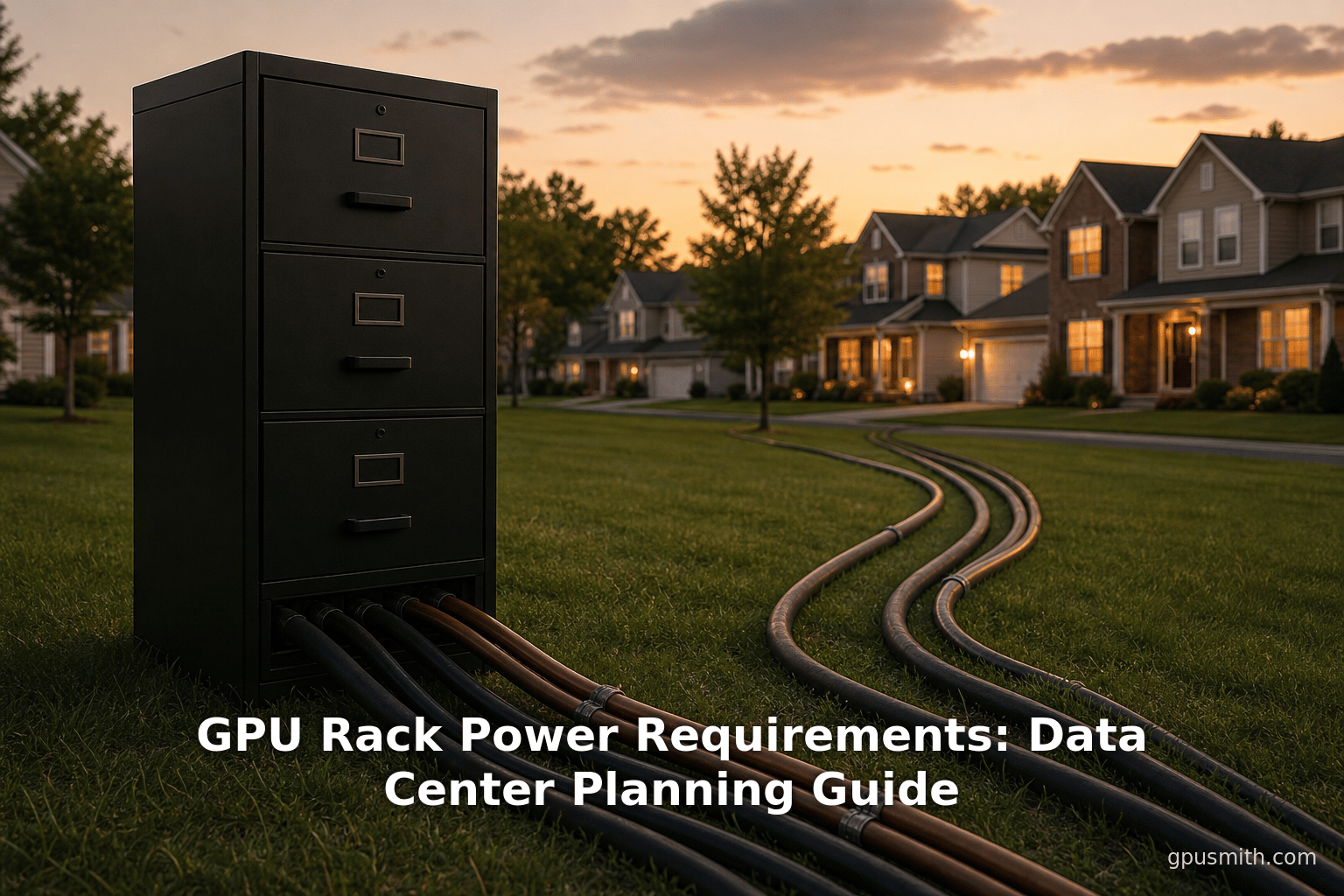
Modern GPU racks require dramatically more electrical power than the servers data centers were originally built for, and the numbers keep climbing. As of July 2026, a typical traditional enterprise rack still draws under 10 kilowatts (kW) [1], but the industry-average rack across all data centers, AI and non-AI combined, reached 27 kW in the AFCOM State of the Data Center Report 2026, up from 16 kW just a year earlier [2]. At the high end, NVIDIA's GB200 NVL72 rack, the current flagship for frontier AI training and inference, draws roughly 120 kW nominal with 130 to 132 kW observed at full load [3], weighs 1.36 metric tons [4], and cannot be air-cooled. NVIDIA's own roadmap points to 600 kW racks by 2027 with the Vera Rubin NVL144/Kyber generation, and Goldman Sachs projects that 2027-era AI server racks will require 50 times the power of the racks that powered the internet a decade ago, with NVIDIA's "Kyber" system needing roughly 600 kW per rack, enough electricity for about 500 US homes packed into the space of a filing cabinet [5].
This report answers what data center planners, facilities engineers, and enterprise buyers need to know about GPU rack power requirements: how much power current and next-generation racks draw, why liquid cooling has become mandatory rather than optional, what the networking fabric demands, and how the physical building itself, from floor loading to electrical service, must change. Air cooling reaches its practical ceiling at roughly 40 to 50 kW per rack [6], a threshold every current-generation NVIDIA GPU platform exceeds at rack scale. Direct-to-chip liquid cooling, in which coolant flows through cold plates mounted directly on GPUs and CPUs, has consequently become the default architecture for any new GPU deployment, with some facilities now supporting more than 200 kW per rack and trending toward 1 megawatt (MW) [7].
The power delivery architecture itself is being rebuilt. NVIDIA is leading a transition from legacy 54-volt in-rack and 415/480-volt AC facility distribution to an 800-volt direct current (VDC) standard, intended to support 1 MW racks starting in 2027, cutting maintenance costs by up to 70% and total cost of ownership by up to 30% [8]. At 1 MW per rack, a legacy 54VDC system would require up to 200 kilograms of copper busbar per rack, a constraint 800VDC eliminates [9]. Networking has scaled in parallel: a single NVIDIA DGX H100 system delivers up to 3.2 terabits per second (Tbps) of aggregate cluster-side bandwidth over eight 400-gigabit ConnectX-7 InfiniBand adapters [10], while the GB200 NVL72's NVLink Switch fabric provides 130 terabytes per second of GPU-to-GPU bandwidth inside a single rack [11].
The macro picture is equally stark. The International Energy Agency (IEA) reports that the capital expenditure of five large technology companies exceeded $400 billion in 2025 and is set to grow a further 75% in 2026, while data center electricity demand rose 17% in 2025 against 3% global electricity demand growth [12]. Hyperscalers are responding with gigawatt-scale campuses: Meta's Hyperion campus in Richland Parish, Louisiana, is designed to deliver over 2 gigawatts (GW) of compute capacity and could scale to 5 GW [13] [14], while xAI's Colossus complex in Memphis, Tennessee, now houses roughly 555,000 GPUs at a design capacity of 2 GW [15]. For planners, the practical takeaway is that power, not floor space, has become the binding constraint on AI data center design, and every subsystem, electrical, mechanical, structural, and networking, must be specified around it from the outset rather than retrofitted after the fact.
Introduction and Background
Data centers were built, for decades, around a predictable envelope: a standard 42-unit (42U) server rack drawing a few kilowatts, cooled by chilled air moving through a raised floor. That envelope has broken. The proximate cause is the graphics processing unit (GPU), the specialized chip that performs the parallel matrix computations underlying modern artificial intelligence (AI) training and inference. A single high-end AI accelerator now draws as much power as an entire rack of general-purpose servers did a decade ago, and organizations deploying these chips at scale, whether hyperscale cloud providers, national research labs, or enterprises building internal AI infrastructure, must plan facilities around power and cooling constraints that did not exist when most current data centers were designed.
This shift did not happen gradually. According to the AFCOM State of the Data Center Report 2026, average rack density was 7 kW in 2021, rose to 8.5 kW in 2023 and 12 kW in 2024, then to 16 kW in 2025, and jumped to 27 kW in 2026 [16]. That trajectory reflects blended figures across an AFCOM membership base still dominated by traditional enterprise data centers [17]; purpose-built AI facilities are already an order of magnitude denser. The reason is architectural: NVIDIA's rack-scale systems connect dozens of GPUs into a single logical machine using high-bandwidth interconnects, and every GPU added to that domain adds proportional electrical load concentrated in the same 19-inch-wide, roughly 60-centimeter-deep footprint [18].
The consequence is that "data center design" and "power engineering" have effectively merged for AI workloads. Average data center operators now report a facility size approaching 38 megawatts (MW), up from 32 MW a year earlier, according to the AFCOM survey, a shift Data Center Knowledge attributes to operators designing for higher rack densities and the need to secure power early in the development cycle rather than incrementally [19]. Uptime Institute's 2025 Global Data Center Survey, meanwhile, found that average server rack power densities continue to rise slowly overall, driven by growing adoption of racks in the 10 to 30 kW range, with facilities above 30 kW still uncommon across the broader installed base [20]. That divergence, a slow-moving average pulled upward by a small number of extremely dense purpose-built AI facilities, is the central tension this report examines: most of the world's data center floor space is not yet built for GPU-scale power density, but the facilities where frontier AI is actually trained and served already are, and the gap between the two is where planning risk concentrates.
This report addresses gpu rack power requirements as its central question, and along the way answers the secondary questions planners raise most often: gpu rack cooling requirements, data center power density for gpus, liquid cooling for gpu racks, gpu cluster network requirements, ai data center power requirements, h100 rack power consumption, data center infrastructure for ai, and gpu rack design guidelines. It draws on vendor technical documentation, engineering white papers, industry surveys, regulatory and energy-agency analysis, and named deployment case studies, current as of July 2026, to give data center planners a grounded, quantified basis for capacity and infrastructure decisions.
Key Changes: How GPU Rack Power Requirements Have Escalated
From Kilowatts to Hundreds of Kilowatts: The Density Curve
The clearest way to understand current GPU rack power requirements is generation by generation. NVIDIA's DGX SuperPOD reference architecture for H100 systems, the workhorse GPU of the 2023 to 2025 AI training boom, is typically deployed at four DGX H100 systems per rack, a configuration NVIDIA's own documentation notes results in "power consumption per rack exceeds 40 kW" [21]. Each individual DGX H100 system houses 8 H100 GPUs and provides 640 gigabytes (GB) of total GPU memory [22], and the system's power supply architecture is designed around 200 to 240 volt AC (VAC) rack power distribution units, split from three-phase circuits into single-phase legs [23]. Independent analysis from ModulEdge places the H100 air-cooled rack ceiling around 40 kW as well, describing it as "the 7.6 kW industry-average rack" multiplied roughly five-fold at high density [24].
The generational jump arrived with NVIDIA's Blackwell architecture and its flagship rack-scale product, the GB200 NVL72. The NVL72 connects 72 Blackwell GPUs and 36 Grace CPUs into a single NVLink domain, drawing 120 to 130 kW per rack [3], about 16 to 17 times the 7.6 kW industry-average rack reported by the Uptime Institute in 2025 [25]. NVIDIA's own marketing materials describe the GB200 NVL72 as delivering 30 times faster real-time trillion-parameter large language model (LLM) inference and 4 times faster training compared to an equivalent H100 cluster, alongside 25 times better energy efficiency [26] [27]; these are vendor-published benchmark comparisons and should be read as such rather than independently audited figures. Physically, the fully configured rack weighs approximately 1.36 metric tons and, per one enterprise buyer's guide, arrives in four separate components (a 1,500 kilogram (kg) compute rack, an 800 kg NVLink switch rack, a 400 kg coolant distribution unit, and a 300 kg power distribution unit) specifically because the assembled unit cannot be moved as a single piece [28].
The successor GB300 NVL72, built on "Blackwell Ultra" GPUs, matches or slightly exceeds the GB200's power draw per Leviathan Systems' cooling analysis [29], and packs 288 GB of HBM3e memory per GPU with roughly 1,100 petaFLOPS of FP4 compute per rack [30]. Looking further out, NVIDIA's Vera Rubin NVL144 platform, branded around the "Kyber" rack architecture connecting 576 Rubin Ultra GPUs, targets roughly 600 kW per rack by 2027 [31], a figure Goldman Sachs independently corroborates, describing "Kyber" as requiring "a whopping 600 kW" per rack, 50 times the power density of CPU data centers from five years prior [32]. SemiAnalysis's supply-chain research puts an even more aggressive "Kyber Ultra" variant at approximately 660 kW per rack [33], and public industry roadmaps already target 1 MW per rack as the subsequent milestone [34].
Table 1 below summarizes this rack power density progression across GPU generations, drawing on NVIDIA documentation, vendor analyses, and industry research.
| Generation / System | Typical rack power | Cooling requirement | Approximate timeframe |
|---|---|---|---|
| General enterprise rack | Under 10 kW [1] | Air | Ongoing |
| DGX H100 SuperPOD (4 systems/rack) | Exceeds 40 kW [21] | Air or hybrid liquid | 2023 to 2025 |
| GB200 NVL72 (Blackwell) | 120 to 130 kW [3] | Mandatory direct-to-chip liquid | 2024 to 2026 |
| GB300 NVL72 (Blackwell Ultra) | Matches or exceeds 120 to 130 kW (per Leviathan Systems' cooling analysis, cited above) | Mandatory direct-to-chip liquid | 2025 to 2026 |
| Vera Rubin NVL144 / Kyber | Approximately 600 kW [5] | Advanced liquid, 800VDC power | 2027 (planned) |
| Kyber Ultra | Approximately 660 kW [33] | Advanced liquid, 800VDC power | 2027 to 2028 (planned) |
| Industry roadmap target | Up to 1 MW [35] | 800VDC, advanced liquid | 2027 and beyond |
The pattern in Table 1 is not linear, it is closer to doubling every generation, and every doubling forces a corresponding change in electrical distribution, cooling topology, and structural design, which the following sections address in turn. It is worth noting that reported figures vary by measurement basis (nominal versus observed at full load) and by source; ModulEdge, for instance, reports the GB200 NVL72 at "120 kW nominal, with 130-132 kW observed at full load" [3], a discrepancy planners should treat as a design margin rather than a contradiction.
Liquid Cooling Becomes Mandatory, Not Optional
The single most consequential change in gpu rack cooling requirements is that air cooling has hit a hard physical ceiling, as established above. Multiple independent sources converge on the same threshold, beyond which the volume of airflow needed to dissipate heat exceeds what hot aisle/cold aisle containment can deliver without unacceptable noise, energy cost, and space consumption. Microsoft's own engineering blog makes the same point from the hardware side: modern GPUs and accelerators require liquid cooling because air cooling becomes impractical at power draws exceeding roughly 1 kW per individual accelerator, given the limited heat capacity of air [36]. Since every current-generation NVIDIA rack-scale GPU platform draws well above that threshold at rack level, liquid cooling has moved from a high-performance-computing niche to a default requirement for any new GPU deployment at scale [37].
The dominant liquid cooling for gpu racks approach is direct-to-chip (DTC) cooling, also called direct liquid cooling (DLC), in which coolant circulates through cold plates mounted directly on GPU and CPU packages [38]. Equinix describes DTC cooling as operating through four interconnected layers: facility-level coolant distribution (a primary loop from the building chiller and a secondary loop to the racks, isolated by a coolant distribution unit or CDU), the CDU itself, rack-level cooling and control, and leak detection and containment [39]. The CDU functions as the central exchange point, transferring cooling power from the building chiller to the servers via a plate heat exchanger and incorporating pumps, filters, and sensors, with N+1 redundant pumps and redundant CDUs commonly specified for reliability [40]. Leviathan Systems notes that a CDU must be sized with margin: a 120 kW GB300 rack requires a CDU capable of rejecting approximately 130 to 140 kW, a 10 to 15% margin above nominal load [41].
Engineering specifications for high-power racks illustrate the scale of what DTC cooling now has to move. Chilldyne's design analysis for a hypothetical 500 kW rack (Hypothetical Example) assumes an 83% heat capture ratio, splitting into 86 kW captured by a rear-door heat exchanger and 414 kW captured by direct-to-chip liquid cooling, with a total system pressure drop of 4 pounds per square inch (psi) [42]. Each 9 kW server node in that design requires 13 liters per minute (lpm) of coolant flow, entering at 40 degrees Celsius (°C) and exiting at 50°C [43], and the rack-level manifold must handle 600 lpm (158 gallons per minute) in total [44]. For the GB200 NVL72 specifically, NVIDIA specifies a coolant flow rate of 20 liters per minute at inlet temperatures below 30°C [45].
Beyond DTC cooling, the industry recognizes rear-door heat exchangers (RDHx), which capture heat at the rack exhaust rather than at the chip, and immersion cooling, which submerges entire servers in dielectric fluid. Schneider Electric's engineering analysis notes that most liquid-cooled capacity deployed today is single-phase DTC, expected to remain dominant, while two-phase DTC is likely to grow gradually as chip thermal design power exceeds single-phase practical limits, and immersion cooling remains a selective, workload-specific choice [46]. Rear-door heat exchangers remain viable for lower-density racks, with commercial units such as Vertiv's Liebert DCD water-cooled active rear door rated around 35 kW [47], an envelope that does not accommodate rack-scale systems like the NVL72.
Governing standards are catching up. ASHRAE (the American Society of Heating, Refrigerating and Air-Conditioning Engineers) Technical Committee 9.9 has long published thermal guidelines defining recommended and allowable temperature and humidity classes (A1 through A4, B, and C) for air-cooled IT equipment [48], and in 2024 released a technical bulletin on liquid cooling stating that "chip power is moving into 'uncharted territory'" as compute workloads push toward faster, more powerful chips with lower temperature requirements and broader liquid cooling use [49], warning that a loss of cooling can be catastrophic for such systems.
GPU Cluster Network Requirements Scale With Power
Networking is the third leg of gpu cluster network requirements, and it scales in near-lockstep with power density because distributed training and inference depend on GPUs exchanging data continuously during synchronized collective operations. Within a rack, GPUs communicate over NVLink and NVSwitch fabrics at bandwidths far exceeding external networking; any GPU in the GB200 NVL72's 72-GPU domain can reach any other at 1.8 terabytes per second (TB/s) with roughly 300 nanosecond latency, and 130 TB/s of aggregate bisection bandwidth. NVIDIA's public specifications describe the same NVLink Switch System delivering 130 TB/s of low-latency GPU communication for AI and high-performance computing (HPC) workloads [11], and fifth-generation NVLink itself provides 1.8 TB/s of GPU-to-GPU interconnect [50].
Between racks and nodes, InfiniBand remains the dominant fabric for large training clusters. A single DGX H100 system integrates eight ConnectX-7 network interface cards (NICs), aggregated into four external 800-gigabit (800G) logical connections, delivering up to 3.2 Tbps of aggregate cluster-side bandwidth per system [51]. This is delivered via NDR (Next Data Rate) InfiniBand, which provides 400 gigabits per second (Gb/s) per port and represents, per FS.com's networking analysis, "the practical intersection of bandwidth adequacy, ecosystem maturity, and infrastructure cost" for H100 and H200 clusters, and the standard NVIDIA specifies for its DGX SuperPOD reference architecture [52]. NVIDIA's ConnectX-7 adapter itself is marketed as providing "ultra-low latency, 400Gb/s throughput, and innovative NVIDIA In-Network Computing engines" purpose-built for HPC and AI workloads [53]. Next-generation XDR (Extreme Data Rate) InfiniBand at 1.6 terabit speeds is purpose-built for the successor B300/GB300 platforms equipped with ConnectX-8 NICs, but offers no meaningful benefit for H100/H200 deployments at added cost [54].
The practical reason this matters for cluster performance is that distributed training relies on collective communication operations, such as AllReduce and AllGather, that generate synchronized, many-to-many traffic across all GPUs simultaneously. A network fabric analysis from Server-Parts.eu notes that "GPUs communicate internally over NVLink/NVSwitch at much higher bandwidth than InfiniBand, so if inter-node network bandwidth is insufficient, GPUs will idle waiting for communication instead of computing" (Source: www.server-parts.eu), meaning that any single weaker path, whether a longer cable, an additional network hop, or misaligned rails, can slow the entire cluster. This is why large training clusters favor a rail-aligned, two-tier fat-tree topology, connecting each GPU's network port to a dedicated leaf switch rail; per Alaya NeW Cloud's fabric documentation, rail-aligned topology can save roughly 30% of training time compared to non-aligned designs, and the general rule of thumb is that clusters of 256 GPUs and above should standardize on InfiniBand rather than RDMA over Converged Ethernet (RoCE) [55]. InfiniBand offers native lossless, credit-based flow control with roughly 1 microsecond end-to-end latency, versus RoCEv2's reliance on data center bridging with priority flow control and explicit congestion notification and roughly 1.5 to 2 microsecond latency, where misconfiguration can leave a RoCE fabric twice as slow as InfiniBand [56].
The 800 Volt DC Power Architecture Shift
Perhaps the most structurally significant change in ai data center power requirements is happening not at the chip but in the wiring: the industry-wide move from AC-based power distribution to 800-volt direct current (VDC). NVIDIA describes the legacy 54VDC in-rack distribution standard as unable to support the megawatt-scale racks now arriving, citing three specific limitations: space constraints (power shelves for a fully populated Kyber rack would consume up to 64 rack units of space at 54VDC, leaving no room for compute), copper overload (a single 1 MW rack at 54VDC requires up to 200 kg of copper busbar, and the busbars alone in a single 1 GW data center could require up to 200,000 kg of copper), and inefficient repeated AC/DC conversions across the power chain [57].
NVIDIA is targeting full-scale production of 800VDC data centers to coincide with its Kyber rack-scale systems in 2027, and describes the transition as enabling racks from 100 kW to over 1 MW using the same underlying power infrastructure [58]. The claimed benefits are substantial: up to 5% improvement in end-to-end power efficiency, up to 70% reduction in maintenance costs from fewer power supply unit (PSU) failures, and up to 30% reduction in total cost of ownership (TCO) [59]. NVIDIA also states that switching from 415VAC to 800VDC enables 85% more power to be transmitted through the same conductor size, since higher voltage reduces current demand and resistive losses, and reduces copper requirements by 45% [60]. SemiAnalysis's electrical engineering analysis frames the physics simply: raising voltage from 54V to 800V cuts current by roughly 15 times and resistive losses by roughly 220 times, which is what makes 800VDC "a step-change in copper mass, thermal load, and distribution cost" [61], and estimates that at 1 GW of IT load, the roughly 5% facility-level power savings from 800VDC translate to over 50 MW of continuous savings, tens of millions of dollars in annual electricity costs [62].
The ecosystem response has been broad. At the Open Compute Project (OCP) Global Summit, NVIDIA announced that CoreWeave, Lambda, Nebius, Oracle Cloud Infrastructure, and Together AI are among the cloud providers designing for 800-volt data centers, alongside more than 50 MGX hardware partners and over 20 industry partners showing new silicon, power components, and support infrastructure [63]. Foxconn detailed a 40-megawatt Taiwan facility, Kaohsiung-1, being built for 800VDC [64], and Vertiv unveiled a complete 800VDC MGX reference architecture for power and cooling infrastructure [65]. Not every hyperscaler is moving in lockstep, however; SemiAnalysis reports that within the "Diablo 400" shared 800VDC specification co-authored by Meta, Google, Amazon, and Microsoft, the four diverge meaningfully in implementation, with Meta running 600 to 800 kW racks with 50 kW output cables, Google pushing to 900 kW, Amazon landing at 800 kW on a bipolar ±400V topology, and Microsoft reportedly making slower progress than the other co-authors [66]. A separate DCD analysis notes that while NVIDIA, OCP, and roughly thirty power-electronics vendors have published a coordinated 800VDC architecture, "what public-facing colocation operators have said about adopting it is a separate question," with a meaningful gap between vendor roadmaps and confirmed operator commitments (Source: www.supercomputing.news).
Implementation Considerations and Process Changes
Deploying GPU racks at these power densities requires facility-level changes far beyond swapping in a denser server. Six areas dominate the implementation checklist for teams following gpu rack design guidelines:
-
Electrical service and distribution. A single rack Power Distribution Unit (rPDU) circuit rated at 100 amps on 208V delivers approximately 28.8 kW, while the same circuit at 415V delivers approximately 57.5 kW [67], which is why many AI deployments require dedicated 480V distribution upgrades, building-level electrical work rather than a rack-level swap, before adopting full 800VDC.
-
Floor loading and structural capacity. Traditional data center floors were engineered to carry 500 to 1,000 kg per square meter for 500 to 700 kg server racks [68], whereas a fully occupied GPU rack can weigh from 1,000 to 1,500-plus kg [69]. Data Center Knowledge similarly reports that a standard 42U rack weighs 1,500 to 2,500 pounds (lbs), with a maximum capacity around 3,000 lbs, while AI equipment loaded with GPUs, smart networking cards, and liquid cooling hardware can easily exceed 4,000 lbs [70]. Rack manufacturers have responded with reinforced products; Vertiv's Rack Extreme cabinet, for instance, is rated for up to 2,045 kg of combined static and dynamic weight capacity [71]. For the GB200 NVL72 specifically, deployment requires specialized hydraulic lifts rated for 2,000 kg, and standard datacenter doors often cannot accommodate the assembled rack's width, sometimes requiring door frames or walls to be removed [72].
-
Chilled water and mechanical capacity. Traditional raised-floor data centers designed for 10 to 20 kW per rack face a 6 to 13 times power density multiplier from a single NVL72 row, and greenfield AI facility designs commissioned in 2025 to 2026 are increasingly specifying capacity in the 200-plus kW per rack range described earlier [7] as a baseline, with chilled-water capacity now derived from liquid-cooling manifold flow rather than computer room air conditioner (CRAC) coverage.
-
UPS and transient power management. GPU training workloads create a distinctive electrical challenge: thousands of GPUs operating in lockstep cause power consumption to swing from peak to idle within milliseconds during synchronized communication, checkpointing, and startup or shutdown events, a pattern Stanford researchers describe as inducing "steep power ramp rates, voltage and frequency shifts, and reactive power transients that can damage transformers, converters, and protection equipment" [73]. NVIDIA's response, introduced with the GB300 NVL72, is a power supply unit with integrated energy storage using electrolytic capacitors (about half the PSU's internal volume, providing 65 joules per GPU) that smooths these spikes, reducing peak grid demand by up to 30% when measured against a Megatron LLM training workload [74] [75]. NVIDIA's own research notes that if grid power demand suddenly ramps up, generation resources can take one to 90 minutes to respond due to physical ramp-rate limitations, which is precisely the mismatch this on-rack energy storage is designed to bridge [76]. At the facility level, Vertiv offers complementary uninterruptible power supply (UPS) features such as "Battery Shield" mode and "Input Power Smoothing," designed to protect against the thermal and electrical stress that rapid AI load fluctuations place on racks, power supply units, and distribution components [77].
-
Grid interconnection. Even before facility-level engineering begins, GPU data centers of gigawatt scale face a lengthy queue to secure utility power. As of mid-2026, the ERCOT (Electric Reliability Council of Texas) large-load interconnection queue stands at roughly 226 gigawatts, up roughly four times year over year, with about 77% attributed to data centers and typical time-to-power of two to four years (Source: dchub.cloud). PJM Interconnection's queue holds roughly 220 GW across approximately 800 projects, with Wood Mackenzie projecting up to 55 GW of data center load on the PJM system by 2030 and typical time-to-power of four to seven years (Source: dchub.cloud). RMI's policy analysis frames the underlying tension: data centers seeking to connect to the grid must navigate a load interconnection process historically not federally standardized, prompting the U.S. Department of Energy to direct the Federal Energy Regulatory Commission (FERC) to initiate rulemaking on load interconnection specifically to accelerate large-load connections such as data centers [78].
-
Networking and cabling infrastructure. NVIDIA's own structured cabling guidance for NDR and XDR InfiniBand and 400/800G Ethernet emphasizes that these interconnects "make extensive use of pluggable optical transceivers and detachable optical fibers for easier installation, inspection and debugging," with structured cabling and patch panels easing serviceability at scale [79].
The retrofit-versus-greenfield decision runs through all six of these considerations. A tactical migration guide for colocation operators frames the core challenge bluntly: "the challenge is not simply adding more kilowatts; it is converting a legacy environment into a controlled, phased, multi-megawatt platform that can support liquid cooling, higher fault currents, and much tighter operational discipline" (Source: deployed.cloud). One vendor buyer's guide estimates air-cooled facilities face $5 to $10 million in retrofit costs per megawatt to support GB200-class deployments, and notes that most enterprise-side procurement in fact still centers on 8-GPU HGX systems rather than full rack-scale NVL72 deployments, since HGX nodes fit into existing air or liquid-cooled colocation space with lower facility retrofit risk, while full-rack NVL72 procurement (roughly $2 to $3 million per rack) carries substantially higher facility retrofit risk at air-only sites [80]. A DataCenterUPS.com analysis quantifies the underlying mismatch in a worked example (Hypothetical Example): a 40-rack data hall designed for 10 kW per rack carries a 400 kW total load; deploying H100 or H200 GPU servers in the same hall at 80 kW per rack pushes the load to 3.2 MW, eight times the original design basis, rendering the UPS, switchgear, PDUs, cabling, and cooling either undersized or non-functional [81].
Data Analysis and Evidence
The quantitative core of the GPU rack power story spans four data domains: rack-level power density surveys, facility-level electricity demand, efficiency metrics, and the underlying macroeconomic capital flows financing it all.
On rack density, the AFCOM State of the Data Center Report 2026 provides the most direct year-over-year benchmark, surveying operators across a base still dominated by traditional data centers rather than purpose-built AI facilities: average rack density moved from 7 kW (2021) to 8.5 kW (2023) to 12 kW (2024) to 16 kW (2025) to 27 kW (2026), a nearly fourfold increase in three years [82]. Uptime Institute's parallel 2025 Global Data Center Survey found average server rack power densities rising "slowly," concentrated in the 10 to 30 kW range, with facilities above 30 kW still rare, a materially more conservative picture than AFCOM's 2026 figure, reflecting Uptime's broader and more historically enterprise-weighted respondent base [83]. This discrepancy between survey sources is worth flagging honestly: it reflects different sampling of traditional versus AI-native facilities, not a factual disagreement about what NVIDIA's rack-scale systems themselves draw.
On facility electricity demand, the IEA's Electricity 2026 report, building on its landmark April 2025 Energy and AI special report, finds that the combined capital expenditure of five large technology companies exceeded $400 billion in 2025 and is set to rise a further 75% in 2026 [84]. Electricity demand from data centers overall grew 17% in 2025, with AI-focused facilities growing even faster, against global electricity demand growth of just 3% [85]. The IEA's satellite-based tracking finds that AI-specific "AI factories," cutting-edge data centers designed specifically for AI, have more than tripled in capacity over the preceding 18 months [86]. Within a data center's own energy budget, the IEA's component breakdown finds servers (CPUs and specialized accelerators like GPUs) account for around 60% of electricity demand on average, storage systems around 5%, networking equipment up to 5%, and cooling ranging from about 7% in efficient hyperscale facilities to over 30% in less-efficient enterprise data centers [87] [88].
On efficiency, Statista's compilation of annual industry survey data (sourced from operator self-reporting) shows global average annual power usage effectiveness (PUE), the ratio of total facility power to IT equipment power, essentially flat for the past six years: 1.58 in 2018, 1.67 in 2019, 1.59 in 2020, 1.57 in 2021, 1.55 in 2022, 1.58 in 2023, 1.56 in 2024, and 1.54 in 2025, based on 526 respondents [89]. Uptime Institute's own research attributes this plateau to legacy infrastructure and region-specific barriers to efficient cooling, even as operators face rising costs and worsening power constraints [90]. Individual purpose-built facilities can substantially beat the global average, however: Telehouse's retrofitted South data center in London's Docklands reports a PUE of 1.27, down from 1.74 under its previous infrastructure, achieved by removing gas-fired boilers and replacing end-of-life heat rejection equipment with Trane chillers delivering free, non-mechanical cooling for around 78% of the year [91]. Newer purpose-built AI facilities target even lower figures; Germany's firstcolo is building its FRA7 facility near Frankfurt with a target PUE below 1.2, supporting rack densities up to 200 kW through a combination of advanced electrical design and liquid cooling [92].
On grid interconnection economics, the Lawrence Berkeley National Laboratory's "Queued Up: 2026 Edition" report, compiled with Interconnection.fyi from more than 50 transmission grid operators representing roughly 98% of installed US generating capacity, provides the authoritative annual snapshot of generator interconnection queue trends as of the end of 2025 [93]. Separately, real-time regional tracking shows ERCOT's large-load queue at approximately 226 GW (roughly quadrupled year over year, with data centers representing about 77% of that queue) and PJM's queue at approximately 220 GW across roughly 800 projects (Source: dchub.cloud).
Table 2 below summarizes rack cooling method capacities as reported across vendor and engineering sources, providing a practical reference for matching cooling architecture to planned rack density.
| Cooling method | Typical rack capacity | Key characteristic |
|---|---|---|
| Air cooling (hot/cold aisle containment) | Up to approximately 40 to 50 kW | Practical ceiling; exceeded by all current NVIDIA rack-scale platforms |
| Rear-door heat exchanger (RDHx) | Approximately 35 kW per commercial unit [47] | Captures heat at rack exhaust; suits moderate-density HGX nodes |
| Direct-to-chip (DTC) liquid cooling, single-phase | 120 kW to 200-plus kW [7] | Dominant architecture for current rack-scale GPU platforms |
| DTC liquid cooling, engineered high-density design | Up to 500 kW (design case) [94] | 83% heat capture ratio; requires precise flow rate and pressure engineering |
| Two-phase DTC / immersion | Growing toward 600 kW-plus | Pilot and early large-scale deployments; adoption accelerating as chip thermal flux exceeds single-phase limits [95] |
Read together, these data points support a consistent conclusion: rack-level power density is scaling far faster than average facility efficiency is improving, which means the industry's overall energy and cooling burden is shifting from an efficiency problem to a raw capacity and grid-access problem, exactly the framing the IEA and interconnection-queue data independently confirm.
Case Studies and Real-World Examples
Meta's Hyperion Campus, Richland Parish, Louisiana
Meta announced in December 2024 that it would build its largest data center to date in Richland Parish, Louisiana, describing a facility that will deliver over 2 gigawatts of compute capacity to train future open-source large language models across 4 million square feet [96]. By April 2026, Engineering News-Record reported the project, since expanded, could ultimately scale to 5 gigawatts of power demand, becoming Meta's largest facility, with CEO Mark Zuckerberg describing the site as large enough to cover a significant portion of Manhattan [97]. To supply that load, Meta reached an agreement with utility Entergy Louisiana to finance seven new natural-gas power plants totaling more than 5.2 gigawatts, roughly 240 miles of 500-kilovolt (kV) transmission lines, and battery storage across multiple locations, while also committing to help fund up to 2.5 gigawatts of new renewable resources [98]. Including three gas plants already under construction, the full project draws power from ten gas-fired units totaling 7.5 gigawatts, an increase equivalent to more than 30% of Louisiana's current grid capacity, according to Fortune's reporting cited by Engineering News-Record [99]. Meta subsequently structured the campus as a $27 billion joint venture with Blue Owl Capital, which owns an 80% interest while Meta retains 20% and provides construction and property management services [100]. This case illustrates that at gigawatt scale, GPU rack power requirements cease to be a facilities problem and become a regional energy infrastructure and utility-financing problem simultaneously.
xAI's Colossus Complex, Memphis, Tennessee
xAI's Colossus campus in Memphis demonstrates both the speed and the friction of building GPU infrastructure at gigawatt scale. Colossus 1, occupying a 785,000-square-foot former Electrolux factory on roughly 217 acres, went live in August 2024, just 122 days after its public announcement, with 100,000 H100 GPUs operational by that September, deployed in 19 days [101]. Colossus 2, a million-square-foot complex on 186 acres, came online in January 2026 [102]. Combined, the campus now houses approximately 555,000 NVIDIA GPUs at a design power capacity of 2 gigawatts, with total investment exceeding $35 billion [103]. To manage power reliability at that scale, xAI announced it would deploy more than $375 million worth of Tesla Megapack battery energy storage units at the site, each individual unit capable of storing more than 3.9 megawatt-hours (MWh) of energy [104] [105]. However, the case also carries a cautionary dimension: the Southern Environmental Law Center reports that the Colossus 2 facility has been powered in part by unpermitted gas turbines releasing smog-forming pollution and hazardous chemicals, prompting a federal Clean Air Act lawsuit joined by the NAACP's Mississippi State Conference [106], illustrating that the speed advantages of unregulated, behind-the-meter generation can carry significant regulatory and community-impact risk that facility planners must weigh against pure deployment velocity.
Microsoft Azure's Fairwater and ND GB200 v6 Deployment
Microsoft became the first cloud provider to bring NVIDIA's Blackwell-generation GB200 system into commercial general availability, announcing in March 2025 that its ND GB200 v6 virtual machines had reached general availability as a 4,000-GPU GB200 supercomputing cluster for training frontier models and accelerating production AI inference [107]. The company's technology press materials described the initial deployment as dedicating roughly two-thirds of the physical server's space to closed-loop liquid cooling infrastructure, versus one-third for compute, connected via InfiniBand networking [108]. Microsoft has since built on that foundation with its "Fairwater" facility design; its Atlanta, Georgia Fairwater site, unveiled in late 2025, connects to a prior Wisconsin Fairwater site and the broader Azure global footprint using, per Microsoft's own architecture description, "a single flat network that can integrate hundreds of thousands of the latest NVIDIA GB200 and GB300 GPUs into a massive supercomputer," which the company terms a "planet-scale AI superfactory" [109]. Microsoft has also pursued a "zonal cooling" strategy across its newer AI data centers, tailoring cooling infrastructure to the specific mix of liquid-cooled accelerators and conventional air-cooled equipment present in each facility, aimed at improving efficiency while supporting the company's energy, carbon, and water reduction goals [110]. Separately, Microsoft has open-sourced a standalone liquid-cooling heat exchanger unit (HXU) design through the Open Compute Project, intended to retrofit direct-to-chip liquid cooling capability into existing air-cooled data centers that lack native liquid infrastructure [111].
European Colocation Retrofits: Telehouse and firstcolo
Not every case study involves a hyperscaler building from a blank slate; much of the near-term GPU power demand will be absorbed by colocation operators retrofitting existing urban facilities. Telehouse Canada completed a liquid-cooling overhaul across its downtown Toronto data center campus in May 2026, enabling rack densities reaching 120 kW while preserving the low-latency interconnection access that urban colocation customers require [112]. In London, Telehouse's South facility retrofit removed gas-fired boilers entirely, migrating to a closed-loop chilled water system delivering the 1.27 PUE cited earlier in this report, while the company simultaneously began construction of a separate £251 million ("West 2") building to add further AI-ready capacity to its Docklands cluster [113]. In Germany, firstcolo broke ground in mid-2026 on its FRA7 facility near Frankfurt, a roughly €250 million, approximately 24-megawatt project designed from inception for rack densities up to 200 kW, certified green electricity, and battery storage capable of feeding surplus power back to the grid, alongside a 20-year waste-heat supply commitment to the neighboring municipality [114]. Meanwhile, in Sweden, HIVE Digital Technologies signed a letter of intent for a long-term high-performance computing (HPC) colocation lease at its 32-megawatt Boden facility, planning a retrofit to support up to 10,000 NVIDIA GB300 GPUs at single-rack densities up to 150 kW using hybrid direct-to-chip liquid cooling combined with air cooling [115]. Together, these cases show colocation operators converging on the 120 to 200 kW rack density range as the practical near-term retrofit target, well above legacy design norms but a step below the 500 kW to 1 MW figures associated with the newest greenfield hyperscale builds.
Implications and Future Directions
The trajectory documented throughout this report has several practical implications for organizations planning GPU infrastructure investments over the next two to three years. First, power procurement now precedes hardware procurement in the planning sequence. Grid interconnection timelines of two to seven years, depending on region and ISO/RTO (Independent System Operator/Regional Transmission Organization), mean that an organization committing to GPU capacity today must often have secured power years earlier, or must accept behind-the-meter generation with its attendant regulatory and reputational risk, as the xAI Colossus case illustrates. Organizations should treat utility engagement as the first, not the last, step in any multi-megawatt AI infrastructure plan.
Second, the industry's power architecture is mid-transition, not settled. The move to 800VDC is real, backed by more than 20 announced industry partners and multiple hyperscaler roadmaps, but as DCD's reporting notes, public commitments from colocation operators remain sparse relative to vendor and hyperscaler announcements (Source: www.supercomputing.news), and even among the hyperscalers co-authoring shared specifications, implementation details diverge meaningfully [116]. Enterprises evaluating owned infrastructure, rather than cloud-consumed GPU capacity, should expect further architectural churn through at least 2028 to 2029, when SemiAnalysis projects a subsequent phase built around centralized rectifiers and solid-state transformers [117].
Third, the gap between average industry rack density (27 kW in the 2026 AFCOM survey) and frontier AI rack density (120 kW-plus and climbing toward 600 kW to 1 MW) means most existing data center floor space is simply the wrong shape for GPU-scale AI workloads, regardless of available power. This is why greenfield construction, rather than retrofit, dominates the largest announced projects, and why colocation retrofits that do succeed (Telehouse, firstcolo, HIVE) are converging on a comparatively modest 120 to 200 kW ceiling rather than chasing the 500 kW-plus figures associated with hyperscale-exclusive campuses. Enterprises should calibrate expectations accordingly: renting capacity in a purpose-built AI-native facility or cloud region will, for the foreseeable future, be the only practical route to genuinely rack-scale (NVL72-class or denser) deployments, while colocation retrofits remain a viable path for moderate-density GPU deployments in the 100 to 200 kW range.
Fourth, on-chip and on-rack power smoothing technology, exemplified by NVIDIA's GB300 energy-storage PSUs, represents a broader trend of pushing grid-stability engineering down to the rack level rather than relying solely on facility-level UPS and utility-side flexibility. As rack densities climb toward 1 MW, the electrical volatility of a single rack starting or stopping a training job approaches the scale of volatility that entire buildings used to represent, meaning rack-level and grid-level engineering are converging into a single discipline that data center planners, electrical engineers, and utility planners will increasingly need to coordinate jointly rather than sequentially.
Frequently Asked Questions (FAQs)
How much power does a GPU rack use? It depends heavily on the hardware generation and configuration. Traditional enterprise racks draw under 10 kW [1]; current AI racks commonly range from 20 kW to more than 100 kW [118]; and NVIDIA's flagship GB200 NVL72 rack draws 120 to 130 kW [3].
What is the h100 rack power consumption? Individual DGX H100 systems house 8 GPUs and 640 GB of GPU memory [22]; NVIDIA's reference architecture, typically deploying four DGX H100 systems per rack, reports power consumption exceeding 40 kW per rack [21].
Do GPU racks always require liquid cooling? Not always, but any rack exceeding roughly 40 to 50 kW effectively requires it, since air cooling cannot practically dissipate more heat than that without excessive airflow, noise, and energy cost, as discussed above. Every current-generation NVIDIA rack-scale platform exceeds that threshold and mandates direct-to-chip liquid cooling [7].
What network bandwidth does a GPU cluster need? Within a rack, GPUs communicate over NVLink at 1.8 TB/s per GPU [50]; between nodes, a single DGX H100 provides up to 3.2 Tbps of aggregate InfiniBand bandwidth [10]; large clusters typically standardize on 400G/800G NDR InfiniBand in a rail-aligned, two-tier fat-tree topology [55].
Why is 800VDC power replacing AC in AI data centers? Because at rack densities above roughly 100 kW, legacy 54VDC and 415/480VAC distribution require impractical amounts of copper and rack space, up to 200 kg of copper busbar per rack at 1 MW under 54VDC [9], whereas 800VDC transmits 85% more power through the same conductor size [60] and reduces total cost of ownership by up to 30% [119].
Can an existing data center be retrofitted for GPU racks? Yes, but with meaningful limits and cost. Retrofits like Telehouse Toronto (120 kW racks) [120] and HIVE's Boden facility (up to 150 kW racks) [121] demonstrate viable retrofit paths, but as noted above, air-cooled facilities can face multi-million-dollar retrofit costs per megawatt for the highest-density platforms, and the very highest-density racks (500 kW-plus) are generally reserved for purpose-built greenfield facilities.
Conclusion
GPU rack power requirements have moved through roughly a tenfold increase in under five years, from single-digit kilowatts for traditional enterprise racks, through the 40-plus kW of air-cooled H100 deployments, to the 120 to 130 kW mandatory-liquid-cooling threshold of today's GB200 and GB300 NVL72 racks, with 600 kW to 1 MW racks already on published vendor roadmaps for 2027 and beyond. That escalation has forced simultaneous, coordinated change across every layer of data center infrastructure: electrical distribution is shifting from AC to 800VDC to handle the copper and space constraints of megawatt-scale racks; cooling has shifted from air to mandatory direct-to-chip liquid cooling with coolant distribution units and precise flow-rate engineering; structural floor loading has had to accommodate racks weighing over a metric ton; UPS and power-electronics design has had to absorb millisecond-scale load swings unique to synchronized GPU training; and networking has scaled to hundreds of terabytes per second within a rack and multiple terabits per second between nodes.
The practical guidance for data center planners is threefold. Plan power and grid interconnection years, not months, ahead of hardware delivery, given ISO/RTO queue times now running two to seven years in the most constrained US markets. Match cooling architecture to genuine planned density rather than current utilization, since successful GPU deployments routinely double in density within a short period after initial pilots. And recognize that the industry's power architecture, from 800VDC adoption to rack-level energy storage, remains mid-transition, meaning infrastructure decisions made in 2026 should build in headroom and vendor-agnostic flexibility rather than betting on a single architecture as final. Organizations that internalize these constraints early will be positioned to deploy GPU capacity reliably as density requirements continue their steep, multi-year climb.
External Sources (121)
About
GPUSmith
Plan and build private AI compute with GPU Smith. We connect workload requirements with GPU hardware, networking, deployment and operating decisions so your infrastructure fits the work it must perform.
GPU Smith provides independent engineering and research for private AI infrastructure. We help technical buyers and operators reason about GPU workload sizing, hardware selection, procurement, deployment and inference operations, from the compute system to the networking, power and cooling requirements around it.
Start with the workload
Useful infrastructure decisions begin with the models, data, throughput, latency and operating constraints a team actually has. GPU Smith helps connect those requirements with system design and deployment choices. The goal is a privately controlled AI environment whose capacity and operational demands are understood before a purchasing decision.
Hardware and supplier research
Our public reference library covers GPUs, complete systems and networking components. The server-vendor directory and manufacturing research help teams investigate suppliers, compare options and follow sources behind technical claims. We distinguish manufacturer specifications from measured benchmarks and advertised capabilities from tested configurations. Reference pages are research resources, not a live inventory listing or a binding equipment quote.
Deployment and operations
GPU Smith's engineering scope includes infrastructure integration, networking, power, cooling and the practical operation of inference workloads. Our published articles explain the tradeoffs behind deployment, procurement and ongoing operations so teams can ask better questions and document decisions.
Work with GPU Smith
Explore the hardware library, GPU references, networking references and vendor research. Contact GPU Smith with your workloads and deployment constraints to discuss a project and confirm current scope, pricing and availability.
Inclusion of a manufacturer or product in our research does not imply a partnership, certification or endorsement.
Disclaimer
This document is provided for informational purposes only. No representations or warranties are made regarding the accuracy, completeness, or reliability of its contents. Any use of this information is at your own risk. GPUSmith shall not be liable for any damages arising from the use of this document. This content was generated with assistance from artificial intelligence tools, which may contain errors or inaccuracies. Readers should verify critical information independently. All product names, trademarks, and registered trademarks mentioned are property of their respective owners and are used for identification purposes only. Use of these names does not imply endorsement. This document does not constitute professional or legal advice. For specific guidance related to your needs, please consult qualified professionals.