
GPUSmith Article
Intel Crescent Island AI GPU Explained: Xe3P and LPDDR5X
Inside this article
- 01Intel Crescent Island AI GPU Explained: Xe3P and LPDDR5X
- 02Introduction and Background
- 03What Is Crescent Island? Definition and Taxonomy
- 04Inside Xe3P: Architecture and Design Philosophy
- 05Memory Subsystem: LPDDR5X Capacity and Bandwidth Tradeoffs
- 06Crescent Island vs Nvidia Rubin and AMD Instinct MI400: Competitive Positioning
- 07Software Stack and Ecosystem Readiness
- 08Deployment Guidance: Who Should Evaluate Crescent Island
- 09Data Analysis and Evidence
- 10Case Studies and Real-World Examples
- 11Implications and Future Directions
- 12Frequently Asked Questions (FAQs)
- 13Conclusion
Intel Crescent Island AI GPU Explained: Xe3P and LPDDR5X
Executive Summary
Intel's Crescent Island is a data center GPU built around a simple bet: that AI inference economics now reward memory capacity over raw memory bandwidth. First disclosed on October 14, 2025 at the OCP Global Summit [1], the chip pairs Intel's Xe3P microarchitecture, a performance-tuned variant of the Xe3 graphics architecture shipping in Panther Lake laptops [2], with up to 160GB of LPDDR5X memory in Intel's reference design [1] and as much as 480GB in board-partner variants disclosed at Computex 2026 [2] [3]. Rather than the HBM4 or GDDR7 memory used by Nvidia and AMD's flagship parts, Crescent Island uses LPDDR5X, the same commodity memory found in laptops and phones [4], to hit a 350W air-cooled TDP [3] at a fraction of the cost per gigabyte of HBM.
The tradeoff is bandwidth. Community and press estimates, based on leaked PCB layouts showing 20 LPDDR5X package sites [5], converge on roughly 1.5 TB/s of memory bandwidth [6], compared with Nvidia's newly announced Rubin GPU at 288GB of HBM4 and 22 TB/s [7] and AMD's Instinct MI455X at 432GB of HBM4 and, per AMD's own Financial Analyst Day materials, roughly 19.6 TB/s of bandwidth [8]. Intel is not trying to out-bandwidth those chips; it is targeting the "prefill" and memory-resident phases of disaggregated inference where capacity, not throughput, is the bottleneck [4], a niche Nvidia itself validated and then abandoned when it shelved its Rubin CPX prefill accelerator (128GB GDDR7, 30 petaflops NVFP4) after acquiring Groq's LPU technology [4] [9].
Timing matters as much as architecture. Customer sampling of Crescent Island is slated for the second half of 2026, with broader availability expected in 2027 [2], which puts it roughly a year behind Nvidia's Rubin platform, already in full production as of the GTC announcement of "seven new chips now in full production" [10], and against AMD's MI400 series, which AMD says will be "available to clients and partners from day one" in 2026 [8]. The launch also lands squarely inside a historic memory shortage: TrendForce projects LPDDR5X contract prices to surge by roughly 90% quarter over quarter in the first quarter of 2026 alone [11], a dynamic that could blunt Crescent Island's cost advantage or, alternatively, make LPDDR5X-based inference cards relatively cheaper than HBM-starved competitors. IDC separately warns the shortage reflects "a potentially permanent, strategic reallocation of the world's silicon wafer capacity" toward HBM, not a temporary cyclical spike [12].
Commercially, Intel remains a distant third in AI accelerators. Independent estimates place Nvidia's 2026 AI accelerator revenue share at 75% to 81%, with AMD around 5% to 7% and Intel near 1%, largely from the underperforming Gaudi 3 line, which missed its own $500 million 2024 revenue target [13]. Yet Intel's Data Center and AI segment still grew 59% year over year to $6.3 billion in the second quarter of 2026 [14], part of what CNBC called Intel's "fastest revenue growth in almost 15 years" [15]. The company is pairing Crescent Island's roadmap with system-level bets, including a $350 million-backed partnership with SambaNova [16], a design that Intel says will "combine GPUs for prefill, SambaNova RDUs for high throughput decode, and Intel Xeon 6 processors as the host and action CPUs" [17], and a disaggregated Xeon-based rack architecture that already has commercial customers in Together.AI and Vector Core Compute[18]. This report explains what Crescent Island is, how Xe3P and its LPDDR5X memory subsystem work, how the chip stacks up against Nvidia Rubin and AMD's MI400 series, and what its 2026/2027 timeline means for buyers evaluating inference infrastructure.
Introduction and Background
The AI accelerator market of 2026 is being reshaped by a single structural fact: inference, not training, is now the dominant workload. Intel's own framing of Crescent Island captures this shift directly. As Intel Chief Technology Officer Sachin Katti put it at the chip's unveiling, "AI is shifting from static training to real-time, everywhere inference, driven by agentic AI" [1]. Katti argued the response requires "heterogeneous systems that match the right silicon to the right task, powered by an open software stack" [1]. That shift changes what “good” silicon looks like. Training clusters are built to maximize floating-point throughput across tightly coupled GPU pods; inference workloads have different bottlenecks by phase. In disaggregated LLM serving, prefill is generally compute-bound, while decode is generally memory-bound; memory capacity can also affect model residency and KV-cache handling [19].
Crescent Island is Intel's answer to that reframing. It is a codename, not a final product name, for an inference-optimized data center GPU built on the Xe3P microarchitecture, a "performance-per-watt" tuned derivative of the Xe3 graphics architecture that already ships in Intel's Panther Lake mobile processors [2]. Intel first confirmed the project on October 14, 2025 at the Open Compute Project (OCP) Global Summit [1], describing it as "a new Intel Data Center GPU code-named Crescent Island... designed to meet the growing demands of AI inference workloads" [1]. Phoronix, one of the first outlets to cover the embargoed announcement, dated its report to "14 October 2025" [20] and noted the underwhelming near-term reality behind the buzz: "what's being announced is a next-gen part but one that is at least one year away still" [20].
The stakes for Intel are considerable. The company's dedicated AI accelerator line, Gaudi 3, has struggled commercially, missing its own $500 million revenue target for 2024 and never fully recovering market traction [13], while Intel's follow-on Falcon Shores chip was quietly repurposed as an internal test vehicle rather than a shipping product [20]. Crescent Island, alongside a longer-term "Jaguar Shores" chip described internally as Intel's first "generally programmable" AI accelerator for customers [21], represents Intel's attempt to re-enter a data center GPU market it effectively ceded to Nvidia, whose Rubin platform is already shipping "seven new chips now in full production" [10], and to AMD. This report walks through what Crescent Island actually is, how its Xe3P architecture and LPDDR5X memory subsystem function, how it compares against Nvidia's Rubin platform and AMD's Instinct MI400 series, and what its 2026 to 2027 delivery window means for organizations planning inference infrastructure. Every specification below is anchored to its "as of" date because, as of July 2026, Intel has not disclosed compute throughput figures, final pricing, or a firm ship date, only memory capacity, form factor, and power targets.
What Is Crescent Island? Definition and Taxonomy
Crescent Island is best understood by placing it within three overlapping categories: what it is architecturally, what workload class it targets, and where it sits in Intel's own product roadmap.
Architecturally, Crescent Island is a discrete data center GPU. It is built on Xe3P, which Intel and outlets covering the October 2025 announcement described as a "performance-oriented variant of the Xe3 architecture" used in Panther Lake, Intel's Core Ultra 300-series mobile chips [2] [1]. The base Xe3 architecture, as documented in Panther Lake's integrated GPU tiles, comes in two configurations: a 4-Xe-Core, 512-shader tile built on Intel's own 3nm process for lower-power SKUs [22], and a 12-Xe-Core, 1,536-shader tile built on TSMC's N3E process for higher-performance configurations [22]. Xe3P scales this design philosophy toward data center throughput and efficiency rather than integrated-graphics power envelopes, and rumor sites have separately reported that Xe3P is expected to reach Intel's next-generation Nova Lake integrated graphics on the client side, extending the same architecture into laptops beyond Panther Lake [6].
By workload class, Crescent Island is inference-optimized. Intel describes it as intended for "tokens-as-a-service" providers and inference use cases [1], while the disclosed FP4-to-FP64 range also indicates support for numerical simulation, weather modeling, and other scientific workloads [2]. Intel has not disclosed peak FLOPS figures, training performance, or end-to-end inference benchmarks as of July 2026, so its suitability beyond the stated inference target remains unestablished [2].
In Intel's roadmap, Crescent Island sits between two generations. It succeeds the effectively cancelled Falcon Shores project and precedes both a client-facing continuation of Xe3P (which, according to leaks, will not produce a gaming-focused Arc card) [6] and a data center follow-on labeled "Xe Next" on an internal roadmap slide shown by Intel Vice President Anil Nanduri in February 2026 [21]. Intel is also validating its open software stack for Crescent Island using current-generation Arc Pro B-Series GPUs, ahead of the data center part's own launch [1], a pragmatic way to de-risk driver and compiler work before committing it to unproven silicon; that same Nanduri, notably, is the executive Intel put in front of press to discuss the Arc Pro B70 workstation card that underpins this validation effort [23].
The practical takeaway for anyone searching “Intel Crescent Island AI GPU explained” is this: it is a discrete, air-cooled, PCIe-form-factor inference accelerator using LPDDR5X instead of HBM, with large disclosed memory configurations. Its eventual fit for compute-bound prefill, memory-bound decode, or other inference workloads cannot be established until Intel publishes performance benchmarks; sampling is planned for the second half of 2026, with broader availability expected in 2027.
Inside Xe3P: Architecture and Design Philosophy
Xe3P's defining design choice is prioritizing performance-per-watt and cost-per-gigabyte over peak throughput, a philosophy visible in every disclosed spec. Intel's own summary of the architecture describes it plainly: "Xe3P microarchitecture with optimized performance-per-watt" [1]. That target manifests in the physical form factor: Crescent Island ships as a PCIe add-in card, not a socketed, liquid-cooled module like Nvidia's Rubin GPUs or AMD's MI455X, at a time when "most high-end GPUs are now using socketed designs," as The Register observed [4]. This is a deliberate simplification: PCIe cards slot into standard, air-cooled servers that enterprises already operate, avoiding the liquid-cooling retrofits that Rubin and MI400-class deployments typically require, since The Register notes Nvidia and AMD's newest parts run at "20 TB/s" of bandwidth at correspondingly high power [4].
Intel confirmed at Computex 2026 that the reference PCIe card carries a 350W thermal design power (TDP), positioning it firmly in air-cooled territory [3]. TechSpot's reporting on the Computex disclosure attributed part of that efficiency to the memory choice itself: "The power efficiency can also be attributed to the use of LPDDR5X memory, which employs a densely packed channel design, enabling significantly higher bandwidth without a corresponding increase in power consumption" relative to the die area and power budget HBM would require [2].
A leaked PCB, first published by hardware leaker YuuKi_AnS and covered by VideoCardz in May 2026, offers the clearest physical picture of the card so far. It shows "a PCIe add-in board with a large GPU package area, several LPDDR5X memory sites and a single 16-pin power connector" [5]. The board reportedly carries "18 VRM positions, with 13 of them expected to be populated" [5], alongside "a USB Type-C connector... apparently for debug or validation" near the rear power connector [5]. None of this is officially confirmed by Intel, and VideoCardz is explicit that "the PCB leak does not confirm final clocks, power limits or performance," but it is consistent with the 350W, air-cooled design Intel has publicly disclosed [5].
Xe3P's precision support is unusually broad for an inference chip. Intel confirmed the card handles everything "from FP4 to FP64," with FP4 aimed at "high-performance AI inference" [2] and FP64 aimed at "numerical simulations and scientific applications such as weather forecasting, climate modeling, fluid dynamics, and astrophysical calculations" [2]. That range hints at ambitions beyond pure LLM token generation, into converged AI/HPC territory that AMD is also targeting with its MI430X part, though Intel has disclosed no FP64 throughput figures to substantiate how competitive Crescent Island would actually be in that role.
Crescent Island did not arrive in a vacuum; Intel used the same OCP Global Summit where it unveiled the chip [1] to reinforce its existing Gaudi 3 accelerator line, announcing "additional Gaudi 3 rack-scale reference designs" that "allow up to 64 accelerators per rack with liquid cooling and 8.2TB of high bandwidth memory" [20]. Phoronix noted, however, that "Intel hasn't aggressively promoted Gaudi 3 in recent quarters after its launch last year," and that Gaudi's software maintenance had lapsed, with the outlet observing the platform had been "losing multiple rounds of the Habana Labs Linux driver maintainers" before seeing renewed activity [20]. That context matters for Xe3P: it signals Intel is not simply layering a new accelerator atop a healthy existing line but is instead using Crescent Island, in part, to move past Gaudi's own execution problems. What is missing from every public Xe3P disclosure, and what will ultimately determine whether the architecture's design philosophy pays off, is peak compute: Intel has not published TFLOPS or PFLOPS figures for any of Crescent Island's supported data types as of July 2026.
Memory Subsystem: LPDDR5X Capacity and Bandwidth Tradeoffs
The single most distinctive fact about Crescent Island is its memory technology choice. Where every major competing inference and training accelerator, Nvidia's Rubin and Blackwell lines, AMD's Instinct MI300 through MI400 series, uses High Bandwidth Memory (HBM) stacked directly on the GPU package, Crescent Island uses LPDDR5X, the low-power DRAM standard developed for smartphones and laptops, the same category TrendForce projects will see historic price increases in 2026 [11]. Intel's original October 2025 disclosure specified "160GB of LPDDR5X memory" as a headline feature [1], and TechSpot confirmed that this 160GB figure represents "the reference configuration" [2], with board partners "given the flexibility to build accelerators with higher configurations, featuring up to 480GB of onboard memory" as disclosed at Computex 2026 [2].
Why choose LPDDR5X at all? Capacity per board is a disclosed advantage, while Intel characterizes the overall design as cost-optimized but has not published pricing or a component-cost comparison [1]. The Register summarized the logic bluntly: LPDDR5X memory "is also cheap, at least relative to HBM or GDDR, which should keep prices down in spite of the global semiconductor supply chain, which has seen memory prices surge by more than 3x since last year" [4]. On capacity, the same outlet noted that Crescent Island's top-end configuration is "significantly more than you'll find on Nvidia's flagship GPUs, which currently top out at 288 GB" [4].
Bandwidth is the other side of that ledger, and here Crescent Island trails HBM-based rivals by an order of magnitude. Intel has not officially disclosed a bandwidth figure, so the industry has triangulated estimates from leaked physical layouts. A PCB leak showing "20 LPDDR5X memory sites, with 12 on the front and 8 on the back of the board" [5] fed a follow-on report citing leaker Bionic_Squash, which projected the card would use "LPDDR5X-9600 memory," reaching "around 1.5 TB/s" of bandwidth [6], on the logic that "a 1280-bit LPDDR5X interface running at 9600 MT/s would provide around 1.54 TB/s of bandwidth" [6]. Tom's Hardware separately noted that Chips and Cheese had cited "an Intel presentation at OCP 2025 saying up to 1.5 TB/s," lending independent corroboration to the same ballpark figure [24].
Not every estimate agrees, however, which is itself a useful signal of how little Intel has confirmed. TechSpot, working from a different assumed configuration of "20 LPDDR5X modules of 24GB each" [2] at "10.7 Gbps memory bandwidth," calculated a lower total of "684 GB/s" [2], while The Register's own back-of-envelope math assuming "a large 1024-bit memory bus" landed at "around 1.2 TB/s" [4]. Whichever estimate proves correct, all cluster well below the 20+ TB/s that The Register notes "Nvidia and AMD's latest GPUs are pushing" [4]. This is the fundamental architectural tradeoff Crescent Island makes: it exchanges substantially lower estimated bandwidth for higher disclosed maximum memory capacity. Whether that tradeoff is favorable will depend on workload behavior, performance measurements, and pricing that Intel has not yet published [1].
It is worth noting that LPDDR5X-9600, the specific memory speed grade rumored for Crescent Island, is not a Crescent Island-exclusive technology; the same speed grade already ships in Intel's own client silicon. Panther Lake's highest-end integrated GPU configuration "supports LPDDR5X-9600 (up to 96 GB maximum capacity), which provides the graphics with 153.6 GB/s of bandwidth" [22], a fraction of the roughly 1.5 TB/s estimated for Crescent Island. The gap illustrates that Crescent Island's bandwidth advantage over a laptop iGPU comes almost entirely from a far wider memory bus, not from a faster memory chip, since both designs reportedly use the same LPDDR5X-9600 speed grade.
The choice also arrives at an unusually risky moment for memory pricing. TrendForce's most recent forecast projects LPDDR5X and LPDDR4X contract prices will "surge by around 90% QoQ in 1Q26" [11]. Because Intel has not published pricing or a component-cost comparison, the effect on Crescent Island’s eventual economics cannot yet be established.
Crescent Island vs Nvidia Rubin and AMD Instinct MI400: Competitive Positioning
Crescent Island does not compete head-on with Nvidia's or AMD's flagship training and dense-inference GPUs; it occupies an adjacent niche these companies have only partially addressed. Understanding that positioning requires comparing Intel Crescent Island, Nvidia's mainline Rubin GPU, Rubin CPX as previously announced, and AMD's Instinct MI455X and MI430X. NVIDIA's March 2026 roadmap materials include Groq 3 LPX but do not list Rubin CPX; they do not confirm that CPX was canceled [25].
Nvidia's Rubin GPU, announced as part of the six-chip (later seven-chip, with the addition of the Groq 3 LPU) Vera Rubin platform, is built for the opposite end of the spectrum from Crescent Island: maximum bandwidth and compute density. It carries "Up to 288 GB of HBM4 per GPU" [7] and, according to Nvidia's own GTC materials, is deployed at rack scale in the Vera Rubin NVL72 configuration, "Integrating 72 Rubin GPUs and 36 Vera CPUs connected by NVLink 6" [10], delivering training efficiency gains of "one-fourth the number of GPUs compared with the NVIDIA Blackwell platform" for large mixture-of-experts models [10]. This is not a card Crescent Island can compete with on raw throughput, nor is Intel trying to.
The more instructive comparison is to Nvidia's Rubin CPX, a chip purpose-built for the same "prefill" phase of disaggregated inference that Crescent Island's memory-heavy design targets. Nvidia's own announcement described it as delivering "up to 30 petaflops of compute with NVFP4 precision" [9] and featuring "128GB of cost-efficient GDDR7 memory to accelerate the most demanding context-based workloads" [9], packaged at rack scale in a system offering "8 exaflops of AI compute" [26] and "100TB of fast memory and 1.7PB/sec of memory bandwidth in a single rack" [26]. Crucially, The Register reported that "by March Nvidia had shelved the idea in order to prioritize its new Groq LPU-based LPX racks" [4], following Nvidia's acquisition of Groq's low-latency inference technology. That leaves a gap in the market for a dedicated, cost-optimized prefill-style accelerator, precisely the gap The Register's headline argues Crescent Island could fill: "Intel's new GPU is what Nvidia's Rubin CPX nearly was" [4]. Notably, however, Nvidia executive Ian Buck reportedly told press that the CPX concept "was still a good idea and we may see the concept resurface in future generations," suggesting Nvidia has not permanently abandoned the category Crescent Island is entering [4].
AMD's Instinct MI400 series, comprising the MI455X and MI430X, splits the difference differently than either Intel or Nvidia. AMD first previewed the lineup at its Financial Analyst Day in November 2025, where TechPowerUp reported the company's claim that MI400 "will deliver up to 40 FP4 and 20 FP8 PFLOPs, roughly twice the compute performance of the current MI350" [8], with memory "increasing capacity from 288 GB to 432 GB and raising total bandwidth from 8 TB/s to 19.6 TB/s" [8]. AMD's own current product page states a higher figure for the same chip: "432 GB (12 stacks) of next-gen HBM4 memory with 23.3 TB/s bandwidth" [27], a discrepancy of roughly 19% between the November 2025 analyst-day figure and the officially published specification as of July 2026, illustrating how even a single vendor's own bandwidth claims for the same chip can shift as a product moves from preview to launch. Aggregated at rack scale, AMD's Helios platform delivers "up to 2.9 exaFLOPS peak OCP MXFP4... 31 TB of HBM4 memory, and 1.67 PB/s of memory bandwidth" [27]. AMD's companion MI430X part is aimed at "sovereign AI, scientific computing and high-performance computing (HPC)" [27], pairing the same 432GB HBM4 capacity with "288 TFLOPS peak hardware-based FP64 performance" for national laboratories and simulation workloads [27]. AMD's own materials list the MI430X's memory bandwidth at "432GB of HBM4 and 2.3 TB/s memory bandwidth" [27], a figure substantially lower than the MI455X despite identical capacity, illustrating that even HBM-based designs make bandwidth-versus-other-tradeoffs depending on target workload. Chief Executive Officer Lisa Su told analysts that MI400-series accelerators "will be available to clients and partners from day one" of the 2026 launch window, while AMD's next-generation MI500 series "is already in advanced design stages" and confirmed for a 2027 launch as part of what TechPowerUp described as AMD "moving to an annual refresh cycle for its Instinct products" [8].
Table 1 below summarizes the disclosed and estimated specifications across these parts as of July 2026.
| Chip | Memory | Bandwidth | Compute (disclosed) | Power / Form Factor | Timing |
|---|---|---|---|---|---|
| Intel Crescent Island (Xe3P) | 160GB LPDDR5X reference; up to 480GB board-partner [2] | Est. ~1.2 to 1.5 TB/s (unconfirmed) [6] | Not disclosed; FP4 to FP64 supported [2] | 350W, air-cooled PCIe [3] | Sampling 2H 2026; availability ~2027 [2] |
| Nvidia Rubin GPU | 288GB HBM4 [7] | 22 TB/s [7] | Not itemized in cited source; full-platform figures disclosed at GTC [10] | Liquid-cooled, rack-scale (NVL72) [10] | "Seven new chips now in full production" as of GTC 2026 [10] |
| Nvidia Rubin CPX (shelved) | 128GB GDDR7 [9] | Not disclosed | 30 PFLOPS NVFP4 [9] | Monolithic die [26] | Announced Sept. 2025; shelved by March 2026 [4] |
| AMD Instinct MI455X | 432GB HBM4 [8] | Up to 19.6 TB/s per AMD analyst-day materials [8] | Up to 40 PFLOPS FP4; 20 PFLOPS FP8 [8] | Liquid-cooled, CDNA 5-based [8] | Available "from day one" of 2026 launch [8] |
| AMD Instinct MI430X | 432GB HBM4 (per AMD, see prose above) | 2.3 TB/s (per AMD, see prose above) | 288 TFLOPS FP64 (per AMD, see prose above) | Liquid-cooled, HPC/sovereign AI focus [8] | Expected availability: 2027 [27] |
The table underscores that Crescent Island is not a like-for-like substitute for any of these parts. Its memory capacity edges out even AMD's 432GB MI400 series at the 480GB board-partner tier, but its bandwidth trails all four HBM- or GDDR-based competitors by a wide margin, and unlike every other chip in the table, Intel has disclosed zero compute throughput figures for any precision. Buyers evaluating Crescent Island today are, by necessity, evaluating a memory specification and a power envelope, not a performance profile.
Software Stack and Ecosystem Readiness
Hardware specifications are only half of what determines whether an inference accelerator gets adopted; the other half is software, and this is historically where Intel's data center GPU efforts have struggled most. Intel's accelerator software stack is built on oneAPI, an open, cross-vendor programming specification backed by the SYCL framework from the Khronos Group, which Intel describes as arising from "the urge to have an open programming model supporting a wide range of GPUs and accelerators" [28]. Intel provides automated migration tooling, the DPC++ Compatibility Tool and its open-source counterpart SYCLomatic, which the company says "can migrate around 90%-95% of your CUDA code in 5 simple steps" [28], a direct attempt to lower the switching cost from Nvidia's CUDA ecosystem.
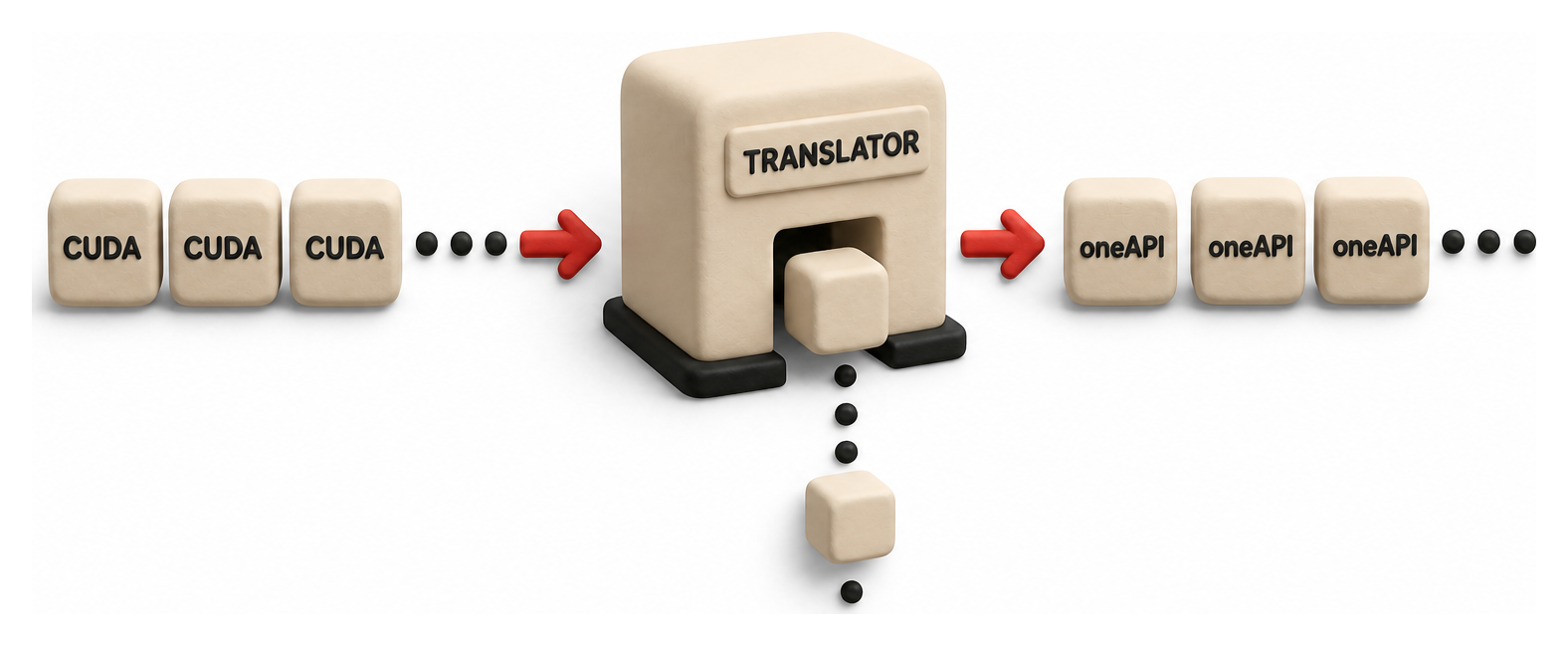
Whether that migration promise translates into real-world adoption is contested. Independent technical commentary on the broader SYCL and oneAPI effort has been more skeptical, arguing that "CUDA didn't win because it was the absolute best in terms of raw performance. It won because NVIDIA built an ecosystem that eliminated friction for developers," and that open alternatives have historically suffered from "committee-driven development" that leaves them perpetually playing catch-up on new hardware features. Tom's Hardware, reviewing Crescent Island's Computex 2026 disclosures, echoed this concern directly for Intel's GPU line specifically, noting that "oneAPI is far less widely adopted than CUDA or ROCm" [24], placing it behind both Nvidia's proprietary stack and AMD's increasingly mature ROCm platform in developer mindshare.
Intel's practical response has been to decouple software validation from hardware availability. Rather than waiting for Crescent Island silicon, the company is "currently being developed and tested on Arc Pro B-Series GPUs to enable early optimizations and iterations" [1], which lets driver, runtime, and inference-serving integrations mature on shipping hardware. That hardware is real and already selling: the Arc Pro B70 launched with "32 Xe2 cores and a 256-bit memory interface that wires the big Battlemage GPU up to 32GB of GDDR6 memory running at 19Gbps" [23] [1], retailing at "$949" for Intel's own card [23], well below the roughly $2,000 Intel says its closest Nvidia competitor costs [23]. Phoronix similarly noted that Crescent Island's confirmation "does lead to more weight for the ongoing Project Battlematrix Linux driver improvements and other ongoing Intel Compute Runtime and Intel Xe Linux driver enhancements" already underway for the Arc Pro B-Series [20].
Beyond raw kernel-level compatibility, orchestration matters increasingly for disaggregated inference, the exact use case Crescent Island targets. The Register reported that "Intel has suggested that Nvidia Dynamo was coming to the platform" [4], referring to Nvidia's open-source framework for splitting prefill and decode operations across heterogeneous hardware, a notable signal that Intel is not trying to build a fully closed inference stack but rather to plug Crescent Island into an increasingly standardized, multi-vendor orchestration layer. The same reporting noted an alternative path: "there is no reason that Intel couldn't use something like LLMd, the open source, open vendor contemporary to Dynamo, to combine its own GPUs with SambaNova RDUs instead" [4], underscoring that Intel's actual go-to-market path for Crescent Island may run through its Xeon-and-SambaNova disaggregated inference partnership rather than a standalone card sold in isolation.
Deployment Guidance: Who Should Evaluate Crescent Island
Given the specification profile above, Crescent Island is best evaluated by three categories of buyer, and poorly suited to a fourth.
Tokens-as-a-service and inference cloud operators running large, sparse mixture-of-experts models where the model's active parameters or KV cache exceed the memory of a single HBM-based GPU are the clearest fit. Intel's own framing calls out this audience explicitly, describing the card as "ideal for 'tokens-as-a-service' providers and inference use cases" [1]. For these buyers, the ability to keep a large model resident on a single 480GB card, rather than sharding it across multiple smaller-memory GPUs, can simplify serving architecture even if per-token latency is higher.
Enterprises building disaggregated prefill/decode pipelines represent a second potential fit. NVIDIA's public materials describe disaggregated serving and list Groq 3 LPX in its March 2026 Vera Rubin roadmap, but do not establish Rubin CPX's final product status [19] [25]. Because prefill operations are, in The Register's words, "mostly compute bound, which means you can get away with using slower GDDR or LPDDR memory rather than pricy HBM" [4], Crescent Island's memory profile could theoretically slot into the prefill role in a heterogeneous pipeline, paired with faster, more expensive accelerators for decode, mirroring the architecture Intel and SambaNova have already demonstrated, which the companies describe as combining "GPUs for prefill, SambaNova RDUs for high throughput decode, and Intel Xeon 6 processors as the host and action CPUs" [17].
Organizations already standardized on Intel infrastructure who value single-vendor procurement and support relationships, and who are willing to accept a roughly one-year lag behind Nvidia and AMD's competing 2026 launches in exchange for that consolidation, form a third viable buyer profile, particularly given Intel's parallel investment in Xeon-based disaggregated inference racks that reached "production-ready rack-scale infrastructure" status with SambaNova and Foxconn by mid-2026 [14].
Conversely, buyers with latency-sensitive, high-concurrency, or training workloads should look elsewhere. Intel has published no compute throughput figures, meaning any organization whose workload is compute-bound rather than memory-bound has no public data to justify a purchasing decision. Sentiment among early observers on Reddit reflects this uncertainty. One commenter on r/LocalLLM framed the entire question as one of pricing rather than capability: "This could be amazing. It will all depend on the price and whether customers stand a reasonable chance of buying it" [29]. A reply argued that "the closest competition to a 'drop this in any rig with an open expansion slot and it's an AI powerhouse' is like $10k currently. I bet Intel will find a way to come in much cheaper, but I'd be shocked if this was cheaper than a 5090" [29]. Another summarized the community's overall skepticism succinctly: "As usual no bad product. Just bad pricing. I hope this will be a 'good' product" [29], reflecting a broader wait-and-see posture pending pricing and benchmarks that remain undisclosed as of July 2026.
Data Analysis and Evidence
Four datasets frame the commercial context Crescent Island is entering: the AI accelerator market structure, Intel's own financial trajectory, the memory pricing environment that directly affects Crescent Island's bill of materials, and the broader hyperscaler revenue backdrop driving all of this investment.
Market share. Independent analyst estimates place Nvidia's 2026 AI accelerator revenue share at "an estimated 75% to 81% of AI accelerator revenue in 2026, based on Silicon Analysts and IDC estimates," with AMD's Instinct line generating "an estimated $7 to $8 billion in 2025, roughly 5% to 7% of the market," and Intel's share estimated near 1%, "most of it from CPUs, not GPUs" [13]. The same analysis pegs the overall "2026 data center accelerator market exceeds $200 billion, per Silicon Analysts" [13]. Nvidia's own reported figures corroborate the scale of that dominance directly: the company posted "Record Data Center revenue of $75.2 billion, up 92% from a year ago" in its most recently reported quarter [30], of which "Data Center compute revenue was a record $60.4 billion, up 77% from a year ago" and "Data Center networking revenue was a record $14.8 billion, up 199% from a year ago" [30], a single quarter roughly ten times the size of Intel's total DCAI segment.
Intel's financial trajectory. Despite its minimal AI GPU share, Intel's Data Center and AI (DCAI) business unit is growing quickly off a low base, posting revenue of "6.3 billion" dollars, "up 59%" year over year in the second quarter of 2026 [14], against total company revenue of "$16.1 billion, up 25% year-over-year" [14]. CNBC reported that Intel's "revenue jumped 25%, the most robust growth for any period since the third quarter of 2011" [15], and quoted CFO David Zinsner acknowledging the company is capacity constrained: Intel "had reached 10 long-term agreements," with data center customers "demanding more than it can produce" [15]. Zinsner added that "Customers continue to signal a strong and sustainable spending environment" on the earnings call [15]. Notably, CNBC also reported that Intel "expects flat PC sales in the third quarter because of the memory shortage" [15], the same LPDDR5X-adjacent supply crunch that directly affects Crescent Island's bill of materials. That DCAI growth, however, is disclosed as a blended figure covering Xeon server CPUs alongside any AI accelerator revenue [14], and Intel does not break out Gaudi or (once shipping) Crescent Island revenue separately, making it impossible to isolate how much of that 59% growth reflects AI accelerator demand specifically versus the broader Xeon 6+ server refresh.
Memory pricing. This is directly material to Crescent Island's eventual economics because Intel describes the design as cost-optimized, but has not published pricing or a component-cost comparison with HBM-based accelerators. TrendForce's most recent formal forecast, however, shows that assumption under pressure: "Contract prices for LPDDR4X and LPDDR5X are both expected to surge by around 90% QoQ in 1Q26, also representing the steepest increases in their history" [11], part of a broader move in which "conventional DRAM contract prices has been revised upward, from a previous estimate of 55-60% to now 90-95%" quarter over quarter [11]. CNBC separately reported TrendForce's assessment that "it expects average DRAM memory prices to rise between 50% and 55% this quarter versus the fourth quarter of 2025," with the analyst calling the increase "unprecedented" [31]. IDC's own analysis frames the root cause as structural, not cyclical: "every wafer allocated to an HBM stack for an Nvidia GPU is a wafer denied to the LPDDR5X module of a mid-range smartphone or the SSD of a consumer laptop," and forecasts "2026 DRAM... supply growth be below historical norms at 16% year-on-year" [12]. The downstream effects are already visible in device pricing: IDC reports that PC vendors "Lenovo, Dell, HP, Acer and ASUS have warned clients of tougher conditions ahead, confirming 15-20% hikes and contract resets as an industry-wide response" [12]. Micron's Sadana told CNBC the industry is "sold out for 2026" [31], meaning Crescent Island's 2026/2027 delivery window will land in the tightest LPDDR5X supply environment on record, a scarcity IDC separately projects will persist as "2026 DRAM... supply growth" stays "below historical norms at 16% year-on-year" [12]. This creates uncertainty for Crescent Island’s eventual economics. Intel has not published pricing, a bill-of-materials comparison, or comparable performance data, so any cost comparison with HBM-based alternatives remains unverified.
Table 2 below aggregates the AI accelerator market share and memory pricing figures discussed above into a single reference view.
| Metric | Figure | Source / As of |
|---|---|---|
| Nvidia AI accelerator revenue share, 2026 | 75% to 81% (est.) | Silicon Analysts / IDC via commandlinux.com, 2026 [13] |
| AMD AI accelerator revenue share, 2026 | 5% to 7% (est.) | Silicon Analysts via commandlinux.com, 2026 [13] |
| Total 2026 data center accelerator market | >$200 billion | Silicon Analysts via commandlinux.com, 2026 [13] |
| Nvidia Data Center revenue, most recent quarter | $75.2 billion, up 92% YoY | Nvidia, Q1 FY2027 [30] |
| Intel DCAI revenue, most recent quarter | $6.3 billion, up 59% YoY | Intel, Q2 2026 [14] |
| Intel Foundry revenue, most recent quarter | $5.8 billion, up 31% YoY | Intel, Q2 2026 [14] |
| LPDDR5X contract price surge, 1Q26 | ~90% QoQ | TrendForce, February 2026 [11] |
| 2026 DRAM supply growth forecast | 16% YoY (below historical norms) | IDC, 2026 [12] |
| Intel stock performance, 2026 year to date | Up over 170% | CNBC, July 2026 [15] |
Taken together, the data paints a picture of a company (Intel) betting on a memory technology (LPDDR5X) at exactly the moment that technology is experiencing its steepest price inflation on record, in order to compete in an accelerator market so dominated by a single rival (Nvidia) that even a successful launch would likely move Intel's overall market share by less than a percentage point in the near term. The price surge does not by itself determine Crescent Island’s competitiveness, but it makes any cost-advantage conclusion premature until Intel publishes pricing and comparable performance data.
Case Studies and Real-World Examples
Because Crescent Island itself has not shipped as of July 2026, no customer has deployed the chip in production. The following cases instead document the surrounding ecosystem, Intel's software validation partners, its system-level inference partnerships, and its direct competitors' early deployments, that will shape how Crescent Island is received when it does arrive.
Intel and SambaNova's Disaggregated Inference Blueprint
In February 2026, Intel Capital participated in a $350 million Series E funding round for AI chip startup SambaNova, alongside lead investors Vista Equity Partners and Cambium Capital. Reuters reported that "SambaNova Systems said on Tuesday it has raised $350 million in a new funding round and struck a partnership with Intel as it seeks to capitalise on surging demand for inference chips used in artificial intelligence applications" [16]. CRN reported the commercial thrust of the deal: SambaNova "plans to tap into Intel's 'global enterprise, cloud and partner channels' to drive sales of joint offerings for 'cloud-scale AI inference'" [32]. Notably, this partnership followed stalled talks over an outright Intel acquisition of SambaNova, with CRN reporting the deal was struck "after acquisition talks between the two companies recently ended" [32], with the companies settling on a technology and go-to-market partnership instead. By July 2026, SambaNova had grown further, raising "$1 billion in a late-stage funding round led by General Atlantic at an $11 billion post-money valuation" [33], a sign that Intel's inference-partnership strategy attached itself to a well-capitalized, fast-growing partner. Intel's own architecture announcement confirmed the joint design: "The design will combine GPUs for prefill, SambaNova RDUs for high throughput decode, and Intel Xeon 6 processors as the host and action CPUs" [17], directly foreshadowing the role Crescent Island itself could eventually fill once it ships, likely alongside or in place of the third-party GPUs currently used for prefill. Intel Data Center Group Executive Vice President Kevork Kechichian framed the rationale in ecosystem terms: "The data center software ecosystem is built on x86, and it runs on Xeon, providing a mature, proven foundation that developers, enterprises, and cloud providers rely on at scale" [17].
The Xeon 6+ Rack-Scale Reference Design with Foxconn (Vector Core Compute and Together.AI)
At Computex 2026, Intel, working with Foxconn and other infrastructure providers, unveiled rack-scale reference designs supporting "up to 128 of either Intel's 128-core Granite Rapids Xeon 6 or 288-core Clearwater Forest Xeon 6+ processors, totaling between 16,384 P-cores and 36,864 E-cores, alongside up to 384 TB of DDR5 in a 100kW power envelope" [18]. On stage, Intel CEO Lip-Bu Tan explained the motivation: "Our customers are asking us to think at the system level to help them serve real agentic workloads at scale" [18]. Unlike the prior hypothetical use cases discussed in this report, this design already has named commercial deployment: The Register reported that "newly launched inference cloud provider Vector Core Compute will be among the first to deploy the platform, and that Together.AI is its first commercial customer" [18]. The disaggregated architecture underlying this deployment "desegregates compute heavy prefill operations to Nvidia GPUs while using SambaNova's AI accelerators for bandwidth-intensive decode operations to boost per-user token output by between 2-3x" [18]. Intel's own Q2 2026 financial disclosure independently confirmed this milestone had moved from demonstration to production readiness: "Intel, SambaNova and Foxconn demonstrated production-ready rack-scale infrastructure for inference and agentic workloads, while Vector Core Compute (VC2) unveiled a disaggregated agentic cloud combining Intel Xeon processors, SambaNova RDUs and NVIDIA Blackwell GPUs" [14]. This case is instructive precisely because it shows Intel's current production deployment uses Nvidia GPUs, not Intel's own accelerators, for the prefill role Crescent Island is designed to eventually fill, underscoring how far Crescent Island still is from displacing incumbent hardware even within Intel's own reference architectures.
Intel Arc Pro B70: The Software Proving Ground
Because no Crescent Island silicon exists in customer hands as of July 2026, the Arc Pro B70 workstation card offers the closest real-world preview of the software stack Crescent Island will inherit, the same platform Intel says "is currently being developed and tested on Arc Pro B-Series GPUs to enable early optimizations and iterations" [1]. Launched by Intel in March 2026, the card pairs "32 Xe2 cores" with "32GB of GDDR6 memory" [23], rated at "367 TOPS, versus 197 TOPS for its extant Arc Pro B60" [23], with a flexible "160-290W" power envelope that board partners can tune [23]. In its own marketing materials, Intel directly compared the card to Nvidia's RTX PRO 4000 Blackwell, claiming that "because Intel's GPU has 25% more memory onboard, it can apparently support a significantly larger context window with the Llama 3.1 8B language model" [23], an early rehearsal of the exact "more memory beats more bandwidth" argument Crescent Island will need to make at data center scale. HotHardware, reviewing the launch, cautioned that "we're surprised not to see a single 3D or HPC benchmark of any kind in Intel's materials" [23], the same benchmark gap that recurs across every Crescent Island disclosure to date. This pattern, favorable memory-capacity comparisons paired with an absence of independently verified throughput data, is likely to repeat when Crescent Island itself reaches customer hands.
Rubin CPX and the NVIDIA Groq 3 LPX Roadmap
NVIDIA's evolving public roadmap for Rubin CPX and Groq 3 LPX is relevant context for Crescent Island's target niche, but it does not establish that Rubin CPX was canceled. Nvidia unveiled Rubin CPX on September 9, 2025, describing it as "a new class of GPU purpose-built for massive-context processing" [9] with "up to 30 petaflops of compute with NVFP4 precision" and "128GB of cost-efficient GDDR7 memory," slated for availability "at the end of 2026" [9]. NVIDIA’s later materials describe the Groq 3 LPX architecture, but they do not state that it replaced Rubin CPX or that NVIDIA acquired Groq [34]. The company's Vera Rubin GTC materials confirm the replacement architecture, "NVIDIA Groq 3 LPX," a rack-scale accelerator built around "256 interconnected NVIDIA Groq 3 LPU accelerators" offering "315 PFLOPS" of AI inference compute, "128 GB" of total SRAM capacity, "40 PB/s" of on-chip SRAM bandwidth, and "640 TB/s" of scale-up bandwidth at rack scale [34]. The system operates around "150 TB/s of on-chip memory bandwidth with high bandwidth scale-up chip-to-chip (C2C) communication per LPU" [34], a materially different architecture, SRAM-first rather than DRAM-capacity-first, optimized for latency-sensitive decode rather than memory-bound prefill. The lesson for evaluating Crescent Island is twofold: first, that even Nvidia, with vastly greater engineering resources, concluded a dedicated GDDR-based prefill chip was not the optimal answer to the disaggregated-inference problem once a lower-latency SRAM alternative became available; and second, that the market segment Crescent Island targets remains genuinely open, since Nvidia's own Ian Buck reportedly signaled the CPX concept "was still a good idea and we may see the concept resurface in future generations" [4], meaning Intel could face renewed direct competition in this niche well before Crescent Island's 2027 broad availability.
(Hypothetical Example) A Regional Cloud Provider Evaluating LPDDR5X Inference Economics
To illustrate how the specifications discussed in this report might translate into a purchasing decision, consider a hypothetical mid-sized regional cloud provider serving open-weight mixture-of-experts models to enterprise customers under 2027 procurement budgets. Such a provider, facing HBM-based GPU costs inflated by the memory shortage documented above, might model total cost of ownership for a 480GB Crescent Island card against splitting the same workload across multiple smaller-memory HBM GPUs. Because Intel has disclosed no pricing and no throughput benchmarks as of July 2026, this remains a purely illustrative exercise: a real procurement decision would require Intel to publish tokens-per-second and tokens-per-dollar figures, alongside firm pricing, neither of which exists in the public record at the time of writing. This hypothetical is included to underscore, not obscure, the genuine information gap facing prospective Crescent Island buyers today.
Implications and Future Directions
Crescent Island's arrival signals three broader shifts worth tracking through 2026 and 2027. First, it confirms that memory capacity has become a distinct competitive axis from memory bandwidth in AI accelerator design, rather than a single scalar quantity vendors simply try to maximize. NVIDIA's March 2026 materials position Groq 3 LPX alongside the Vera Rubin platform, while Rubin CPX is absent from those materials; that supports a qualified observation of a product-strategy shift, not a confirmed pivot or cancellation. AMD validated it with the MI430X's lower-bandwidth, capacity-focused HPC variant, and Intel is now betting its entire re-entry into data center GPUs on the capacity side of that split [25]. Buyers should expect this bifurcation, compute-and-bandwidth-optimized chips for decode and training, capacity-and-cost-optimized chips for prefill and memory-resident inference, to become a standard axis of accelerator marketing and benchmarking, not a one-off Intel experiment, especially as AMD itself moves to "an annual refresh cycle for its Instinct products" [8], signaling that specialization cycles across the industry are compressing rather than lengthening.
Second, the memory supply chain has become a direct strategic input to AI chip roadmaps, not merely a bill-of-materials line item. With TrendForce projecting roughly 90% quarterly surges in LPDDR5X and conventional DRAM contract prices [11] and IDC describing a "potentially permanent, strategic reallocation of the world's silicon wafer capacity" toward HBM [12], Crescent Island’s eventual economics are exposed to memory-market volatility. Intel has not published pricing or a component-cost comparison, so neither a cost advantage nor the relative sensitivity of HBM-based competitors can be established. Any organization evaluating Crescent Island's economics in 2027 should model memory pricing at delivery time, not at announcement time.
Third, Intel's re-entry strategy is explicitly systems-first, not chip-first. The SambaNova partnership, the Xeon 6+ rack-scale reference designs with Foxconn, and the Arc Pro B-Series software validation program all predate Crescent Island silicon itself, suggesting Intel is trying to build the surrounding orchestration, software, and channel relationships before betting everything on a single chip's specifications. This mirrors, deliberately or not, the same disaggregated, heterogeneous-hardware philosophy Nvidia is pursuing with Dynamo, Groq, and Vera Rubin, a platform Nvidia says now has "seven new chips now in full production" [10], and AMD is pursuing with its own Helios rack-scale platform. If this pattern holds, Crescent Island's eventual market reception may depend as much on how well it slots into these system-level architectures as on its standalone specifications. The "Xe Next" placeholder already visible on Intel's internal roadmap [21] further suggests Intel views Crescent Island as the first entry in a sustained cadence, not a one-off product, a signal that matters for buyers weighing long-term platform commitments over single-generation purchases. That cadence will need continued capital: Intel's own Q2 2026 disclosure notes the company is "meaningfully increasing our investments in equipment, clean room space, and substrates" to support both products and foundry growth [14].
Frequently Asked Questions (FAQs)
What is Intel Crescent Island? Crescent Island is the codename for an Intel data center GPU built on the Xe3P microarchitecture and optimized for AI inference workloads. Intel’s reference design has 160GB of LPDDR5X memory, while board-partner configurations have been reported at up to 480GB [1] [2].
What are Intel Crescent Island's specs? The reference design carries 160GB of LPDDR5X memory, up to 480GB in board-partner configurations, a 350W air-cooled TDP, a PCIe form factor, and support for data types from FP4 to FP64 [1] [3] [2]. Compute throughput (FLOPS) has not been disclosed as of July 2026.
When is the Intel Crescent Island release date? Customer sampling is planned for the second half of 2026, with broader availability expected in 2027 [2]. Phoronix's original coverage cautioned it would "actually ship more broadly in 2027 but just noting their customer sampling for H2'2026 in the embargoed news release" [20].
What is the Xe3P architecture? Xe3P is a performance-per-watt optimized variant of Intel's Xe3 graphics architecture, the same base architecture used in Panther Lake's integrated GPUs, adapted for data center inference workloads rather than client graphics [2] [1].
How does Crescent Island compare to Nvidia Rubin? Nvidia's Rubin GPU offers 288GB of HBM4 at 22 TB/s of bandwidth [7], far outpacing Crescent Island’s unconfirmed estimates, which range from 684 GB/s to roughly 1.2–1.5 TB/s, while trailing its 480GB maximum capacity. Rubin is a general-purpose training-and-inference GPU already in full production [10], while Crescent Island is inference-only and roughly a year behind on availability.
How does Crescent Island compare to AMD MI400? AMD's MI455X offers 432GB of HBM4 and up to 40 PFLOPS of FP4 compute [8], available "from day one" of a 2026 launch window [8], while Crescent Island's compute figures remain entirely undisclosed.
What is a 480GB LPDDR5X AI GPU used for? Large memory capacity per card can let a single accelerator hold larger models or KV caches resident in memory without sharding across multiple GPUs. In disaggregated LLM serving, prefill is generally compute-bound, while decode is generally memory-bound; the value of extra capacity depends on the model and serving configuration [19] [1].
What is Crescent Island's inference performance? Intel has not disclosed compute throughput, end-to-end inference latency, or tokens-per-second figures for Crescent Island as of July 2026 [2]; available data suggest only memory, power, and form-factor specifications have been confirmed to date.
What is Intel's data center GPU roadmap after Crescent Island? Intel has shown an internal roadmap slide labeling the step after Xe3P as "Xe Next" [21], and separately named "Jaguar Shores" as its first "generally programmable" GPU AI accelerator for customers, following the internal-only Falcon Shores chip [21].
Is Crescent Island related to Intel's Gaudi accelerators? No; Gaudi 3 is a separate, ASIC-derived accelerator line that Intel used the same October 2025 OCP Global Summit [1] to promote alongside Crescent Island's unveiling with "additional Gaudi 3 rack-scale reference designs" [20], but Gaudi 3 missed its own $500 million 2024 revenue target [13], and Crescent Island represents a distinct, Xe-architecture-based approach rather than a direct Gaudi successor.
Can I buy an Intel GPU with similar memory capacity today? Not at data center scale. The closest available product as of July 2026 is the Arc Pro B70 workstation card, which ships with 32GB of GDDR6 memory and retails for $949 [23], a small fraction of Crescent Island's 160GB to 480GB range, and part of the same software validation effort Intel says "is currently being developed and tested on Arc Pro B-Series GPUs" [1] rather than a substitute for the data center part.
Conclusion
Intel's Crescent Island is, as of July 2026, a well-defined memory strategy attached to an unproven chip. Intel has disclosed a 160GB LPDDR5X reference design, Xe3P, and a second-half-2026 customer-sampling target, while subsequent reporting describes higher board-partner memory configurations and a 350W air-cooled PCIe design. Intel positions the GPU as power- and cost-optimized for inference, but has not published pricing, a component-cost comparison, or performance data sufficient to establish its eventual economics or workload fit [1]. NVIDIA's public March 2026 materials establish only that Groq 3 LPX was added to the Vera Rubin roadmap while Rubin CPX was absent; they do not confirm a CPX cancellation, replacement, or acquisition. In disaggregated LLM serving, prefill is generally compute-bound and decode generally memory-bound, so any benefit from Crescent Island’s capacity must be assessed against the model and serving configuration [25] [19].
What remains unproven is execution. Intel has published no compute throughput figures, no pricing, and no independently verified benchmarks for Crescent Island, leaving every comparison in this report anchored to memory specifications and power envelopes rather than measured performance. The chip also arrives into a historically adverse memory pricing environment, with LPDDR5X contract prices surging roughly 90% quarter over quarter as of early 2026, and into a market so lopsided that Nvidia alone books more data center revenue in a single quarter than Intel's entire company generates in two. Intel's parallel bets, the SambaNova partnership, the Xeon 6+ disaggregated inference racks already running commercial workloads for Together.AI and Vector Core Compute, and the software validation work already underway on Arc Pro B-Series GPUs, suggest the company understands that Crescent Island's success depends on more than a single chip's specification sheet. For buyers, the practical guidance is straightforward: Crescent Island is worth tracking closely through its second-half-2026 sampling phase and 2027 availability window, but any procurement decision made before Intel publishes real throughput and pricing data would be speculative rather than evidence-based.
External Sources (34)
About
GPUSmith
Plan and build private AI compute with GPU Smith. We connect workload requirements with GPU hardware, networking, deployment and operating decisions so your infrastructure fits the work it must perform.
GPU Smith provides independent engineering and research for private AI infrastructure. We help technical buyers and operators reason about GPU workload sizing, hardware selection, procurement, deployment and inference operations, from the compute system to the networking, power and cooling requirements around it.
Start with the workload
Useful infrastructure decisions begin with the models, data, throughput, latency and operating constraints a team actually has. GPU Smith helps connect those requirements with system design and deployment choices. The goal is a privately controlled AI environment whose capacity and operational demands are understood before a purchasing decision.
Hardware and supplier research
Our public reference library covers GPUs, complete systems and networking components. The server-vendor directory and manufacturing research help teams investigate suppliers, compare options and follow sources behind technical claims. We distinguish manufacturer specifications from measured benchmarks and advertised capabilities from tested configurations. Reference pages are research resources, not a live inventory listing or a binding equipment quote.
Deployment and operations
GPU Smith's engineering scope includes infrastructure integration, networking, power, cooling and the practical operation of inference workloads. Our published articles explain the tradeoffs behind deployment, procurement and ongoing operations so teams can ask better questions and document decisions.
Work with GPU Smith
Explore the hardware library, GPU references, networking references and vendor research. Contact GPU Smith with your workloads and deployment constraints to discuss a project and confirm current scope, pricing and availability.
Inclusion of a manufacturer or product in our research does not imply a partnership, certification or endorsement.
Disclaimer
This document is provided for informational purposes only. No representations or warranties are made regarding the accuracy, completeness, or reliability of its contents. Any use of this information is at your own risk. GPUSmith shall not be liable for any damages arising from the use of this document. This content was generated with assistance from artificial intelligence tools, which may contain errors or inaccuracies. Readers should verify critical information independently. All product names, trademarks, and registered trademarks mentioned are property of their respective owners and are used for identification purposes only. Use of these names does not imply endorsement. This document does not constitute professional or legal advice. For specific guidance related to your needs, please consult qualified professionals.