GPUSmith Article
Is Kaytus on the Entity List? Inspur's Rebrand Explained
Inside this article
- 01Executive Summary
- 02Introduction and Background
- 03Kaytus, Aivres, and the Corporate Lineage Behind the Inspur Brand Family
- 04The US Entity List: What Is Actually Listed, and What Is Not
- 05The BIS "50 Percent" Affiliates Rule and Its Suspension
- 06Procurement Compliance: Can US Companies Buy Kaytus, Aivres, or Inspur Servers?
- 07Data Analysis and Evidence
- 08Case Studies and Real-World Examples
- 09Implications and Future Directions
- 10Conclusion
- 11Frequently Asked Questions (FAQs)
Executive Summary
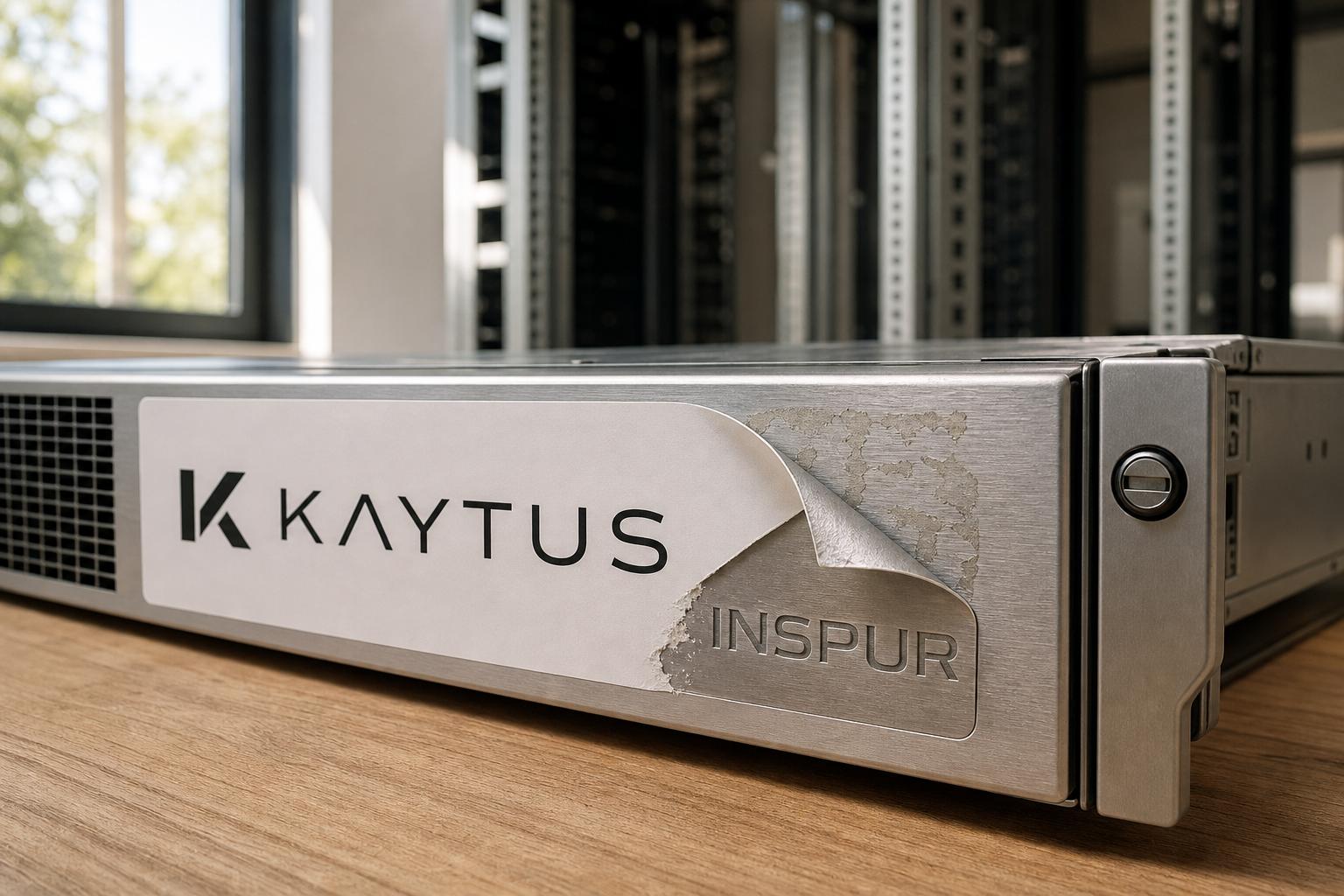
Kaytus is not named, on its own, anywhere on the United States Department of Commerce's Entity List, the Bureau of Industry and Security (BIS) roster that requires a license before controlled American technology can be exported to a listed party [1]. That narrow, literal answer, however, sits inside a much wider web of restrictions that make the practical answer far less reassuring for buyers. Kaytus Systems Pte. Ltd. (formerly KAYTUS Singapore Pte. Ltd.) and its sister brand Aivres Systems Inc. (formerly Inspur Systems, Inc.) are, according to a 2024 federal patent lawsuit, "wholly-owned indirect subsidiaries" of IEIT Systems Co., Ltd., the entity long known as Inspur Electronic Information Industry Co., Ltd. or Inspur Information [2]. IEIT Systems itself was added to the Entity List on March 25, 2025, alongside five other Inspur Group affiliates, for contributions to Chinese military supercomputing [3] [4]. Its parent, Inspur Group Co., Ltd., has been on the Entity List since March 2, 2023 [5] [6].
The Kaytus and Aivres brand names exist, in large part, because of that 2023 listing. A federal complaint filed by Hewlett Packard Enterprise (HPE) in April 2024 alleges that Inspur "changed the name of at least one entity that places Accused Products into the stream of commerce in the United States" shortly after being blacklisted, renaming Aivres from Inspur Systems on May 1, 2023, and renaming a related asset-holding company Betapex on September 18, 2023 [7] [8]. That lawsuit settled and was dismissed with prejudice on April 1, 2025, after 351 days of litigation, on undisclosed financial terms [9].
Whether that subsidiary status actually restricts a purchase from Kaytus or Aivres today turned, until late 2025, on a regulatory question that has since flipped twice. On September 29, 2025, BIS adopted the "Affiliates Rule," which would have automatically applied Entity List restrictions to any foreign company owned 50 percent or more, directly or indirectly, by a listed parent, which would clearly capture Kaytus and Aivres given their ownership by IEIT Systems [10]. Six weeks later, as part of a broader US-China trade agreement, BIS suspended that rule for one full year, from November 10, 2025, to November 9, 2026 [11]. As of this report's July 16, 2026 publication date, the rule remains suspended, meaning Kaytus and Aivres are not automatically restricted purely by ownership, though BIS guidance still warns that transacting with a subsidiary that acts as "an agent, a front, or a shell company" for a listed parent can itself violate export controls [12].
This report traces that lineage in full: how Inspur Group, IEIT Systems, Aivres, Betapex, Kaytus, and Inspur USA relate to one another; what the Entity List does and does not cover; why the Affiliates Rule matters and why it is currently paused; and how buyers evaluating Kaytus servers for procurement should structure due diligence. It places Kaytus and Aivres in context against comparable cases, including Huawei's server spinoff xFusion, the 2019 Sugon-to-Nettrix rename, and the 2025 investigation into Aivres's role supplying the Singapore-based reseller Megaspeed, which allegedly routed billions of dollars of Nvidia hardware toward China [13]. It also draws on IDC's Worldwide Quarterly Server Tracker, which recorded IEIT Systems (Inspur's Chinese entity) holding a 3.7 percent global server revenue share in the third quarter of 2025, even as its revenue fell 10.5 percent year over year while the overall market grew 61 percent [14]. The bottom line for procurement teams: Kaytus is not literally on the Entity List, but it is one ownership layer removed from two entities that are, and the regulatory shield protecting that distinction is scheduled to disappear on November 10, 2026 unless BIS extends the suspension again.
Introduction and Background
The question "is Kaytus on the entity list" surfaces most often among data center buyers, export compliance officers, and IT procurement teams evaluating server hardware from a company whose name did not exist before 2023. Kaytus is the commercial brand used internationally, primarily outside mainland China, for a server and AI infrastructure product line manufactured within the corporate structure of Inspur, China's largest domestic server maker [8] [15]. Its sibling brand in the United States, Aivres, sells rack, tower, and liquid-cooled AI servers built around NVIDIA and AMD accelerators from a demonstration center in Milpitas, California [16].
The Entity List itself is a supplement to the Export Administration Regulations (EAR), maintained by BIS, that names foreign parties who require a specific license, reviewed under varying degrees of scrutiny up to a "presumption of denial," before receiving items subject to US export jurisdiction [1]. Being added to the Entity List does not make a company illegal to buy from in the ordinary retail sense; rather, it restricts US-based and, in many cases, foreign companies from exporting or reexporting controlled American technology, software, or foreign-made items containing controlled US content, to that listed party without government authorization.For hardware buyers, the practical consequence is usually that the listed company can no longer legally obtain the Intel, AMD, or Nvidia silicon that its servers are built around, at least not through authorized US channels, since listed entities such as Inspur Group and IEIT Systems face a license requirement covering "all items subject to the EAR" under a "policy of denial" review standard [3].
Inspur Group Co., Ltd. was added to the Entity List on March 2, 2023, alongside 4Paradigm Technology Co. and Loongson Technology, for "acquiring and attempting to acquire U.S.-origin items in support of the China's military modernization efforts" [6]. Two years later, on March 25, 2025, six additional Inspur Group subsidiaries, including the entity known internationally as IEIT Systems, joined the list for "contributions to Inspur's development of supercomputers for military end use" [3]. Neither round of additions named "Kaytus," "Aivres," or "Betapex" individually [2]. Those three brand names surface instead in a different federal record: a 2024 patent infringement lawsuit in which Hewlett Packard Enterprise alleged that Inspur restructured its US and Singapore sales operations, in part, to keep selling servers in America despite the 2023 blacklisting [7]. This report works through both records methodically, so buyers can see precisely where the Entity List's literal boundary sits and where the reputational and regulatory risk actually extends beyond it.
Kaytus, Aivres, and the Corporate Lineage Behind the Inspur Brand Family
Understanding whether Kaytus is subject to export restrictions requires untangling a corporate structure that spans China, Hong Kong, Singapore, and California. At the top sits Inspur Group Co., Ltd., a Jinan, Shandong-headquartered conglomerate founded in 1983 and listed on the Shanghai, Shenzhen, and Hong Kong stock exchanges, with businesses spanning cloud computing, big data, enterprise resource planning software, and servers [5]. Inspur Group owns roughly one third of Inspur Electronic Information Industry Co., Ltd., the entity that trades internationally under the names IEIT Systems and Inspur Information [17]. IEIT Systems, in turn, wholly owns the US company that sells servers under the Aivres name [17], and, per sworn allegations in HPE's federal complaint that the presiding judge treated as adequately pleaded for jurisdictional purposes, also wholly owns the Singapore-registered Kaytus entity and a second California holding company called Betapex [2].
The renaming history matters because it is documented under oath rather than asserted informally. HPE's complaint, filed April 15, 2024 in the US District Court for the Northern District of California, names as defendants "Inspur Group Co., Ltd.," a Chinese corporation; "IEIT Systems Co., Ltd.," also known as Inspur Electronic Information Industry Co., Ltd. and Inspur Information; "Aivres Systems Inc.," a California corporation "formerly known as Inspur Systems, Inc."; "Betapex Inc.," a California corporation "formerly known as Inspur Asset Holdings, Inc."; "Inspur USA Inc.," registered as a foreign corporation in California; and "KAYTUS Singapore Pte. Ltd.," a Singapore corporation "now known as Kaytus Systems PTE. LTD." [2]. Table 1 below summarizes how each of these entities maps onto its predecessor name, its jurisdiction, and its current relationship to the Entity List.
Table 1: Inspur-Linked Entities, Renames, and Entity List Status (as of July 2026)
| Current Brand or Entity Name | Predecessor Name | Jurisdiction | Individually Entity Listed? | Relationship to Listed Parent |
|---|---|---|---|---|
| Inspur Group Co., Ltd. | Inspur Group | China (Jinan, Shandong) | Yes, since March 2, 2023 [6] | Ultimate parent; owns approximately one third of IEIT Systems |
| IEIT Systems Co., Ltd. (Inspur Electronic Information Industry / Inspur Information) | Same legal entity, multiple trade names | China | Yes, since March 25, 2025 [3] | Subsidiary of Inspur Group; parent of Aivres, Betapex, and Kaytus |
| Aivres Systems Inc. | Inspur Systems, Inc. (renamed May 1, 2023) | California, USA | No | Wholly owned indirect subsidiary of IEIT Systems [2] |
| Betapex Inc. | Inspur Asset Holdings, Inc. (renamed September 18, 2023) | California, USA | No | Wholly owned indirect subsidiary of IEIT Systems |
| Kaytus Systems Pte. Ltd. | KAYTUS Singapore Pte. Ltd. | Singapore | No | Wholly owned indirect subsidiary of IEIT Systems |
| Inspur USA Inc. | Same legal entity | Foreign corporation registered in California | No | Named in the 2024 HPE suit but voluntarily dismissed without prejudice on September 9, 2024 [2] |
The table shows a consistent pattern: the two entities holding legal title to the "Inspur" name (the Group and IEIT Systems) are the two that carry Entity List designations, while the three downstream operating brands that customers actually transact with (Aivres, Betapex, and Kaytus) do not appear on the list by name. HPE's complaint alleges this structure is not incidental. It states that Inspur "changed the name of at least one entity that places Accused Products into the stream of commerce in the United States and in this judicial district shortly after being placed on the Entity List, renaming Defendant Aivres from Inspur Systems, Inc. to Aivres Systems, Inc. on May 1, 2023" [7], and that Betapex changed its name from Inspur Asset Holdings "due to the placement of Defendant Inspur Group on the entity list and the negative press coverage that followed thereafter" [7]. HPE further alleged that Aivres's KR2280-X2 server "is identical to KAYTUS' KR2280V2 server product," except for cosmetic branding differences [8], reinforcing that Kaytus and Aivres function as regionally branded outputs of the same underlying hardware design and manufacturing operation. Today, Kaytus markets itself simply as "a provider of IT infrastructure products and solutions, offering a range of cutting-edge, open, and environmentally-friendly infrastructure products for cloud, AI, edge, and other emerging scenarios," serving "70+ countries and regions" [18], while Aivres describes itself as "a data center and AI infrastructure solutions provider" building GPU-dense platforms in partnership with NVIDIA and AMD [19]. Neither website discloses the IEIT Systems or Inspur Group ownership chain.
Beyond its US-facing brands, Inspur maintains a wide footprint in mainstream enterprise computing that predates its 2023 listing. Independent reporting describes Inspur as "an active member of the Open Compute Project" that "operates joint ventures with IBM and Cisco within China to supply local businesses, as well as running its own cloud platform in the country" [8]. These partnerships illustrate why the Kaytus and Aivres question matters beyond a narrow compliance niche: Inspur is not a marginal player attempting to sneak into a market it has never served, but a top-tier global server vendor with a decade-plus history of Western technology partnerships, now navigating those relationships around an active blacklisting.
The US Entity List: What Is Actually Listed, and What Is Not
BIS describes the Entity List as a roster of "certain foreign entities, including businesses, research institutions, government and private organizations, individuals, and other types of legal persons" that face specific license requirements before receiving items subject to the EAR [1]. Listings carry different "license review policies" depending on the severity of the underlying concern. Inspur Group's original 2023 entry carried a "presumption of denial" review policy [6], while the six additional Inspur subsidiaries listed in March 2025, including IEIT Systems, received a stricter "policy of denial" alongside a footnote 4 designation [3]. A footnote 4 designation extends the license requirement to "foreign-produced items that are subject to the EAR pursuant to" the foreign direct product rule, meaning even non-US-manufactured components built using controlled American technology or tooling can trigger a license requirement when destined for that entity.
The March 2025 rule that added IEIT Systems was part of a roughly 80-entity expansion covering China, Taiwan, Iran, Pakistan, South Africa, and the United Arab Emirates [4]. BIS stated the goal was to "restrict the Chinese Communist Party's (CCP) ability to acquire and develop high-performance and exascale computing capabilities, as well as quantum technologies, for military applications" and to "impede China's development of its hypersonic weapons program" [20], and then-Under Secretary of Commerce for Industry and Security Jeffrey Kessler said the Entity List is "one of many powerful tools at our disposal to identify and cut off foreign adversaries seeking to exploit American technology for malign purposes" [17]. Reuters reported that the six new Inspur listings were added "for contributing to the development of supercomputers for the Chinese military" [15], and noted that Inspur Group had itself been placed on the list back in 2023 [15]. AP's coverage of the same action noted that "six are subsidiaries of the Inspur Group, China's leading cloud computing and big data service provider," and that the listings targeted efforts to build "'exascale' supercomputers" [4].
Table 2 lays out the full regulatory timeline relevant to Kaytus and its affiliated entities, from the original 2023 listing through the most recent suspension of the affiliates rule discussed in the next section.
Table 2: Regulatory Timeline for Inspur-Linked Entity List Actions
| Date | Action | Entities or Rule Affected | Primary Source |
|---|---|---|---|
| March 2, 2023 | Inspur Group added to Entity List, presumption of denial | Inspur Group Co., Ltd. | Federal Register 88 FR 13673 [6] |
| May 1, 2023 | Inspur Systems, Inc. renamed Aivres Systems, Inc. | Aivres | HPE complaint via The Register [7] |
| September 18, 2023 | Inspur Asset Holdings, Inc. renamed Betapex Inc. | Betapex | The Register [7] |
| April 15, 2024 | HPE patent suit filed against Inspur Group, IEIT Systems, Aivres, Betapex, Inspur USA, and Kaytus | All named Inspur-linked entities | PatSnap litigation record [9] |
| March 25, 2025 | Six additional Inspur Group subsidiaries added to Entity List, footnote 4, policy of denial | IEIT Systems and five related entities | Federal Register 2025-05427 [3] |
| April 1, 2025 | HPE v. Inspur settled, dismissed with prejudice | Litigation closed | PatSnap [9] |
| September 29 to 30, 2025 | BIS adopts the Affiliates Rule (the "50 percent rule") | Would automatically list majority-owned affiliates of Entity List/MEU List parties | Morgan Lewis analysis of 90 FR 47201 [10] |
| November 10, 2025 | Affiliates Rule suspended for one year, as part of a US-China trade agreement | Suspension runs through November 9, 2026 | Federal Register 2025-19846 [11] |
Read together, the table confirms the central, literal answer to this report's title question: Kaytus is not on the Entity List, and neither is Aivres, as of July 2026. What is listed is the parent chain sitting directly above both brands. That distinction has real legal consequence under the EAR's traditional "legally distinct entity" standard, which BIS itself now describes as an approach that "can enable diversionary schemes, such as the creation of new foreign companies to evade Entity List restrictions" [10]. That admission, embedded in the very rule meant to close the gap, is effectively BIS acknowledging that structures resembling the Inspur-to-Aivres-to-Kaytus rename pattern were the problem the Affiliates Rule was designed to solve.
The March 2025 Inspur-linked additions sit inside a far larger tightening of AI chip and semiconductor controls that BIS pursued across 2022 to 2025. A December 2024 rule alone added "24 types of semiconductor manufacturing equipment and 3 types of software tools for developing or producing semiconductors" and an "addition of 140 entities to the Entity List, in addition to 14 modifications" spanning "semiconductor fabs, tool companies, and investment companies" [21]. That single action was roughly 20 times larger, in entity count, than the Inspur-linked additions a few months later, underscoring that the Kaytus and Aivres story is one strand within a much broader campaign to restrict Chinese access to advanced chips and chipmaking equipment, not an isolated case. Against that backdrop, Nvidia's China-specific H20 accelerator was itself newly restricted in 2025, and Nvidia's chief executive told an audience at Computex in May 2025 that, in his own assessment, "I think, all in all, the export control was a failure" [13], a comment that reflects how contested the underlying policy remains even among the companies whose products it restricts.
The BIS "50 Percent" Affiliates Rule and Its Suspension
On September 29, 2025, BIS adopted an interim final rule formally titled "Expansion of End-User Controls to Cover Affiliates of Certain Listed Entities," commonly called the Affiliates Rule or the 50 percent rule. Morgan Lewis summarized its core mechanism plainly: the rule "automatically extends the US Department of Commerce's Entity List and Military End-User (MEU) List to entities owned 50% or more by entities on either list," whether "directly or indirectly, individually or in the aggregate" [10]. Under this framework, a company wholly owned by a listed party, such as the relationship HPE alleges exists between IEIT Systems and each of Aivres, Betapex, and Kaytus, would automatically inherit the parent's license requirements without needing to be separately named. BIS's own FAQ confirms the threshold: any foreign entity "at least 50 percent owned by one or more parties on the Entity List, Military End-User (MEU) List, or Specially Designated National (SDNs)" designated under certain sanctions programs becomes "subject to the licensing requirement and license review policy of their listed parent(s)" [1].
The rule's arrival triggered immediate alarm among trade compliance practitioners because, as Kharon's analysis pointed out, "few of those subsidiaries have ever appeared on a government blacklist," meaning the government's Consolidated Screening List "will no longer comprise an exhaustive listing of foreign entities subject to Entity List license requirements" once the rule took hold [12]. In practice, this meant compliance teams could no longer rely on a simple name-match screen; they would need to trace beneficial ownership chains, exactly the kind of ownership chain this report has just traced for Kaytus, Aivres, and Betapex. The rule's aggregate ownership math is designed precisely for multi-layer chains like the one connecting Kaytus to Inspur Group: Kharon's guidance walks through a hypothetical in which stakes from two listed parents aggregate to the 50 percent threshold in a non-listed company, and if that now-restricted company in turn owns half of a fourth company, the fourth company is swept in as well, because "the math for the BIS 50% rule 'resets' at each level of subsidiary ownership" [12]. Applied to the actual Kaytus chain, Inspur Group's roughly one-third stake in IEIT Systems, combined with IEIT Systems's full ownership of Kaytus, is exactly the kind of layered structure the rule's aggregation and reset logic was built to reach.
That regime, however, did not last. On November 3, 2025, a White House fact sheet accompanying a broader US-China trade agreement confirmed the United States would "suspend for one year, starting on November 10, 2025, the implementation of the interim final rule titled Expansion of End-User Controls to Cover Affiliates of Certain Listed Entities" [12]. BIS formalized the suspension in a final rule published November 12, 2025, stating plainly that "the first phase, effective on November 10, 2025, and ending November 9, 2026, is a one-year suspension of the Affiliates Rule," with the removed provisions scheduled to be "added back into the EAR" effective November 10, 2026, "absent a future extension" [11].
That suspension does not mean the underlying risk has vanished, only that it is not currently self-executing by ownership percentage alone. Kharon's guidance to compliance officers is unambiguous on this point: "With the rule suspended, is it safe to transact with affiliates of listed entities? Not necessarily" [12]. BIS's separate FAQ guidance, unaffected by the suspension, still states that a company acting "as an agent, a front, or a shell company for the listed entity in order to facilitate transactions that would not otherwise be permissible with the listed entity" is likely violating export controls regardless of whether the Affiliates Rule is in force [12]. BIS additionally encourages exporters who transact "with knowledge that the items are destined to a subsidiary, sister, parent, or other affiliate of a listed entity" to take extra due diligence steps to confirm the goods will not ultimately reach the listed parent. Notably, the Affiliates Rule, even when active, only ever flows downstream from parent to subsidiary, never upstream; BIS's own guidance confirms it "will not apply to U.S. companies" that happen to be owned by a listed foreign parent, and it does not restrict the non-listed parents of listed entities [12]. Given that Aivres and Betapex are themselves California corporations, that carve-out is relevant, though it does not remove the underlying diversion risk BIS flagged.
Procurement Compliance: Can US Companies Buy Kaytus, Aivres, or Inspur Servers?
The direct answer to whether US companies can buy Inspur servers is straightforward: not through authorized channels involving controlled US technology, because Inspur Group Co., Ltd. and IEIT Systems Co., Ltd. both carry Entity List license requirements with a "policy of denial" review standard, meaning applications for a license to export to them are presumptively rejected [3] [4]. Whether the same is true for Kaytus servers or Aivres servers is a harder, fact-specific question that depends on how a given transaction is structured and what due diligence the buyer performs.
For procurement and export compliance teams building a review process, several elements of a standard EAR compliance checklist apply directly to Kaytus and Aivres evaluations. A working checklist should include the following steps:
- Classify the product. Determine whether the server, GPU, or networking hardware being purchased carries an Export Control Classification Number (ECCN) on the Commerce Control List, since this determines whether any license analysis is even necessary [22].
- Screen the counterparty by name and by known aliases. Cross-reference the vendor, and every alias documented in federal filings, including "Inspur Information," "IEIT Systems Co. Ltd.," "Wave Electronic Information Industry Co., Ltd.," and related historical names, against the Entity List, the Denied Persons List, the Unverified List, and the Specially Designated Nationals list [22] [3].
- Trace beneficial ownership, not just the counterparty's legal name. Since a name-only match will not catch Kaytus, Aivres, or Betapex, teams should document that these entities are indirect subsidiaries of an Entity List company, per the sworn allegations in HPE's federal complaint, and apply Red Flag 29 style scrutiny even though the Affiliates Rule that would formalize this analysis is currently suspended.
- Assess end use and end user, particularly for AI accelerators, since BIS's stated rationale for listing IEIT Systems centered on "contributions to Inspur's development of supercomputers for military end use" [3].
- Maintain export documentation, including licenses, classifications, and end-use statements, for five years from the transaction date, as required under 15 CFR Part 762 [22].
- Monitor for regulatory change, specifically the November 9, 2026 expiration of the Affiliates Rule suspension, since a US company that purchases from Kaytus or Aivres under a compliance posture calibrated to today's suspended rule may need to revisit that posture well before the deadline [12].
A separate, practical consideration for enterprise and government buyers is warranty, firmware, and support continuity risk that sits outside export law entirely. Given the documented pattern of entity renaming following sanctions pressure, from Inspur Systems to Aivres, from Inspur Asset Holdings to Betapex, and from KAYTUS Singapore to Kaytus Systems [7] [2], buyers should assume brand and corporate-entity continuity is not guaranteed over a multi-year hardware refresh cycle, and should build contractual protections, such as source-code and firmware escrow or clearly assignable support contracts, accordingly.
Compliance planning for Kaytus and Aivres should also account for the volatility of chip-level export policy layered on top of entity-level restrictions. Nvidia's China-specific H20 accelerator, a scaled-down part designed to remain within earlier control thresholds, was restricted and then reopened under revised terms within 2025 alone, and one supply chain analysis put Nvidia's China market share as having "dropped from 95% to 50%" over the course of the controls [13]. Because Aivres and Kaytus servers are built around whichever Nvidia and AMD parts are legally available to them at a given moment, a compliance program that only checks counterparty names against the Entity List, without also tracking which specific processor SKUs are authorized for a given destination, will miss a substantial part of the relevant risk surface.
It is also worth situating Kaytus and Aivres against the wider landscape of China server makers under export controls, since procurement teams frequently evaluate several vendors together. Loongson Technology was added to the Entity List in the same March 2023 action as Inspur Group [6]. Sugon, a supercomputer manufacturer, has been listed since 2019, and its spinoff Nettrix, founded by former Sugon executives, was itself added to the Entity List in the same March 2025 action that caught IEIT Systems [13] [17]. By contrast, xFusion, the Huawei server spinoff discussed in more detail below, has never been individually placed on the Entity List, though its lineage traces to a company that has been listed since 2019. These parallel cases illustrate that the pattern behind Kaytus is not unique to Inspur; it reflects a broader dynamic in which Chinese hardware conglomerates facing US restrictions restructure into differently named, often Singapore- or California-registered entities that continue to access US markets and, in some documented cases, US-origin chips.
Data Analysis and Evidence
Quantifying the scale of the market Kaytus and its siblings operate in helps explain why the Entity List question carries commercial weight beyond compliance theory. According to IDC's Worldwide Quarterly Server Tracker, the global server market reached a record $112.4 billion in vendor revenue during the third quarter of 2025, a 61 percent year-over-year increase [14]. Revenue from x86 servers rose 32.8 percent to $76.3 billion, while non-x86 server revenue, a category that includes many AI accelerator platforms, surged 192.7 percent to $36.2 billion [14]. Servers with an embedded GPU accounted for more than half of total server market revenue in the quarter, growing 49.4 percent year over year, a trend IDC attributes to hyperscalers and cloud providers adopting higher compute density [14].
Table 3 presents IDC's top-five vendor rankings for the quarter, which is where the Inspur brand family's market position becomes visible in independent data, since IDC tracks the vendor under its listed legal name, IEIT Systems, rather than the Kaytus or Aivres brand names used at the point of sale.
Table 3: Top 5 Worldwide Server Vendors by Revenue, Third Quarter 2025 (IDC)
| Rank | Company | 3Q25 Vendor Revenue | 3Q25 Market Share | 3Q24 Market Share | Year-over-Year Change |
|---|---|---|---|---|---|
| 1 | Dell Technologies | $9,301.62 million | 8.3% | 9.7% | +37.2% |
| 2 | Super Micro | $4,498.11 million | 4.0% | 7.4% | -13.2% |
| 3 (tie) | IEIT Systems (Inspur) | $4,140.48 million | 3.7% | 6.6% | -10.5% |
| 3 (tie) | Lenovo | $4,004.44 million | 3.6% | 4.6% | +26.1% |
| 5 | Hewlett Packard Enterprise | $3,398.15 million | 3.0% | 5.0% | -2.3% |
Source: IDC Worldwide Quarterly Server Tracker, published December 11, 2025 [14].
IEIT Systems (Inspur) generated $4.14 billion in vendor revenue in the third quarter of 2025 alone, a figure that underscores why the Entity List distinction matters commercially: this is a company generating billions of dollars in quarterly hardware revenue, some portion of which is presumably realized through the Aivres and Kaytus brands in markets where the Inspur name carries sanctions baggage. Notably, IEIT Systems's revenue and market share both declined year over year, down 10.5 percent even as the overall market expanded 61 percent, a divergence consistent with a company facing constrained access to the Nvidia and AMD accelerators driving the rest of the market's growth. ODM Direct sales, meaning custom systems built directly for hyperscalers, made up 59.4 percent of total market revenue in the quarter, up sharply from 45.1 percent a year earlier, reflecting how concentrated cloud buying has become relative to named-brand OEM sales [14].
Regional growth patterns in the same IDC dataset help explain why access to the US market carries such outsized commercial stakes for a China-linked vendor family like Inspur, Aivres, and Kaytus. The United States was "the fastest growing region in the server market with an increase of 79.1% compared to the third quarter of 2024, fueled by a 105.5% growth in the accelerated server segment," while mainland China grew "at 37.6% year-over-year growth in 2025Q3 accounting for almost a fifth of the quarterly revenue worldwide" [14]. A vendor family effectively excluded from the fastest-growing segment of the fastest-growing region, while still competing for share in a still-large but comparatively slower-growing China market, has an obvious commercial incentive to maintain access to US-facing brands such as Aivres and Kaytus rather than compete solely under the Inspur name.
The scale of hardware flow at stake in the Aivres relationship specifically is documented in a separate 2025 investigation. According to reporting cited in a supply chain analysis of AI chip diversion, Aivres, operating as a US-incorporated entity, "became the primary supplier for Megaspeed's $4.6 billion procurement operation and brokered a separate $100 million deal for 2,300 Blackwell GPUs for INF Tech, a Shanghai AI startup, routing the transaction through an Indonesian telecom company" [13]. That deal size, on its own, is roughly equivalent to a full quarter of IEIT Systems's entire global server revenue, illustrating how a single Aivres-brokered relationship can represent a meaningful share of the broader Inspur corporate family's commercial activity.
Case Studies and Real-World Examples
HPE v. Inspur Group: Patent Litigation Exposes the Rebrand
The clearest documented account of how Kaytus and Aivres came to exist runs through Hewlett Packard Enterprise's own patent litigation rather than through export control enforcement. HPE filed suit on April 15, 2024 in the Northern District of California, asserting five US patents covering server architecture, memory subsystem management, and infrastructure control technology, patent numbers US7634671B2, US8218566B2, US8108508B1, US8335891B2, and US9229737B2 [9], against at least 15 accused Inspur, Aivres, and KAYTUS rack server models plus the Inspur Physical Infrastructure Manager (ISPIM) software platform [7]. Presiding Judge Jon S. Tigar granted a partial motion to dismiss several claims on patent-eligibility grounds under 35 U.S.C. Section 101, denied Betapex's motion to dismiss for failure to state a claim, and, most relevant to the entity list question, denied Inspur Group's motion to dismiss for lack of personal jurisdiction "without prejudice to re-filing," ordering jurisdictional discovery instead because the court found the company's California-based conduct, in concert with Aivres's Milpitas office, could not yet be fully assessed on the existing record [2]. HPE voluntarily dismissed Inspur USA from the case without prejudice on September 9, 2024 [2]. The litigation ultimately settled, with the parties filing a stipulated notice of settlement and the case dismissed with prejudice on April 1, 2025, after 351 days, on confidential financial terms, with the court noting that "the financial terms, licensing structure, and any ongoing royalty obligations remain confidential and are not reflected in the public docket" [9]. This case is the single most detailed public record establishing, under a federal court's docket rather than press reporting alone, that Aivres, Betapex, and Kaytus are affiliated subsidiaries of the same corporate family as the sanctioned Inspur Group.
The Megaspeed-Aivres GPU Diversion Investigation
A second, ongoing case study concerns Aivres's role as a hardware supplier to Megaspeed, a Singapore-based company that Tom's Hardware reported traces its roots to 7Road International, "a Chinese gaming company with ties to the state" that has "rapidly become Nvidia's largest buyer in Southeast Asia" [23]. US officials and Singaporean authorities were, as of the reporting date, examining "whether Megaspeed acted as a conduit for restricted Nvidia AI chips ultimately destined for China," and "Singapore's government has confirmed it is investigating potential export control violations" [23]. A separate analysis noted that Aivres, because it "operates as a US entity," was positioned to "lawfully purchase Nvidia products and resell them" to Megaspeed, becoming its primary hardware supplier [13]. This case demonstrates precisely the diversion risk BIS cited when adopting, and then suspending, the Affiliates Rule: a US-incorporated affiliate of an Entity List company can, absent an active ownership-based restriction, continue lawfully purchasing controlled American hardware.
Sugon to Nettrix: A Precedent From 2019
The Inspur-to-Aivres-to-Kaytus pattern was not the first of its kind. Sugon, a Chinese high-performance computing manufacturer, was added to the Entity List in 2019 for building supercomputers used by the Chinese military [13]. Former Sugon executives subsequently formed Nettrix, which established supplier relationships with Nvidia, Intel, and Microsoft [13]. One industry analysis summarized the underlying loophole bluntly, noting it was "trivial to set up a friendly, non-restricted entity next door" to a listed company [13]. Six years after Sugon's original listing, Nettrix itself was finally added to the Entity List in the same March 2025 action that caught IEIT Systems, with the New York Times reporting that Nettrix "was founded by former executives from another Chinese tech firm that has been on the Entity List since 2019" and "reportedly formed ties with Nvidia, Intel Corp. and Microsoft Corp. following its launch a few years ago" [17]. The gap between Sugon's 2019 listing and Nettrix's 2025 listing, roughly six years, provides a useful benchmark for how long a rename-based workaround can operate before enforcement catches up, and offers context for how long the Aivres and Kaytus brands, which emerged from Inspur's 2023 listing, might continue operating without individual designation.
xFusion: Huawei's Server Spinoff Charts a Different Path
The most instructive point of comparison for the question "is xFusion on the entity list" is Huawei itself, not xFusion directly. Huawei Technologies Co., Ltd. was added to the Entity List in May 2019, when BIS amended the EAR "by adding Huawei Technologies Co., Ltd. (Huawei) to the Entity List" [24]. In response, xFusion "was formed in September 2021 out of Huawei's x86 business after US sanctions blocked Huawei's access to Intel server chips," with the assets transferred at an undisclosed valuation to Henan Super Fusion Energy Technology Co., a subsidiary of a provincial state-owned enterprise [25]. Unlike Aivres or Kaytus, which remain wholly owned indirect subsidiaries of a listed entity, xFusion severed its Huawei ownership entirely; Henan Super Fusion, not Huawei, owns roughly 70 percent of the company today, with the balance held by state investors including China Telecom and China Mobile Capital Holding [25] [26]. As of January 2026, xFusion is not individually named on the Entity List and had hired Citic Securities to begin preparations for a Chinese initial public offering, with Reuters describing the move as "adding the Huawei spin-off to a list of tech firms tapping investor fervour for AI" [26]. xFusion posted revenue of RMB 43.5 billion (roughly $6.1 billion) in its most recent reported year, ranking second in the Chinese server market behind Inspur [25]. Notably, xFusion's own international marketing mirrors the Kaytus pattern in one respect: Light Reading found that on its global website, xFusion "claims to be a Singapore company and does not identify its Chinese state ownership or its use of Huawei-sourced technology" [25], reinforcing that ownership-obscuring positioning is a broader industry pattern rather than a Kaytus-specific one.
Implications and Future Directions
The most consequential date for anyone evaluating Kaytus, Aivres, or comparable Chinese-affiliated server brands is November 9, 2026, when the current suspension of the BIS Affiliates Rule is scheduled to expire "absent a future extension" [11] [12]. If the rule is allowed to snap back into force as written, its 50 percent aggregate ownership test would appear to sweep in Kaytus, Aivres, and Betapex automatically, given their status as wholly owned indirect subsidiaries of the now-listed IEIT Systems. Procurement organizations with multi-year hardware refresh cycles or long-term support contracts involving Kaytus or Aivres equipment should treat that date as a hard compliance checkpoint, not a distant contingency, and should build contract language that anticipates a possible license requirement arising mid-contract.
A second, related uncertainty is whether the US-China trade agreement that produced the November 2025 suspension will hold, be extended, or be reversed before its scheduled expiration. Because the suspension was explicitly negotiated as part of a broader bilateral trade deal rather than adopted purely on regulatory merits, its durability is tied to the state of the wider US-China relationship, a variable well outside any individual company's control. Kharon's compliance guidance captured the uncertainty succinctly, noting that "the volatility of the U.S.-China dynamic, experts say, makes it difficult to predict what could come next" [12]. Enforcement uncertainty following the original 2023 Inspur listing was itself well documented at the time: when Inspur Group was first added to the Entity List, "chip industry insiders and their advisers said firms were trying to assess whether they had to halt supplying Inspur's subsidiaries," and two years later Reuters reported it "could not immediately determine whether the U.S. companies continued to do business with the subsidiaries" [15]. That multi-year gap between uncertainty and enforcement mirrors the six-year gap documented between Sugon's 2019 listing and Nettrix's 2025 listing discussed above, reinforcing that ambiguity about subsidiary status tends to persist for years before regulators resolve it one way or another.
Third, the pattern documented across Inspur, Sugon, and Huawei suggests that even a reinstated Affiliates Rule would not fully close the gap it targets, since it applies prospectively to ownership structures BIS can identify, while corporate restructuring, further renaming, or dilution of ownership below the 50 percent aggregate threshold remain available responses. BIS's own guidance already anticipates this, warning that foreign parties with "significant minority ownership by, or other significant ties to" an Entity List entity still present "a Red Flag of potential diversion risk," requiring additional due diligence even when a formal ownership threshold is not met [10] [12]. For buyers, the durable lesson is that compliance built around today's list of named entities, rather than around ownership-tracing methodology, will always lag the restructuring that sanctioned companies have repeatedly demonstrated they are willing to undertake.
Conclusion
Kaytus is not on the US Entity List, and neither is its US-facing sister brand, Aivres. That is the precise, literal, and currently accurate answer to this report's central question. It is also, on its own, an incomplete answer for anyone making a procurement or compliance decision. Kaytus Systems Pte. Ltd. and Aivres Systems Inc. are, per allegations documented in a federal patent lawsuit that a US district court treated as adequately pleaded, wholly owned indirect subsidiaries of IEIT Systems Co., Ltd. [2], an entity that has carried Entity List restrictions since March 2025 [3], itself sitting beneath Inspur Group Co., Ltd., which has carried Entity List restrictions since March 2023 [6]. The rename events that produced the Aivres and Betapex names, on May 1 and September 18, 2023 respectively, occurred within months of Inspur Group's original listing, and HPE's own complaint attributes the Betapex rename directly to sanctions-related "negative press coverage" [7].
The regulatory mechanism that would make this ownership chain legally decisive, the BIS Affiliates Rule adopted in September 2025, is active in name but suspended in practice through November 9, 2026 [11], as part of a broader US-China trade agreement. Buyers, compliance officers, and export control professionals evaluating Kaytus, Aivres, or comparable brands such as xFusion should therefore treat the Entity List's literal text as a floor, not a ceiling, for due diligence: it tells a buyer what is unambiguously restricted today, but it does not capture the ownership relationships that BIS itself has acknowledged create diversion risk, nor does it anticipate the next corporate rename that history, from Sugon to Nettrix [13], from Huawei to xFusion, and from Inspur to Aivres and Kaytus, suggests is a recurring feature of this market rather than an isolated event. As of this report's July 2026 publication date, the most defensible compliance posture is one built on beneficial ownership tracing and contractual flexibility, not on a static Entity List name check, given that the single regulatory tool designed to formalize that tracing remains, for now, switched off.
Frequently Asked Questions (FAQs)
Is Kaytus on the Entity List? No. As of July 2026, neither Kaytus Systems Pte. Ltd. nor its predecessor name, KAYTUS Singapore Pte. Ltd., appears individually on the BIS Entity List. Its indirect parent, IEIT Systems Co., Ltd., has been listed since March 25, 2025, and its ultimate parent, Inspur Group Co., Ltd., has been listed since March 2, 2023 [3].
Is Aivres on the Entity List? No, Aivres Systems Inc. is not individually named on the Entity List. It is a California corporation, formerly Inspur Systems, Inc., and, per allegations in a 2024 federal complaint, a wholly owned indirect subsidiary of the now-listed IEIT Systems [2].
What is the relationship between Kaytus, Aivres, and Inspur? Inspur Group owns approximately one third of Inspur Electronic Information Industry Co., Ltd. (IEIT Systems), which in turn wholly owns Aivres, and, per HPE's federal complaint, also wholly owns Betapex and Kaytus as indirect subsidiaries [17] [2].
Does the ownership link to Inspur, by itself, make it illegal to buy from Kaytus or Aivres? Not automatically. Under the "legally distinct entity" standard BIS has historically applied, ownership by a listed parent does not by itself trigger export restrictions; the legal risk arises when a subsidiary "acts as an agent, a front, or a shell company for the listed entity in order to facilitate transactions that would not otherwise be permissible with the listed entity" [12], or when the (currently suspended) Affiliates Rule is reinstated.
Can US companies buy Inspur servers? Not through authorized channels involving controlled US-origin technology. Inspur Group and IEIT Systems both carry "policy of denial" license review standards on the Entity List, meaning license applications to export controlled items to them are presumptively rejected [3].
What was the Aivres and Inspur rebrand history? Inspur Systems, Inc. was renamed Aivres Systems, Inc. on May 1, 2023, shortly after Inspur Group's March 2023 Entity List addition; Inspur Asset Holdings, Inc. was renamed Betapex Inc. on September 18, 2023 "due to the placement of Defendant Inspur Group on the entity list and the negative press coverage that followed thereafter," according to HPE's complaint [7].
What products does Kaytus sell compared to Aivres? Both brands sell overlapping server hardware built on similar underlying designs; HPE's lawsuit alleged that "Aivres' KR2280-X2 product is identical to KAYTUS' KR2280V2 server product" aside from branding [8]. Kaytus markets primarily outside the Americas, while Aivres operates as the brand facing the United States and allied markets from its Milpitas, California facility [16].
Is xFusion on the Entity List? No, xFusion, Huawei's former x86 server division, is not individually listed. Huawei Technologies Co., Ltd. has been listed since 2019, but xFusion was spun off in September 2021 into majority ownership by a Henan provincial state-owned enterprise, severing direct Huawei ownership [25].
What should procurement teams do for Kaytus servers procurement compliance? Screen the counterparty and all documented aliases against the Entity List, Denied Persons List, Unverified List, and SDN List; trace beneficial ownership rather than relying on brand name alone; document end-use and end-user review, particularly for AI accelerator hardware; retain export records for five years under 15 CFR Part 762; and monitor the November 9, 2026 Affiliates Rule suspension deadline as a contract risk checkpoint [22].
Why is the Affiliates Rule relevant if it is currently suspended? Because it defines what happens automatically once it is reinstated. Under the rule, any entity owned 50 percent or more, directly or indirectly, individually or in aggregate, by a listed party inherits that party's license requirements, which would appear to cover Kaytus, Aivres, and Betapex given their documented ownership by IEIT Systems [10].
External Sources (26)
About
GPUSmith
Plan and build private AI compute with GPU Smith. We connect workload requirements with GPU hardware, networking, deployment and operating decisions so your infrastructure fits the work it must perform.
GPU Smith provides independent engineering and research for private AI infrastructure. We help technical buyers and operators reason about GPU workload sizing, hardware selection, procurement, deployment and inference operations, from the compute system to the networking, power and cooling requirements around it.
Start with the workload
Useful infrastructure decisions begin with the models, data, throughput, latency and operating constraints a team actually has. GPU Smith helps connect those requirements with system design and deployment choices. The goal is a privately controlled AI environment whose capacity and operational demands are understood before a purchasing decision.
Hardware and supplier research
Our public reference library covers GPUs, complete systems and networking components. The server-vendor directory and manufacturing research help teams investigate suppliers, compare options and follow sources behind technical claims. We distinguish manufacturer specifications from measured benchmarks and advertised capabilities from tested configurations. Reference pages are research resources, not a live inventory listing or a binding equipment quote.
Deployment and operations
GPU Smith's engineering scope includes infrastructure integration, networking, power, cooling and the practical operation of inference workloads. Our published articles explain the tradeoffs behind deployment, procurement and ongoing operations so teams can ask better questions and document decisions.
Work with GPU Smith
Explore the hardware library, GPU references, networking references and vendor research. Contact GPU Smith with your workloads and deployment constraints to discuss a project and confirm current scope, pricing and availability.
Inclusion of a manufacturer or product in our research does not imply a partnership, certification or endorsement.
Disclaimer
This document is provided for informational purposes only. No representations or warranties are made regarding the accuracy, completeness, or reliability of its contents. Any use of this information is at your own risk. GPUSmith shall not be liable for any damages arising from the use of this document. This content was generated with assistance from artificial intelligence tools, which may contain errors or inaccuracies. Readers should verify critical information independently. All product names, trademarks, and registered trademarks mentioned are property of their respective owners and are used for identification purposes only. Use of these names does not imply endorsement. This document does not constitute professional or legal advice. For specific guidance related to your needs, please consult qualified professionals.