GPUSmith Article
Kimi K2 Hardware Requirements: VRAM, Nodes and Cost to Run
Inside this article
- 01Kimi K2 Hardware Requirements: VRAM, Nodes and Cost to Run
- 02Introduction and Background
- 03Minimum Viable Configurations: Quantized and Consumer-Grade Hardware
- 04Recommended Production Configurations: Multi-GPU Server Nodes
- 05API and Cloud-Rental Alternatives: Usage-Based Cost Paths
- 06Comparative Context and Market Positioning
- 07Data Analysis and Evidence
- 08Case Studies and Real-World Examples
- 09Implications and Future Directions
- 10Frequently Asked Questions (FAQs)
- 11Conclusion
Kimi K2 Hardware Requirements: VRAM, Nodes and Cost to Run
Executive Summary
Kimi K2, the open-weight mixture-of-experts (MoE) large language model released by Chinese AI lab Moonshot AI, presents a hardware problem that has little precedent in mainstream deployment: a 1 trillion total-parameter model with only 32 billion parameters active per token [1]. Independent confirmation comes from Together AI, which describes the same design as "1T total parameters with 32B active per token" using a "Mixture-of-Experts design selecting 8 experts from 384" [2]. That split means Kimi K2 is computationally cheap to run per token but memory-expensive to load, since every one of its 384 experts must sit somewhere in fast memory even though only 8 are consulted for any given token. Moonshot AI's own deployment guide states that the smallest practical cluster for native FP8 inference at 128,000-token context is 16 GPUs of the H200 or H20 class, wired together with tensor parallelism or a combination of data and expert parallelism [3]. At list price, that hardware alone runs into the hundreds of thousands of dollars to purchase, with hourly cloud rental rates detailed in the cost analysis later in this report.
For individuals and small teams, the practical floor is far lower. Community quantization from Unsloth compresses the full 1.09 terabyte (TB) FP8/BF16 checkpoint down to as little as 245 gigabytes (GB) at 1.66-bit precision, with the stated requirement being that combined disk space, system RAM, and GPU video RAM (VRAM) sum to at least 247GB [4]. At that extreme, a single 24GB consumer GPU such as an RTX 4090 can technically load and run the model by offloading the mixture-of-experts layers to system RAM, though at roughly 1 to 2 tokens per second [4]. More usable speeds, in the range of 20 to 25 tokens per second, require either a 512GB Apple Mac Studio with an M3 Ultra chip running at 819 gigabytes per second (GB/s) of unified memory bandwidth [5], or a single AMD EPYC server with 12-channel DDR5 memory, a build that hobbyists on Reddit have priced at roughly $10,000 to $15,000 [6].
On the economics side, Kimi K2 launched in July 2025 at an application programming interface (API) price of $0.60 per million input tokens and $2.50 per million output tokens, undercutting comparable proprietary models by a wide margin [7]. As of July 2026, that original API line has reached end of life [8], replaced by a successor family (Kimi K2.5, K2.6, K2.7 Code, and K3) priced between $0.60 and $0.95 per million input tokens depending on tier [9]. Self-hosting these successor models on rented cloud GPUs, using the same architecture and Multi-head Latent Attention (MLA) mechanism as the original, costs meaningfully more per token than the API in typical on-demand configurations, according to deployment provider Spheron's published cost model detailed later in this report, though spot-market pricing narrows that gap considerably. For most organizations, that math favors the hosted API unless data residency, customization, or very high sustained volume justifies the capital and operational overhead of self-hosting.
This report walks through Kimi K2's hardware requirements at every tier: minimum-viable quantized setups for hobbyists, Moonshot's own recommended production node configurations, the cost of renting versus buying the necessary GPUs, and how the model's requirements compare with K2-series successors and rival open-weight models such as DeepSeek-V3. It also documents named deployment cases from inference providers Baseten, Spheron, Together AI, and NVIDIA's optimization partners, alongside community-reported do-it-yourself builds, to give a grounded, verifiable picture of what it actually costs in dollars, GPUs, and memory to bring a trillion-parameter open model to life as of July 2026.
Introduction and Background
Kimi K2 is an open-weight large language model developed by Moonshot AI, a Beijing-based AI lab, and first released in July 2025. Its defining architectural choice is a sparse Mixture-of-Experts (MoE) design: the model has 1 trillion total parameters spread across 384 distinct "expert" sub-networks, but only 32 billion parameters (roughly 8 experts plus one always-on shared expert) are activated for any single token [1]. Independent inference provider Fireworks AI describes the same mechanism in its own architecture write-up: "only about 8 of these experts (roughly 32 billion parameters) activate, dynamically routing the input to the most relevant skills in real time" for every processed token [10]. This is the same broad architectural family as DeepSeek-V3, and Moonshot has confirmed the lineage directly: Kimi K2's inference stack "reuses the DeepSeekV3CausalLM architecture" and repackages the checkpoint weights to fit it, while setting "model_type": "kimi_k2" in the checkpoint's config.json so inference engines apply Kimi-specific optimizations rather than treating it as an ordinary DeepSeek-V3 checkpoint [3]. The model uses 61 layers total, of which only 1 is a conventional dense layer, an attention hidden dimension of 7,168, and a Multi-head Latent Attention (MLA) mechanism for handling context [1]. It was "trained with the Muon optimizer" to achieve, in Moonshot's own words, "exceptional performance across frontier knowledge, reasoning, and coding tasks while being meticulously optimized for agentic capabilities" [1], using a refined variant that the Kimi Team's arXiv technical report describes as "the MuonClip optimizer, which improves upon Muon with a novel QK-clip technique to address training instability" [11]. The model was trained on 15.5 trillion tokens with this approach, achieving what the same report describes as "zero loss spike" during pre-training at this unprecedented scale [11], a training run Together AI's own model announcement corroborates independently as "trained on 15.5 trillion tokens with zero instability using MuonClip optimizer" [2].
This sparse design is exactly why "hardware requirements" is a more complicated question for Kimi K2 than for a conventional dense model of similar quality. A dense 70-billion-parameter model needs enough compute and memory bandwidth to process 70 billion parameters for every token.
Kimi K2 needs to process only 32 billion parameters per token computationally, which keeps inference relatively fast once weights are loaded, but it still needs enough combined memory (VRAM, system RAM, or fast disk) to hold all 1 trillion parameters, because any of the 384 experts could be selected on the next token. In its native block-FP8 format, that full checkpoint occupies approximately 1.09 terabytes (TB) of storage [4]. That single fact drives nearly every hardware decision covered in this report, from the 16-GPU minimum Moonshot recommends for production, to the extreme low-bit quantizations the open-source community has built to let the model run, however slowly, on a single consumer GPU. Hugging Face's own hosting metadata lists the successor Kimi K2 Thinking checkpoint at a marginally larger disclosed 1.1 trillion parameters, reflecting minor architectural refinements made between the two releases [12]. Fireworks AI's own deployment guidance is candid about the operational cost of that footprint, noting that "infrastructure support for MoE routing, memory handling for extreme context windows, and quantization are critical for practical deployment" and that "unlocking the full potential of Kimi K2 demands experienced engineers" familiar with its open architecture [10].
Since its debut, the Kimi K2 lineage has moved quickly. Moonshot shipped an upgraded Kimi K2-Instruct-0905 in September 2025 that extended context length from 128,000 to 256,000 tokens [13], improved agentic coding accuracy on SWE-bench Verified from 65.8 percent to 69.2 percent [13], and, per Moonshot's own release notes, "offers advancements in both the aesthetics and practicality of frontend programming" without changing the underlying hardware envelope [13]. Moonshot then shipped a reasoning-focused Kimi K2 Thinking in November 2025 that added native INT4 quantization-aware training for roughly double the generation speed at equivalent quality [12]. By July 2026, the family has continued into Kimi K2.5, K2.6, K2.7 Code, and K3, and Moonshot's hosted API for the original K2 slugs has been formally retired [8], a change confirmed independently by an API pricing tracker stating outright that "the Kimi K2 series will be officially discontinued" as customers are migrated to newer tiers [9]. This report focuses primarily on the hardware needed to self-host the original Kimi K2 and Kimi K2 Thinking open-weight checkpoints, which remain fully downloadable and runnable. Hardware conclusions are limited to the K2-series checkpoints discussed here; K3 is a separate 2.8-trillion-parameter model and requires fresh deployment sizing.
Minimum Viable Configurations: Quantized and Consumer-Grade Hardware
The lowest possible entry point for running Kimi K2 locally depends entirely on quantization, the process of compressing model weights to a lower numerical precision to shrink both storage and memory footprint. The community project Unsloth publishes what it calls "Dynamic" GGUF quantizations of Kimi K2, ranging from a 1.66-bit configuration up to nearly full 6.5-bit precision, describing the resulting models as achieving "SOTA performance in knowledge, reasoning, coding, and agentic tasks" relative to naive quantization approaches [4]. Unsloth's own guidance states plainly that "the only requirement is disk space + RAM + VRAM ≥ 247GB" to run its smallest, 1.8-bit quant, and that this combined-memory figure, not GPU VRAM alone, is what determines whether the model will load [4]. In practice this means a machine with a single 24GB consumer-grade GPU (an RTX 4090 or similar) and roughly 256GB of system RAM can load and run the model with the mixture-of-experts layers offloaded to RAM, producing an estimated 1 to 2 tokens per second [4]. That speed is workable for asynchronous or exploratory use but too slow for interactive chat. Unsloth is explicit that meaningfully faster generation needs considerably more headroom: its documentation states that "for optimal performance you will need at least 247GB unified memory or 247GB combined RAM+VRAM for 5+ tokens/s" [4], effectively drawing a line between "it loads" and "it is usable."
Unsloth recommends a more balanced middle ground for most hobbyists: the UD-Q2_K_XL quant at 381GB on disk, which the company describes as the option that will "balance size and accuracy" [6]. To keep this quant fully in fast memory rather than relying on disk offloading, the realistic hardware floor becomes a machine with roughly 400GB of combined RAM and VRAM. Two device classes dominate community discussion of this tier. The first is Apple's Mac Studio with the M3 Ultra chip, which Apple's own technical specifications confirm ships with up to 819GB/s of unified memory bandwidth [5] and, per widely cited community configurations, up to 512GB of unified memory in a single chassis, letting it run the Q2 or Q3 quantizations natively without any network-connected second machine [6]. The second is a server-class x86 build: a single AMD EPYC 9005-series processor paired with 12 channels of DDR5-6400 memory, which one detailed Reddit cost breakdown priced at roughly $7,200 for 1,152GB of RAM [14] plus about $1,400 for the CPU and a compatible motherboard, for a system total under $10,000 before case, cooling, and a discrete GPU for the non-expert layers [14].
Community-reported throughput on this class of hardware clusters around 20 to 25 tokens per second for native 8-bit inference, according to one detailed technical estimate from the same Reddit thread: "Running full Kimi K2 at native 8bit on DDR5-6400 12channel should result in... about 20-25tok/sec" [14]. Another user reported a real-world figure of about 18 tokens per second on an EPYC 9684X with only 384GB of memory and a single RTX 3090 for offload, using a roughly 3-bit-per-weight quantization [14]. For the 4-bit tier specifically, another contributor summarized the jump in requirements bluntly: "Ballpark, you're looking at a total of 650GB for a Q4. There is no consumer hardware that'll run that, period" [6], a figure that sits above Unsloth's own 588GB UD-Q4_K_XL quant size once packaging overhead is included. One consistent theme across these builds is that Kimi K2's use of Multi-head Latent Attention (MLA) keeps the key-value (KV) cache, the memory needed to track conversation context, remarkably small: one contributor calculated that a full 128,000-token context window requires less than 10GB of cache memory, versus far more for models using conventional multi-head attention [14]. This means long-context usage does not multiply the hardware bill the way it does for many other large models, a distinguishing feature that keeps even the minimum-viable configurations usable for substantial coding and document-analysis tasks rather than short chat turns alone.
Kimi K2 Thinking, the November 2025 reasoning variant, is somewhat more forgiving at the low end because it was trained natively in INT4 through quantization-aware training rather than quantized after the fact, meaning its 4-bit checkpoints carry less accuracy loss than post-hoc quantization of the base K2 model [12]. Unsloth's own guidance for this specific model notes that because "the model was originally released in INT4 format," only the 4-bit or 5-bit Dynamic GGUF variants are needed to preserve full precision, with higher-bit quants offering no meaningful accuracy benefit [4], and its recommended balanced quant for Kimi K2 Thinking specifically comes in smaller than the original model's equivalent tier, at "UD-Q2_K_XL (360GB)" rather than 381GB [4]. Community-facing comparisons put its practical self-hosting floor at INT4 weights totaling roughly 594GB, sized to fit across 8 H100 GPUs or 16 A100 GPUs at full precision, or considerably less on quantized single-node consumer builds [15].
The same debate resurfaces with each new release, and its persistence is itself informative. When Kimi K2.6 shipped in April 2026, a fresh Reddit thread asking what hardware would be needed drew wildly divergent answers that map neatly onto the quantization math above. One commenter estimated the compressed full-weight checkpoint at roughly 595GB, arguing that two networked 512GB Mac Studios would be needed to keep the whole model in fast memory [16]. A second, citing Moonshot's own deployment guide for the newer model, reported that "2 4090s and 2.25TB (yes, TeraBytes) of RAM would give you about 44.5T/s," a figure consistent with the CPU-offload throughput seen on the original K2 [16]. Total cost estimates in that same thread ranged as high as $50,000 to $100,000 for a setup capable of both fast chat and usable coding-agent prompt processing, with one commenter noting "you're looking at ~$30k for chat, ~$60k for coding" as a more moderate baseline [16]. One commenter also flagged a practical constraint many hobbyist plans overlook: a fully loaded multi-GPU rig "will trip your breakers" on standard residential electrical circuits, since a 200,000-dollar-plus hardware stack draws enough continuous power to exceed a typical home circuit's capacity [16].
Recommended Production Configurations: Multi-GPU Server Nodes
For any deployment that needs to serve multiple concurrent users at reasonable latency, Moonshot AI's own official deployment guide supersedes community workarounds. The guide states unambiguously that "the smallest deployment unit for Kimi-K2 FP8 weights with 128k seqlen on mainstream H200 or H20 platform is a cluster with 16 GPUs" using either pure tensor parallelism (TP) or a combined data-parallel-plus-expert-parallel (DP+EP) strategy [3]. This 16-GPU figure typically spans two physical eight-GPU nodes, connected by high-speed networking such as InfiniBand, since NVIDIA's own product specifications confirm the H200 "is the first GPU to offer 141 gigabytes (GB) of HBM3e memory at 4.8 terabytes per second (TB/s)" [17], enough capacity in a 16-card cluster to hold the roughly 1TB FP8 checkpoint plus headroom for the KV cache and activation memory. Moonshot explicitly recommends scaling beyond 16 GPUs, not below it, for production traffic: "You may scale up to more nodes and increase expert-parallelism to enlarge the inference batch size and overall throughput" [3].
The guide names four supported inference engines, each with different hardware trade-offs:
- vLLM (version v0.10.0rc1 or later is required): the most widely used option, supporting both pure tensor parallelism up to a degree of 16 [3], and combined data-parallel-plus-expert-parallel configurations that can use libraries such as DeepEP and DeepGEMM for further throughput gains on H200 hardware.
- SGLang: supports the same TP and DP+EP patterns, and additionally supports a "prefill-decode disaggregation" architecture in which separate GPU pools handle the initial prompt-processing (prefill) and token-by-token generation (decode) stages. Moonshot's own worked example for this pattern uses a tensor-parallel size of 32 across four prefill nodes and a tensor-parallel size of 96 across twelve decode nodes on H200 hardware [3].
- KTransformers: a memory-efficient engine purpose-built for offloading MoE layers to CPU RAM, useful for the consumer and workstation tier discussed above; Moonshot's own guidance instructs users to "copy all configuration files (i.e., everything except the .safetensors files) into the GGUF checkpoint folder" before launching the engine [3].
- TensorRT-LLM: NVIDIA's engine, which the guide documents running across two eight-GPU nodes (16 GPUs total) using the
mpirunmulti-node launcher, with a tensor-parallel size of 16 and expert-parallel size of 8, after first following NVIDIA's published instructions to "build TensorRT-LLM v1.0.0-rc2 from source and start a TRT-LLM docker container" [3].
Third-party GPU cloud providers translate this official guidance into concrete rack specifications. Spheron, a GPU rental marketplace, publishes a sizing table for the K2 architecture family showing that FP16 precision (roughly 2TB of weights) needs 16x H200 or 12x B200 GPUs; FP8 precision (roughly 1TB) needs 8x H200 or 6x B200; and AWQ INT4 quantization (roughly 630GB) can run on 8x H200 or as few as 4x B200 GPUs (Source: spheron.network). This eight-way tensor-parallel topology benefits from staying on a single node connected by NVLink: NVIDIA's own specifications confirm up to four H200 GPUs can be bridged with "NVIDIA NVLink™" fabric to accelerate large language model inference, with multi-GPU inference gains of up to 1.7x over unlinked configurations [17]; splitting the same GPU count across nodes connected only by standard networking instead introduces materially higher latency for the frequent all-reduce communication that tensor parallelism requires. For original Kimi K2 FP8 weights at 128,000-token context, production planning should use Moonshot's documented 16-GPU H200 or H20 minimum. An eight-H200 configuration may be a weight-capacity estimate or apply to separately documented successor-model deployments, but it is not Moonshot's documented minimum deployment unit for the original model at that context length [3].
Storage and system-level requirements around the GPU node also matter in practice: the compressed model weights alone run to several hundred gigabytes depending on precision, so provisioning meaningfully more disk than the raw checkpoint size, to cover temporary download files, the operating system, and the inference engine's virtual environment, avoids mid-deployment storage failures. Model download and initial loading across a distributed node can take significant time even on fast networking, since multi-hundred-gigabyte shards must be pulled from Hugging Face or a mirror and distributed across each GPU's memory before the server reports ready.
API and Cloud-Rental Alternatives: Usage-Based Cost Paths
For teams unwilling or unable to commit to a multi-GPU capital purchase, the two usage-based alternatives are Moonshot's own hosted API and renting the necessary GPUs by the hour from a cloud provider. Moonshot's API bills by the token, and its own documentation clarifies the conversion for planning purposes: "for a typical English text, 1 token is roughly equivalent to 3-4 English characters," and it separately confirms that "Chat Completion API charges: We bill both the Input and Output based on usage," while noting that "file-related interfaces (file content extraction/file storage) are temporarily free" [18]. At launch in July 2025, Kimi K2's API pricing undercut comparable proprietary models substantially: an independent report from trade publication TechTarget confirmed the model was "priced below OpenAI-comparable models at the noncached price of $0.60 per million input tokens and $2.50 per million output tokens," against OpenAI's roughly $2 and $8 per million tokens for a comparable-tier model at the time [7]. Third-party inference platform Together AI launched its own hosted access to the model that same month at a somewhat higher rate, pricing it to "Deploy Kimi K2 at $1.00 per 1M input tokens and $3.00 per 1M output tokens," a reminder that hosted marketplace pricing can sit above Moonshot's own direct API [2]. As of July 2026, that specific legacy pricing line is no longer purchasable: a specialist tracker of API rate limits and pricing confirms "the legacy Kimi K2 family (kimi-k2-0905-preview and related slugs) reached end-of-life on May 25, 2026" [8], with the current successor lineup priced from $0.60 to $0.95 per million input tokens depending on model tier, plus a roughly 83 percent discount on cached input tokens [8].
A pricing tracker specializing in Chinese-model API costs adds further granularity, listing the current flagship Kimi K2.6 at $0.95 per million input tokens on a cache miss and $0.16 per million tokens on a cache hit, a roughly six-fold discount [9], while the fastest "turbo" variants, aimed at latency-sensitive applications, carry a premium output price of $8.00 per million tokens [9]. The same tracker's worked cost example for a moderate-volume coding agent running 400 million input and 100 million output tokens per month on the legacy Kimi K2 model, assuming a 70 percent cache-hit rate on a stable project context, comes to a "Total = $364.00/month" [9], a useful real-world anchor for teams sizing their own API budgets against the self-hosting alternative discussed below. Moonshot's own platform documentation confirms the broader generational shift directly, listing the current commercial lineup as Kimi K3, Kimi K2.7 Code, and Kimi K2.6, alongside a note that the older Moonshot V1 series faces a "full platform sunset expected on August 31" 2026 [18].
Renting the underlying GPUs directly, rather than paying per token, is the other usage-based path, and it is the one that scales best for organizations running the open-weight checkpoint at high, sustained volume with strict data-control requirements. As of early 2026, market data aggregated across 67 cloud providers puts the H200's cohort median rental price at roughly $4.11 per GPU-hour, with a documented range from $2.30 at the cheapest neocloud provider to $13.78 on Microsoft Azure [19]. Lambda's published pricing lists a single H100 SXM instance at $3.99 per GPU-hour, a B200 SXM6 instance at $6.69 per GPU-hour, and lower-tier A100 80GB instances for lighter quantized workloads at $2.79 per GPU-hour [20], while GPU marketplace Jarvislabs advertises a lower rate of $3.80 per hour for a single H200 and notes that hyperscaler H200 pricing tops out near $10.60 per hour [21].
Translating these hourly rates into a per-million-token cost makes the trade-off concrete. Spheron's own worked example for an eight-GPU H200 node running FP8 inference shows the arithmetic: "At 1,000 tok/s on 8x H200 SXM5 on-demand, you are paying $34.88/hr (8 GPUs x $4.36). At 1 million tokens, that works out to roughly $9.69/M tokens on-demand or $3.91/M tokens at spot pricing" (Source: spheron.network). This self-hosted figure is a capacity-based estimate, not a direct comparison with an API price: API bills separately for cache-hit input, other input, and output tokens, while GPU rental is incurred for elapsed provisioned time. A valid comparison must specify the model, input/cache-hit/output mix, throughput, and GPU utilization. Self-hosting may still be appropriate for organizations that need private-network deployment, data residency, or model customization. Notably, per-GPU purchase costs for H200 hardware run $30,000 to $40,000 outright [21], meaning a single H200 rented around the clock for a year on a discount provider costs roughly $33,000, which is already close to the lowest reported hardware purchase price once power, cooling, and depreciation are factored in [21].
Comparative Context and Market Positioning
Kimi K2's memory profile is unusual but not unique. It sits in a specific class of very large, sparsely activated MoE models that includes its own architectural relative, DeepSeek-V3, whose codebase Kimi K2's inference engine reuses directly [3]. Both models activate a small fraction of their total parameters per token, and both therefore trade a heavier fixed memory cost for lighter per-token compute compared with a dense model of similar benchmark quality. This is why, on the official evaluation results Moonshot publishes, Kimi K2 Instruct scores competitively with or ahead of DeepSeek-V3-0324 and dense frontier models like GPT-4.1 on coding and agentic benchmarks such as SWE-bench Verified, where K2 records 65.8 percent accuracy in agentic single-attempt mode against DeepSeek-V3's 38.8 percent [1], while running at similar per-token compute cost to the smaller active-parameter footprint models in that comparison set. The Kimi Team's own technical report corroborates these figures independently, stating that "K2 obtains 66.1 on Tau2-Bench, 76.5 on ACEBench (En), 65.8 on SWE-Bench Verified, and 47.3 on SWE-Bench Multilingual" [11]. The successor reasoning model, Kimi K2 Thinking, extends this lead on tool-heavy agentic search benchmarks, scoring 60.2 percent on BrowseComp against DeepSeek-V3.2's 40.1 percent, according to Moonshot's own published evaluation table [12].
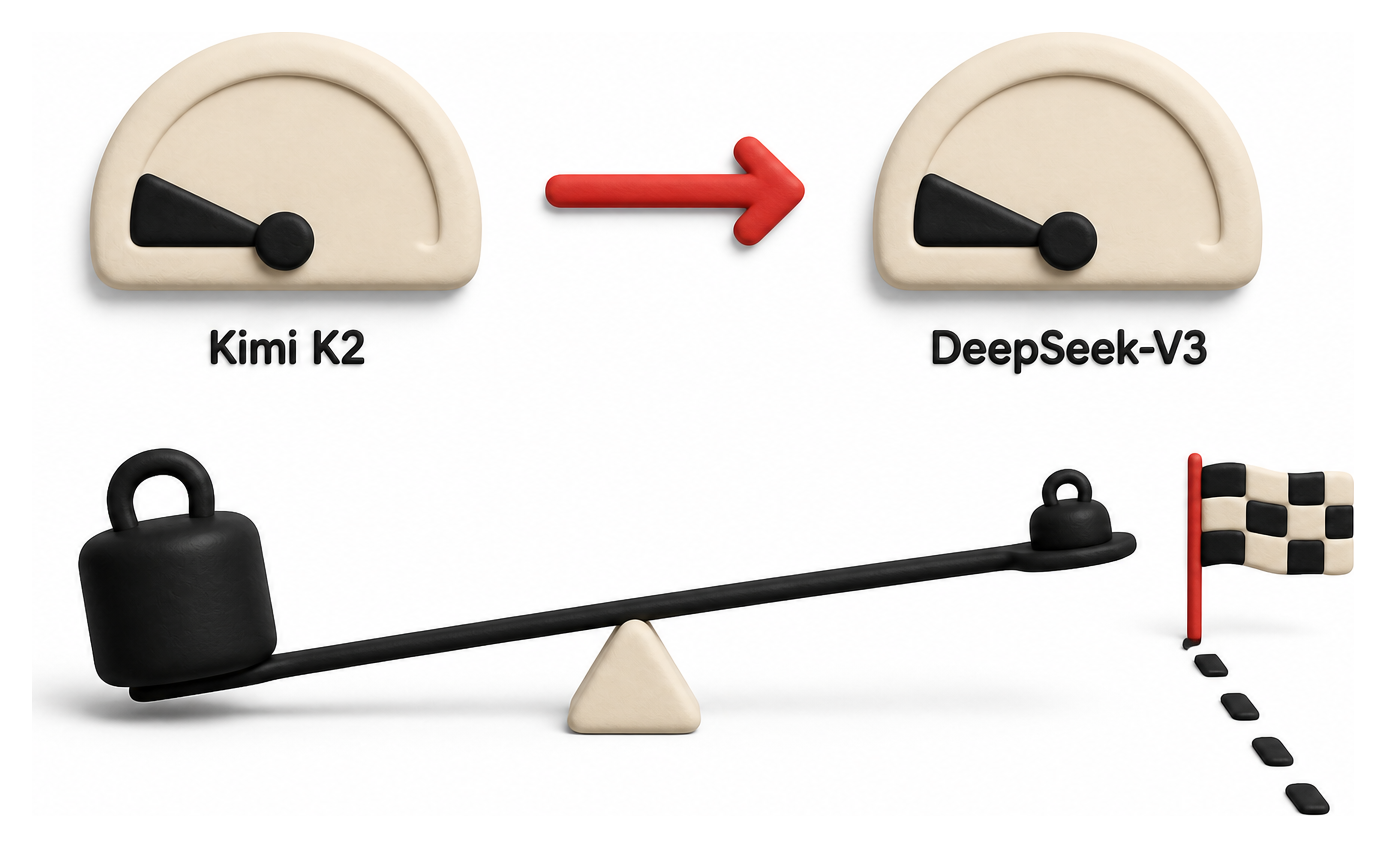
Within the K2 series, hardware requirements have shifted generationally rather than shrinking. Kimi K2.6, released in April 2026, keeps the same 1 trillion total, 32 billion active parameter structure and the same core MLA and MoonViT vision-encoder architecture as its predecessor K2.5, but Spheron's deployment documentation notes its officially recommended hardware moved to "8x H200, 8x B200, 8x B300" with "H200 is now the baseline" rather than an aspirational upgrade path (Source: spheron.network). This K2-series pattern does not establish sizing for K3, which Moonshot identifies as a separate 2.8-trillion-parameter model. NVIDIA's own comparison confirms the scale of that generational jump on the memory side alone: the H200 offers "nearly double the capacity of the NVIDIA H100 GPU with 1.4X more memory bandwidth" [17], which is precisely the kind of per-card VRAM growth that lets a fixed GPU count absorb a growing multimodal and long-context feature set.
Against other prominent open-weight models circulating in the same period, independent aggregator benchmarking places Kimi K2 firmly in the largest tier by raw parameter count, alongside models like Qwen3-235B-A22B and GLM-4.5, though K2's total parameter count of 1 trillion is roughly four times larger than Qwen3's 235 billion, even though both are MoE designs with double-digit-billion active parameters [1]. This size differential is the practical reason Kimi K2 requires a substantially larger minimum GPU count than Qwen3-class models, which can often run acceptably on a single 80GB or 141GB GPU at moderate quantization, whereas Kimi K2 cannot, regardless of quantization level, drop below roughly 230GB of combined memory even at its most aggressive 1.66-bit compression [4]. An independent self-hosted LLM benchmark leaderboard confirms this cluster-scale minimum directly: it lists Kimi K2.6 among the frontier models that "list a 16x H100 80GB (1,280GB total) minimum" for full-precision deployment, in the same hardware tier as DeepSeek-V4-Pro and GLM-5.2 (Source: onyx.app).
For buyers weighing self-hosting against the API, the market has also produced a third path: specialized inference providers who absorb the hardware complexity and resell access at a margin over raw compute cost, similar in structure to renting GPUs but with the deployment engineering already solved. Baseten, for instance, reports achieving over 340 tokens per second on Kimi K2.5 using a custom EAGLE-3 speculative-decoding model and NVIDIA Blackwell-generation GPUs, framing the resulting service as "8x cheaper and 4.5x faster than Claude Opus" for comparable agentic coding workloads [22]. Together AI took a similar serverless-deployment approach at Kimi K2's original launch, promising "99.9% availability SLA with multi-region deployment and enterprise security hosted on SOC 2 compliant servers" so that agentic workloads complete reliably during traffic surges [2]. This is a meaningful third option for teams that want the cost profile of self-hosting without directly operating GPU clusters.
Below, Table 1 summarizes the community GGUF quantization tiers available for the original Kimi K2 checkpoint, showing how aggressively memory footprint can be traded against model fidelity.
| Quantization | Approximate Bits per Weight | Disk Size | Practical Minimum Combined RAM + VRAM |
|---|---|---|---|
| UD-TQ1_0 (1.8-bit Dynamic) | 1.66 | 245GB [4] | ~247GB, works with a single 24GB GPU plus RAM offload |
| UD-IQ1_M | 1.93 | 304GB | ~310GB |
| UD-IQ2_XXS | 2.42 | 343GB | ~350GB |
| UD-Q2_K_XL (recommended balance) | 2.71 | 381GB [6] | ~390GB; Unsloth/community-recommended "balance size and accuracy" tier |
| UD-Q3_K_XL | 3.5 | 452GB | ~460GB |
| UD-Q4_K_XL | 4.5 | 588GB [4] | ~600GB |
| UD-Q5_K_XL | 5.5 | 732GB | ~750GB |
| Full FP8 (native) | 8 | 1.09TB [4] | 8× H200 is a weight-capacity estimate only; Moonshot’s minimum FP8 deployment unit at 128k context is 16 H200 or H20 GPUs. |
The pattern in Table 1 is that disk size and memory requirement scale nearly linearly with bit precision, since the 384 experts dominate the parameter count and do not compress unevenly the way some architectures allow. This makes Kimi K2 relatively predictable to size for: a target quantization level maps directly to a target memory budget, with the caveat, discussed above, that KV cache overhead stays small thanks to MLA even at long context lengths, so context length is a comparatively minor factor in the total memory bill relative to weight storage.
Data Analysis and Evidence
Cloud GPU rental pricing is the single largest variable in the cost of running Kimi K2 outside a hosted API, so understanding the spread across providers is essential to any deployment decision. Table 2 compiles verified on-demand hourly rates for the three GPU classes most relevant to Kimi K2 deployment: the H100 and H200 (Hopper generation, the platform Moonshot's own guide targets) and the B200 (Blackwell generation, now also officially supported for the newer K2.6 release).
| GPU | VRAM per GPU | Reported Rental Range | Cohort Median (early 2026) |
|---|---|---|---|
| NVIDIA H100 SXM | 80GB | $3.29 to over $10 per GPU-hour | ~$3.15 per GPU-hour |
| NVIDIA H200 SXM | 141GB, per NVIDIA's official spec [17] | $2.30 to $13.78 per GPU-hour [19] | ~$4.11 per GPU-hour |
| NVIDIA B200 SXM6 | 180 to 192GB | $6.69 to $9.86 per GPU-hour [20] | Not yet established, market still forming |
| NVIDIA A100 SXM (80GB) | 80GB | $1.99 to $2.79 per GPU-hour | ~$1.79 per GPU-hour [19] |
Table 2 shows that H100 pricing has fallen sharply, from above $7 per GPU-hour in early 2024 to roughly $3.15 by the current period, a trend that directly benefits anyone provisioning a Kimi K2 cluster on the older but still fully supported Hopper generation of hardware [19]. The H200's wider price band, nearly six-fold between the cheapest and most expensive provider, reflects the fact that 141GB cards remain supply-constrained: aggregated market data shows H200 and H100 stock confirmed for only about "48-53%" of listed capacity at any given time, meaning roughly half the catalog is provisioning-dependent rather than immediately available [19]. Hyperscaler pricing (Azure, AWS) also carries a substantial premium over specialist neoclouds for identical hardware. For an organization sizing a 16-GPU Kimi K2 cluster as Moonshot's guide recommends, the gap between provider choice at the median H200 rate ($4.11) and the hyperscaler high end ($13.78) translates to a difference of over $150 per hour for the same cluster, or well over $1 million annually for continuous operation, making provider selection one of the highest-leverage decisions in a self-hosting plan.
Power and cooling infrastructure is a related but frequently underestimated cost driver. Published hardware specifications for the H200 in SXM form factor list a maximum thermal design power of "700 W (configurable)" per card [21], which means Moonshot's recommended 16-GPU minimum cluster can draw over 11 kilowatts from GPUs alone before accounting for host CPUs, memory, networking, and cooling overhead, a load that requires dedicated datacenter-grade electrical and cooling infrastructure rather than a standard office or residential circuit. NVIDIA itself frames memory bandwidth, not just raw compute, as the binding constraint for workloads like this: "memory bandwidth is crucial for HPC applications as it enables faster data transfer, reducing complex processing bottlenecks" [17], reinforcing why Kimi K2's memory-bound MoE design benefits disproportionately from each successive GPU generation's bandwidth gains. This power reality is precisely what one community commenter flagged when warning that a fully loaded local Kimi K2 rig "will trip your breakers" in a home setting [16], a real constraint for hobbyist and small-office deployments considered earlier in this report.
On the compute-efficiency side, published benchmarks of the Kimi K2 architecture family show that hardware generation and inference-engine optimization compound meaningfully. NVIDIA's own technical blog documents a speculative-decoding technique called DFlash that the company reports "boosts inference performance up to 15x on NVIDIA Blackwell," with published checkpoints explicitly covering "model families including Qwen, Kimi K2.6, Llama, Gemma, and gpt-oss" [23] and delivering "1.5x higher" throughput than the previously dominant EAGLE-3 speculative-decoding baseline [23]. Independently, Spheron's benchmark table for an eight-GPU H200 node running FP8 inference reports throughput dropping from roughly 1,800 tokens per second at 8,000-token context and batch size 8, down to approximately 420 tokens per second at full 256,000-token context and batch size 1 (Source: spheron.network), illustrating the standard trade-off between context length, batch concurrency, and aggregate throughput that any capacity-planning exercise must account for. The same benchmark set shows the newer B200 hardware roughly doubling short-context throughput relative to H200, at a proportionally higher hourly rental cost.
Quantization's effect on quality is a further quantitative dimension worth flagging honestly: independent community testing consistently reports that even Unsloth's most aggressive 2-bit dynamic quantizations retain strong practical coding ability, with reviewers noting the compressed model could "one-shot all our tasks including this one, Heptagon and others tests even at 2-bit" [4], a claim consistent with Moonshot's own design choice to use quantization-aware training in the Kimi K2 Thinking successor rather than treat quantization purely as a post-hoc compression step.
Case Studies and Real-World Examples
Baseten's Blackwell Speculative-Decoding Deployment
Inference platform Baseten published a detailed engineering account, dated February 11, 2026, of how it achieved the fastest independently benchmarked Kimi K2.5 inference on the Artificial Analysis leaderboard, reaching over 340 tokens per second [22]. Two engineering choices drove the result. First, because Kimi's INT4 checkpoints target Hopper-class hardware rather than the newer Blackwell architecture, Baseten had to decompress the released INT4 weights back to BF16 and then re-quantize them into NVIDIA's NVFP4 format using NVIDIA's ModelOpt toolkit, a nontrivial conversion path the company describes explicitly: "There is no direct path from INT4 to NVFP4" [22]. Second, because Kimi K2.5 has no smaller sibling model in its family to serve as an off-the-shelf speculative decoding draft model, Baseten instead trained a custom EAGLE-3 speculator that "weighs in around a billion parameters, making it lightweight to run alongside Kimi K2.5," using hidden states captured from the target model itself as training data [22]. The business result Baseten reports is an offering priced and benchmarked as "8x cheaper and 4.5x faster than Claude Opus" for comparable agentic coding workloads, illustrating how inference-engineering investment on top of the base hardware can materially change the economics documented earlier in this report [22].
Together AI's Day-One Serverless Launch of Kimi K2
Third-party inference platform Together AI made Kimi-K2-Instruct available on its "Frontier AI Cloud Platform" the same week Moonshot released the model in July 2025, positioning it as "arguably the best open-source model available" at the time [2]. Rather than requiring customers to provision and operate GPU clusters themselves, Together AI's pitch was that Kimi K2 is "now available serverlessly," meaning "no infrastructure setup" and "no throttling" for teams that would otherwise need to replicate Moonshot's own 16-GPU minimum topology in-house [2]. The company's launch pricing of $1.00 per million input tokens and $3.00 per million output tokens sat above Moonshot's own $0.60 and $2.50 direct API rates, illustrating the general pattern that third-party hosting marketplaces charge a premium over the model creator's own API for the convenience of skipping infrastructure management entirely. This case demonstrates that even in the earliest days after a trillion-parameter open-weight release, credible serverless alternatives to both self-hosting and the creator's own API existed for teams unwilling to wait for in-house cluster procurement.
Spheron's H200 and B200 Reference Architecture for Kimi K2.6
GPU marketplace Spheron Network published a full deployment runbook for Kimi K2.6, Moonshot's April 2026 release, including exact hourly pricing, storage sizing, and vLLM launch commands for both H200 and B200 node types. The guide's central sizing table shows that FP8 precision inference, the practical production target, needs roughly 1TB of GPU memory across 8x H200 or 6x B200 GPUs, while AWQ INT4 quantization compresses that to roughly 630GB, fitting on the same 8x H200 count or as few as 4x B200 cards. Spheron's guide includes an important cross-check for anyone attempting the smaller AWQ path: it explicitly warns that "4x H200 provides only 564 GB total, which is insufficient for the ~630 GB AWQ weight footprint," meaning the AWQ path requires the larger-VRAM B200 cards specifically, not simply fewer H200s (Source: spheron.network). This case is a useful cautionary example of how quantization-tier and GPU-model choice interact: the naive assumption that a smaller quantized checkpoint always allows fewer or cheaper GPUs breaks down once total-VRAM-per-node becomes the binding constraint rather than raw weight size.
Community DIY EPYC Server Builds for Sub-$15,000 Local Inference
A widely discussed Reddit thread in the r/LocalLLaMA community, "Run Kimi-K2 without quantization locally for under $10k," documents a detailed hardware bill of materials assembled by user DepthHour1669: 12 sticks of 96GB DDR5-6400 memory (1,152GB total) for approximately $7,200, paired with an AMD EPYC 9005-series processor and a compatible 12-channel motherboard for roughly $1,400, aiming to approximate the memory bandwidth of a 512GB Apple Mac Studio at a fraction of the cost [14]. Other commenters in the thread pressure-tested the estimate: one pointed out that "9005 CPU with 12 CCDs will hit over 4k$" once realistic component sourcing and motherboard-compatibility requirements were factored in, pushing the all-in cost closer to $12,000 to $15,000 [14]. A separate commenter, tomz17, reported real-world empirical results from a similar build: roughly 18 tokens per second on a 9684X EPYC processor with 384GB of DDR5-4800 memory and a single RTX 3090 for offload, describing the setup as "nothing amazing, but definitely usable," while cautioning it "obviously would not scale well to multiple simultaneous users" [14]. A separate thread produced a competing bill of materials, an EPYC 9654P processor on a wide-channel server motherboard with 12 sticks of 64GB DDR5-4800 memory, which one commenter estimated "comes out to ~12-14k" all in [6]. This case study grounds the abstract quantization-tier math in Table 1 against several independently assembled, benchmarked systems, and shows the gap between theoretical minimum requirements and comfortable single-user performance.
NVIDIA's Cross-Vendor Speculative Decoding Support for Kimi K2.6
NVIDIA's developer relations team documented a broadly applicable speculative-decoding framework called DFlash that the company states delivers "inference performance up to 15x on NVIDIA Blackwell" compared with standard autoregressive decoding [23]. The company's research team released twenty separate DFlash model checkpoints on Hugging Face, with explicit Blackwell and Hopper hardware recipes, and Kimi K2.6 named directly among the covered model families alongside Qwen, Llama, Gemma, and gpt-oss [23]. This case illustrates that hardware-vendor-level optimization work for the Kimi K2 architecture family is now mainstream enough to receive first-party NVIDIA engineering support rather than remaining purely a community or single-provider effort, a meaningful signal for enterprise buyers weighing the model's long-term operational viability.
The r/LocalLLM Community Cost Survey for Kimi K2.6
When a user with only a 16GB-RAM MacBook Pro asked the r/LocalLLM community what hardware would be needed to run the newer Kimi K2.6 locally [16], the resulting thread became an informal, crowd-sourced cost survey that mirrors the official quantization math documented in Table 1 remarkably closely. One reply, citing Moonshot's own updated deployment guide, reported that a minimal two-GPU setup with 2.25TB of system RAM could reach approximately 44.5 tokens per second, while a more balanced 768GB server with a single consumer GPU was judged the practical sweet spot by another commenter [16]. A third participant, weighing the all-in cost of ownership rather than raw specifications, concluded flatly that "even the highest speced M5 MacBook wouldn't be able to run Kimi 2.6" and that a capable local setup requires "tens of thousands of dollars" [16]. This organic convergence across independent commenters, none referencing each other's math, is itself a form of validation for the hardware figures presented earlier in this report.
Implications and Future Directions
The most consistent theme across every hardware tier examined in this report is that Kimi K2's memory footprint, not its raw compute demand, is the binding constraint on deployment. A 32-billion-active-parameter compute budget is genuinely modest by frontier-model standards, comparable to mid-sized dense models that run comfortably on a handful of GPUs. It is the need to keep all 384 experts resident in fast memory that pushes minimum viable configurations to 247GB of combined memory even at extreme quantization, and pushes Moonshot's own recommended production floor to 16 GPUs. This has two forward-looking implications. First, further hardware progress in the form of larger-VRAM single GPUs, such as the jump from the H200's 141GB to the B200's roughly 180 to 192GB, will continue to reduce the GPU count needed per node faster than it reduces the total dollar cost, since per-card prices rise alongside VRAM. Second, quantization-aware training, the technique Moonshot adopted for Kimi K2 Thinking's native INT4 weights, is likely to become the default rather than the exception across the model family, since it demonstrably preserves more quality per bit than post-hoc quantization of a full-precision checkpoint, directly lowering the effective hardware floor for future releases without a corresponding quality tax.
The rapid cadence of K2-series releases, from K2 in July 2025 to K2 Thinking in November 2025, K2.5 in early 2026, K2.6 in April 2026, and K2.7 Code in June 2026, has a practical implication for infrastructure planning: verified K2-series checkpoints may share a broadly similar memory envelope, but each release still requires deployment validation for its precision, context length, and inference engine. This conclusion does not extend to K3. Moonshot identifies K3 as a separate 2.8-trillion-parameter model, so its VRAM, node count, and production topology must be sized independently rather than inferred from a 16-GPU H200 Kimi K2 deployment.
On the economic side, Moonshot's displayed API prices vary materially by model and token type: K3 is $3.00 per million input tokens, $0.30 per million cache-hit input tokens, and $15.00 per million output tokens, while K2.7 Code and K2.6 each cost $0.95 per million input tokens and $4.00 per million output tokens, with cache-hit input at $0.19 and $0.16 respectively [24]. A GPU-rental estimate expressed as one cost per million tokens cannot establish which option is cheaper without a stated model, input/cache-hit/output mix, throughput, and utilization. Data residency, sustained utilization, interruption tolerance, and customization needs remain material deployment considerations.
Frequently Asked Questions (FAQs)
How much VRAM do I need to run Kimi K2? It depends entirely on quantization level. At the extreme low end, Unsloth's 1.66-bit dynamic quantization requires combined disk, RAM, and VRAM of at least 247GB, and can technically run with as little as a single 24GB consumer GPU if the rest is offloaded to system RAM, albeit at only 1 to 2 tokens per second [4]. For native FP8 production serving, Moonshot's own guide specifies a minimum deployment unit of 16 GPUs on mainstream H200 or H20 platforms. Sixteen 141GB H200 GPUs provide about 2.26TB of combined GPU memory, while sixteen 96GB H20 GPUs provide about 1.54TB; the 16-GPU figure is Moonshot's deployment recommendation, not a claim that both GPU options have the same VRAM [3].
What GPUs does Kimi K2 need? Moonshot's official documentation targets NVIDIA H200 and H20 (Hopper generation) GPUs for tensor-parallel and expert-parallel deployment, and TensorRT-LLM deployment examples use the same 16-GPU H200 topology [3]. For Kimi K2.6, Spheron's deployment guide recommends both H200 and B200 configurations and describes H200 as its baseline; this is Spheron's sizing guidance, not Moonshot documentation.
How many nodes does Kimi K2 need for production deployment? A minimum of two eight-GPU nodes (16 GPUs total) for standard tensor-parallel or data-parallel-plus-expert-parallel serving, per Moonshot's deployment guide [3]. Larger deployments, particularly those using SGLang's prefill-decode disaggregation pattern, can scale to separate prefill and decode node pools, with Moonshot's documented example spanning four prefill nodes at tensor-parallel size 32 and twelve decode nodes at tensor-parallel size 96 [3].
What is the cost to run Kimi K2 locally? Hardware alone ranges from roughly $10,000 for a hobbyist AMD EPYC server build with heavy quantization [6] up to several hundred thousand dollars for a purchased 16-GPU H200 production cluster. Renting the equivalent cloud hardware costs roughly $9.69 per million tokens processed on an eight-GPU H200 node at on-demand pricing, or as low as $3.91 per million tokens at spot pricing, per the cost model detailed in the API and Cloud-Rental Alternatives section above.
Is Kimi K2's API cheaper than self-hosting? It cannot be determined from a single API input-token rate and a single GPU-rental cost per million tokens. The API charges separately for input, cache-hit input, and output tokens, whereas self-hosting costs depend on the model, provisioned GPU time, achieved throughput, and utilization. Compare matched scenarios using the same model and input/cache-hit/output mix before drawing a cost conclusion. Data residency, customization, and operational requirements can also justify self-hosting independently of price [25][26].
Can I run Kimi K2 on a single GPU? Only at extreme quantization with most of the model offloaded to system RAM or disk. Unsloth's smallest 1.8-bit quant fits within a single 24GB GPU's VRAM for the always-active layers, with the mixture-of-experts layers offloaded elsewhere, producing roughly 1 to 2 tokens per second [4]. Most current GPUs cannot hold the full model without offloading. NVIDIA lists 288GB of HBM3e per B300 GPU, so it can hold the table's 245GB extreme quantization in principle, though limited runtime headroom may still make offloading or additional GPUs preferable.
What are Kimi K2's minimum hardware specs? The documented practical floor is 247GB of combined disk, RAM, and VRAM for the most aggressive open-source quantization [4], though usable interactive performance in community testing generally requires closer to 380GB to 400GB of fast memory, corresponding to the Q2_K_XL quantization Unsloth itself recommends as the balanced default [6].
Does context length change Kimi K2's hardware requirements much? Comparatively little, thanks to MLA. One community estimate puts the KV cache for a full 128,000-token context window at less than 10GB [14], and production sizing for the 256,000-token-context K2.6 successor, detailed in Table 1 and the production configuration discussion above, still shows KV cache under 40GB even at FP8 precision with MLA, meaning weight storage, not context length, dominates the hardware budget.
Conclusion
Kimi K2's hardware requirements are best understood as a direct consequence of its mixture-of-experts design: modest per-token compute paired with an enormous, largely fixed memory footprint that any deployment, from a single-GPU hobbyist experiment to a sixteen-GPU production cluster, must accommodate in full. At the low end, aggressive quantization down to roughly 1.66 bits per weight brings the combined memory requirement to about 247GB, enough for a single consumer GPU with heavy RAM offloading to run the model at exploratory speeds. At the production end, Moonshot AI's own deployment guidance sets 16 GPUs of the H200 or H20 class as the practical starting point for native FP8 serving, a configuration that costs on the order of tens of dollars per GPU-hour to rent or several hundred thousand dollars to purchase outright.
Between those two poles sits a well-documented middle tier: 512GB Apple Mac Studios, single-socket AMD EPYC servers with wide DDR5 memory channels, and mid-range quantizations in the 350GB to 600GB range, all of which put local inference within reach of well-resourced individuals and small teams for a total hardware cost in the $10,000 to $25,000 range, or up to $50,000 to $100,000 for setups that need both fast chat responsiveness and usable coding-agent prompt processing. Moonshot's current pricing is model-specific: its platform displays K3 at $3.00 per million input tokens, $0.30 per million cache-hit input tokens, and $15.00 per million output tokens; K2.7 Code and K2.6 are $0.95 per million input tokens and $4.00 per million output tokens, with cache-hit input at $0.19 and $0.16 respectively [24]. Whether self-hosting is less expensive depends on the model, token mix, throughput, utilization, and operational requirements; strict data residency and customization can independently justify it. As the Kimi lineage has evolved from the original K2 through K2 Thinking, K2.5, K2.6, and beyond, the shared 1-trillion-parameter, 32-billion-active-parameter MoE architecture makes original-K2 sizing a useful starting point. Each successor still requires independent deployment validation: K2.6, for example, has a 256K context window, native INT4 quantization, and a vision encoder, so its precision, memory, and node requirements should not be inferred from the original K2's documented 16-GPU FP8 minimum.
External Sources (26)
About
GPUSmith
Plan and build private AI compute with GPU Smith. We connect workload requirements with GPU hardware, networking, deployment and operating decisions so your infrastructure fits the work it must perform.
GPU Smith provides independent engineering and research for private AI infrastructure. We help technical buyers and operators reason about GPU workload sizing, hardware selection, procurement, deployment and inference operations, from the compute system to the networking, power and cooling requirements around it.
Start with the workload
Useful infrastructure decisions begin with the models, data, throughput, latency and operating constraints a team actually has. GPU Smith helps connect those requirements with system design and deployment choices. The goal is a privately controlled AI environment whose capacity and operational demands are understood before a purchasing decision.
Hardware and supplier research
Our public reference library covers GPUs, complete systems and networking components. The server-vendor directory and manufacturing research help teams investigate suppliers, compare options and follow sources behind technical claims. We distinguish manufacturer specifications from measured benchmarks and advertised capabilities from tested configurations. Reference pages are research resources, not a live inventory listing or a binding equipment quote.
Deployment and operations
GPU Smith's engineering scope includes infrastructure integration, networking, power, cooling and the practical operation of inference workloads. Our published articles explain the tradeoffs behind deployment, procurement and ongoing operations so teams can ask better questions and document decisions.
Work with GPU Smith
Explore the hardware library, GPU references, networking references and vendor research. Contact GPU Smith with your workloads and deployment constraints to discuss a project and confirm current scope, pricing and availability.
Inclusion of a manufacturer or product in our research does not imply a partnership, certification or endorsement.
Disclaimer
This document is provided for informational purposes only. No representations or warranties are made regarding the accuracy, completeness, or reliability of its contents. Any use of this information is at your own risk. GPUSmith shall not be liable for any damages arising from the use of this document. This content was generated with assistance from artificial intelligence tools, which may contain errors or inaccuracies. Readers should verify critical information independently. All product names, trademarks, and registered trademarks mentioned are property of their respective owners and are used for identification purposes only. Use of these names does not imply endorsement. This document does not constitute professional or legal advice. For specific guidance related to your needs, please consult qualified professionals.