GPUSmith Article
Who Owns ZT Systems Now After the AMD-Sanmina Split?
Inside this article
- 01Executive Summary
- 02Introduction and Background
- 03What ZT Systems Was Before the Split
- 04Stage One: AMD's Full Acquisition of ZT Systems (August 2024 to March 2025)
- 05Stage Two: The Sanmina Divestiture Agreement (May 2025)
- 06Stage Three: Sanmina's Completed Acquisition and the Preferred NPI Partnership
- 07What AMD Kept: The Design and Customer-Enablement Business
- 08What Sanmina Bought: The Manufacturing Business and Its Facilities
- 09Data Analysis and Evidence
- 10Case Studies and Real-World Examples
- 11Implications and Future Directions
- 12Frequently Asked Questions (FAQs)
- 13Conclusion
I'll add links directly to the article content based on genuine topical matches.
Executive Summary
As of July 2026, ZT Systems exists as two separate businesses under two separate owners, the product of a deliberate three-step corporate carve-up that began in August 2024. The design and customer-enablement half of the former private company, historically responsible for engineering rack-scale AI servers for hyperscale cloud customers, now sits inside Advanced Micro Devices (AMD, NASDAQ: AMD) as part of its Data Center Solutions business unit. The manufacturing half, including ZT's factories in Secaucus, New Jersey; Georgetown, Texas; and Almelo, the Netherlands, is now owned outright by Sanmina Corporation (NASDAQ: SANM), a San Jose, California-based electronics manufacturing services (EMS) provider, following a deal that closed on October 27, 2025 [1].
The chain of ownership began on August 19, 2024, when AMD agreed to acquire the entirety of ZT Systems, a 30-year-old, privately held server maker previously controlled by founder and CEO Frank D. Zhang through Alpine Eagle LLC, alongside Taiwan's Inventec Corporation and other investors, for $4.9 billion in cash and stock [2] [3]. AMD said at the time it had no interest in becoming a systems manufacturer and would resell the manufacturing arm once the acquisition closed [4]. AMD completed the full acquisition on March 31, 2025, after clearing antitrust review in the European Union, Singapore, and other jurisdictions [5]. Then, on May 19, 2025, AMD announced it would sell the manufacturing side to Sanmina in a deal worth up to $3 billion, structured as $2.25 billion in cash for net assets, a $300 million premium split evenly between cash and Sanmina stock, and up to $450 million in contingent, performance-based consideration [6]. That transaction, which Sanmina Chairman and CEO Jure Sola later said had closed ahead of schedule, was completed on October 27, 2025.
Under the legal structure of the sale, Sanmina Corporation acted as buyer, ZT Group Int'l, Inc. was the target company, and the seller was AMD Design, LLC, a wholly owned AMD subsidiary that had held 100 percent of ZT's equity interests since the March 2025 closing [7]. AMD retained the design, engineering, and customer-enablement organization, roughly 1,000 of ZT's approximately 2,500 original employees, while Sanmina absorbed the roughly 1,500-person manufacturing workforce along with the physical plants [8] [9]. Founder Frank Zhang subsequently moved to AMD as senior vice president of ZT Manufacturing to shepherd the divestiture, while ZT President Doug Huang took on a senior engineering leadership role at AMD, a transition detailed further below.
The deal's rationale, on both sides, was strategic rather than purely financial. AMD wanted rack-scale systems engineering talent to compete with Nvidia's DGX approach without becoming a hardware seller that competes with its own hyperscale customers, and it now uses that team on projects such as the "Helios" rack-scale reference design and the six-gigawatt AMD-OpenAI infrastructure agreement announced in October 2025 [10] [11]. Sanmina, in turn, gained an immediate and outsized foothold in cloud and AI infrastructure manufacturing: by its fiscal second quarter of 2026 (ended in late March 2026), the ZT Systems unit alone generated $1.88 billion in quarterly revenue, helping push total company revenue to $4.01 billion and prompting Sanmina to raise its full-year fiscal 2026 guidance to a range of $13.7 billion to $14.3 billion [12] [13]. In short: nobody today "owns ZT Systems" as a single entity. AMD owns the brains, Sanmina owns the factories, and the ZT Systems name and newsroom now live on Sanmina's corporate umbrella as a wholly owned manufacturing subsidiary.
Introduction and Background
ZT Systems spent nearly three decades as one of the least-known, most-important names in enterprise computing. Founded in 1994 and headquartered in Secaucus, New Jersey, the company began by building desktop PCs and pedestal servers, pivoted in 2004 toward high-performance systems for financial services and high-frequency trading customers near the New York exchanges, and by 2010 had moved into rack-scale infrastructure design [9]. By 2013 it had landed its first hyperscale cloud customers, and by 2024 it was quietly shipping hundreds of thousands of servers a year and generating roughly $10 billion in annual revenue, according to AMD's own disclosures at the time of its acquisition announcement, almost all of it tied to around a dozen hyperscaler and cloud-builder relationships [8]. Business-data tracker CB Insights placed ZT Systems' valuation in the August 2024 deal at between $4.5 billion and $4.9 billion, a slightly more conservative range than the flat $4.9 billion headline figure AMD and ZT Systems themselves announced [14].
Prior to its sale, ZT Systems (legally ZT Group Int'l, Inc.) was privately held, controlled by founder and chief executive Frank D.Zhang through an entity called Alpine Eagle LLC, with Taiwan-based electronics manufacturer Inventec Corporation (TWSE: 2356) and other minority holders also named as sellers in the definitive acquisition agreement [2]. CB Insights lists ZT Systems' founding year as 1994 and its headquarters as 200 Plaza Drive, Secaucus, New Jersey, describing the company as "a provider of AI and general purpose compute infrastructure within the hyperscale computing sector" prior to its acquisition [14].
That independent, single-owner history ended in three stages over roughly 14 months. Stage one was AMD's agreement, announced August 19, 2024, to acquire ZT Systems in its entirety for $4.9 billion, a deal AMD framed explicitly around the "$400 billion data center AI accelerator opportunity in 2027," seeking to keep ZT's engineering talent while shedding its manufacturing operations [3]. Stage two was the completion of that full acquisition on March 31, 2025, after review by antitrust authorities including the European Commission (which faced a March 12, 2025 decision deadline) and Singapore's Competition and Consumer Commission [15] [5]. Stage three was the sale of the manufacturing half to Sanmina, announced May 19, 2025 and completed October 27, 2025 [6]. This report walks through each stage of that ownership transition in detail, quantifies the money and headcount involved, explains why AMD structured the deal this way, and describes what ZT Systems looks like today as a business unit inside Sanmina.
What ZT Systems Was Before the Split
To understand who owns ZT Systems now, it helps to understand what ZT Systems actually did as a single company. ZT Systems was not a chipmaker; it was an original design manufacturer (ODM) and systems integrator that took silicon from AMD, Intel, and Nvidia and turned it into complete, rack-scale, liquid-cooled server infrastructure ready for hyperscale data centers. Patrick Moorhead of Moor Insights & Strategy, writing at the time of the AMD deal, characterized ZT as "a leading hyperscale systems design and ODM house for GPU rack systems" that designed, integrated, manufactured, and deployed rack-level AI systems, with Amazon Web Services and Microsoft Azure rumored to be its largest customers [16]. Reuters separately confirmed that Microsoft and Meta Platforms were among ZT's customers ahead of the deal's EU antitrust review [15]. Even while the AMD acquisition proceeded, ZT Systems continued shipping products for competing chip vendors under its own brand, including "ACX200 Solutions Featuring NVIDIA GB200 Grace Blackwell Superchips," underscoring that the manufacturing business Sanmina eventually acquired had long served multiple silicon vendors, not AMD alone [17].
Two operating halves. By 2024, ZT Systems' business split naturally into two functions that would later become the fault line of the AMD deal:
- Design and customer enablement: the engineering organization that worked directly with chip vendors on early silicon designs (AMD's EPYC processors and MI250 and MI300 accelerators among them), and with hyperscale customers on bespoke rack and cluster architectures. AMD CEO Lisa Su noted that ZT "did some of our first EPYC designs and MI 250 designs with us, and they've been fully engaged on MI 300 designs" [16].
- Manufacturing and deployment: the physical plants and supply-chain operations that built and shipped completed racks. This half operated out of large facilities in Secaucus, New Jersey; Georgetown, Texas (near Austin); and Almelo, the Netherlands, and it employed roughly 1,500 of ZT's approximately 2,500 total staff at the time of the AMD deal [9]. ZT's manufacturing-era engineering also left an intellectual-property trail: CB Insights recorded 31 patents filed by the company, with cooling technology, computer hardware cooling, and parallel computing among its most common topics, and at least one such filing, a "Fluid control apparatus for air vents in rack assembly" submitted in August 2023, was still being granted as late as March 2026, months after the Sanmina acquisition closed [14].
Why AMD wanted, but did not want to keep, both halves. AMD's argument for the acquisition was that AI infrastructure competition had become "a vertically oriented system and software game," not just a chip game, so it needed in-house rack-scale engineering expertise to compete with Nvidia's DGX systems approach. But AMD's Forrest Norrod, executive vice president and general manager of the company's Data Center Solutions business unit, was equally explicit that AMD would not become a systems seller in competition with its own hyperscaler customers, a stance Moorhead contrasted with Supermicro's much thinner net margins compared with AMD's roughly 25 percent margin profile [16]. That is why AMD structured the deal from day one as "buy all of ZT, keep the engineers, sell the factories."
Stage One: AMD's Full Acquisition of ZT Systems (August 2024 to March 2025)
On August 19, 2024, AMD announced a definitive agreement to acquire ZT Systems in a cash-and-stock transaction valued at $4.9 billion, including a contingent payment of up to $400 million tied to post-closing milestones [3]. Under the terms disclosed by Forbes contributor Patrick Moorhead following a direct briefing from AMD CEO Lisa Su, roughly 75 percent of the consideration was to be paid in cash and 25 percent in AMD stock, additive to roughly $1 billion AMD had already invested in ZT over the prior year [16]. A subsequent regulatory filing on the transaction laid out the mechanics precisely: a closing consideration of $1.125 billion in AMD stock and $3.375 billion in cash payable to sellers, RSU holders, and warrant holders, plus contingent consideration of up to 740,964 AMD shares and up to $300 million in cash based on post-closing milestones [2]. AMD financed part of the deal through a $1.5 billion senior notes offering completed in March 2025, split between $875 million of 4.212 percent notes due 2026 and $625 million of 4.319 percent notes due 2028 [2].
AMD CEO Lisa Su told Reuters the acquisition's core value was straightforward: "The main way (ZT Systems) is additive to the company is we sell more GPUs" [4]. Following the announcement, AMD's shares rose more than 2 percent, while Sanmina's own stock would later fall more than 5 percent when its role in the divestiture was announced nine months on [18]. Analyst reaction to the original deal was cautiously positive: Creative Strategies CEO Ben Bajarin said the purchase gave AMD "much stronger lock-in with their data center customers," calling it "a net positive for their long-term revenue strategy," while Summit Insights managing director Kinngai Chan said "the sale of the (ZT Systems) manufacturing business will have no impact onto AMD in the long run" [4].
Regulatory path to close. The acquisition required clearance in multiple jurisdictions. Singapore's Competition and Consumer Commission (CCCS) ran a public consultation between November 26 and December 10, 2024, ultimately determining the deal would not reduce competition in the city-state because the combined entity would lack sufficient market power to harm competition through bundling or tying [5]. In Europe, a European Commission filing set a deadline of March 12, 2025 for a decision on whether to clear the deal without an in-depth investigation, since EU rules allow the executive body to "either approve the deal with or without remedies after its preliminary review or... open a four-month-long investigation if it has serious concerns" [15], and trade publication Global Competition Review reported that AMD and ZT Systems expected their tie-up to secure "unconditional" EU approval without remedies [19]. Financial commentators framed the Singapore clearance similarly, describing it as "clearing a significant regulatory hurdle for the semiconductor giant" on AMD's path to closing [5]. ZT Systems was represented in the transaction by law firm Paul, Weiss, Rifkind, Wharton & Garrison, with a team led by partners Chelsea Darnell and James Langston that also included dedicated antitrust partners, among them Annie Herdman, given the multi-jurisdictional review [20]. The Paul Weiss team also included tax partner Brian Krause and intellectual property partner Jonathan Ashtor [20], as well as real estate partner Peter Fisch and litigation counsel Audrey Paquet, underscoring the cross-disciplinary complexity of separating ZT's design and manufacturing functions and diligencing its owned facilities ahead of the eventual Sanmina sale [20].
Closing and leadership transition. AMD completed the acquisition on March 31, 2025, positioning the deal around what AMD by then described as a "$500 billion data center AI accelerator opportunity in 2028," an upward revision from the $400 billion, 2027 figure used at announcement. Forrest Norrod said the acquisition was "a significant milestone in our AI strategy to deliver leadership training and inferencing solutions," while welcoming "Frank Zhang, Doug Huang and the talented ZT Systems team to AMD." Founder Frank Zhang became AMD senior vice president of ZT Manufacturing, tasked specifically with leading the divestiture of the manufacturing arm he had built, while Doug Huang became senior vice president of Data Center Platform Engineering, leading the design and customer-enablement teams that AMD intended to keep permanently [21]. CRN summarized the arrangement bluntly: AMD "closed the $3 billion divestiture of ZT Systems' manufacturing unit to Sanmina but will retain ZT Systems' rack-scale AI solutions design and customer enablement teams" [22].
Stage Two: The Sanmina Divestiture Agreement (May 2025)
Roughly seven weeks after finishing the ZT Systems acquisition, AMD announced on May 19, 2025 that it had reached a definitive agreement to sell the ZT Systems manufacturing business to Sanmina Corporation. Reuters described the arrangement plainly: "AMD will sell the server-manufacturing business of recently acquired ZT Systems to Sanmina in a $3 billion deal, making the U.S.-based contract manufacturer its partner for building AI hardware as the chip designer works to onshore supply chains" [18]. Reuters explicitly tied the deal's timing to broader U.S. trade policy, noting it came "amid global trade tensions and U.S. President Donald Trump's efforts to expand domestic semiconductor manufacturing," and separately observed that AMD's parallel plan to make chips at a new TSMC production site in Arizona marked "the first time its products will be manufactured in the U.S." [18]. Reuters also framed the decision to keep ZT's design unit as competitively necessary, since "ZT's design unit could be an important portfolio item for AMD, which has been struggling to compete against Nvidia" in the market for AI processors [18], and the same report detailed the buyer-side mechanics, noting the deal "also includes a $450 million contingent consideration based on the business' financial performance over the next three years" [18].
Precise deal structure. Sanmina's own press release, headlined "Sanmina Announces Acquisition of Data Center Infrastructure Manufacturing Business of ZT Systems from AMD," itemized the purchase price as "$2.55 Billion Cash and Equity, Plus $450 Million in Contingent Consideration, Totaling Up to $3 Billion" [23]. Broken down further, Sanmina agreed to pay $2.25 billion in cash for the manufacturing assets at target net asset value, subject to a working-capital adjustment mechanism, plus a $300 million premium split 50 percent cash and 50 percent Sanmina equity, and up to $450 million in contingent consideration tied to the business's financial performance over three years, with the Sanmina equity issued to AMD carrying a three-year lock-up (sales limited to 33 percent in the first year, 33 percent in the second year, and the remainder in the third) and the transaction backed by $2.5 billion in committed financing from Bank of America [23]. AMD itself confirmed the arrangement was "consistent with intentions announced at the time of ZT Systems acquisition," tying the May 2025 divestiture directly back to the plan disclosed the previous August, and reiterated that it would keep "ZT Systems' rack-scale AI solutions design and customer enablement expertise to accelerate quality and time-to-deployment for cloud customers," language nearly identical to what it had used when the original acquisition closed two months earlier [6].
The formal Equity Purchase Agreement, filed with the U.S. Securities and Exchange Commission and dated May 18, 2025, named the parties precisely: "Sanmina Corporation, a Delaware corporation ('Buyer'), ZT Group Int'l, Inc., a New Jersey corporation (the 'Company'), AMD Design, LLC, a Delaware limited liability company and wholly owned subsidiary of AMD (the 'Seller'), and Advanced Micro Devices, Inc.," confirming that "the Seller owns 100% of the Equity Interests of the Company" and reflecting that AMD's internal restructuring following the March 2025 acquisition had consolidated the manufacturing business into ZT Group Int'l as a distinct legal entity ahead of resale [7]. The agreement further defined "Business" as ZT's activity "of manufacturing advanced server hardware solutions (including... storage hardware solutions) for cloud computing and artificial intelligence, and providing related post-manufacturing services and support," explicitly excluding "the Design Business" that AMD kept [7].
Why Sanmina. At the time of the announcement, Sanmina reported that ZT Systems' manufacturing arm carried "current annual net revenue run-rate... approximately $5 - $6 billion," with what Sanmina called "promising" prospects as new accelerated compute platforms launched [23]. Jure Sola, Sanmina's Chairman and CEO, said the same release positioned Sanmina "as an industry leader in the Cloud and AI ecosystem" by combining "Sanmina's global expertise and vertical integration capabilities with ZT Systems' high-quality manufacturing capacity in the U.S. and Europe." The transaction was unanimously approved by Sanmina's board of directors and was expected to close near the end of calendar 2025.
Stage Three: Sanmina's Completed Acquisition and the Preferred NPI Partnership
Sanmina completed its acquisition of the ZT Systems manufacturing business on October 27, 2025, closing ahead of the original year-end 2025 target. Jure Sola said, "I am pleased we were able to close the acquisition quickly and ahead of schedule. The addition of ZT Systems significantly enhances our scale and deepens our engagement within the fast-growing Cloud and AI end-market" [24]. AMD's own announcement of the same closing highlighted that "AMD retains ZT Systems' world-class design and customer enablement teams to accelerate the quality and time-to-deployment of AMD AI systems for cloud customers," while "Sanmina becomes a preferred new product introduction (NPI) manufacturing partner for AMD cloud rack and cluster-scale AI solutions to further strengthen the AMD ecosystem of ODM and OEM partners" [1]. Norrod added, "Rack-scale innovation marks the next chapter in the AMD data center strategy... Our strategic partnership with Sanmina brings U.S.-based manufacturing strength together with AMD AI systems design and enablement expertise to deliver quality, speed and flexibility at scale" [1].
Sanmina laid out its "Compelling Strategic Rationale" for the deal in four points, including that "ZT Systems brings large state-of-the-art manufacturing facilities located in New Jersey and Texas, with large amounts of power and advanced liquid cooling capabilities, as well as an operation in the Netherlands, complementing Sanmina's existing U.S. and global manufacturing footprint" [24]. Sanmina itself is a Fortune 500 electronics manufacturing services (EMS) company founded in 1980 by Jure Šola and Milan Mandarić, headquartered in San Jose, California, that reported $8.13 billion in revenue for fiscal 2025 (ended in late September 2025), ranking 471st on the Fortune 500 as of 2026 [25]. Sanmina's own scale was itself built through acquisition: in December 2001 the company merged with SCI Systems of Huntsville, Alabama, for $6 billion in cash, stock, and debt, first establishing Sanmina as one of the industry's largest contract manufacturers [25]; Jure Sola himself has served as chairman and chief executive since 1991, three years before ZT Systems itself was even founded [25]. Before the ZT Systems deal closed, Sanmina employed approximately 34,000 people across 21 countries on four continents [22], a figure the company's own company-profile page later updated to approximately 39,000 employees worldwide, trading on Nasdaq under the ticker symbol SANM with operations spanning "20 countries on four continents," serving customers primarily in "the industrial, medical, defense and aerospace, automotive, communications networks and cloud infrastructure sectors" [26].
The ZT Systems brand itself did not disappear. Its corporate newsroom at ztsystems.com continues to operate, but now under Sanmina's ownership, describing "Sanmina expands Cloud and AI capabilities with acquisition of ZT Systems data center infrastructure manufacturing business from AMD" on its own homepage banner, and republishing the October 2025 closing announcement as "Transformational Acquisition Complements Sanmina's Comprehensive Capabilities, Accelerates Entry into Cloud and AI Market" [17] [27]. In other words, ZT Systems today operates as a Sanmina-owned brand and manufacturing subsidiary rather than an independent company, while its former engineering core reports up through AMD's Data Center Solutions business unit.
What AMD Kept: The Design and Customer-Enablement Business
The half of ZT Systems that AMD retained is smaller in headcount than the manufacturing business but arguably more strategically important to AMD's competitive position against Nvidia. This retained group, roughly 1,000 design and customer-enablement engineers, now reports to Forrest Norrod inside AMD's Data Center Solutions business unit, with former ZT President Doug Huang leading it as AMD senior vice president of Data Center Platform Engineering [21]. Industry analysis firm NextPlatform noted that Huang had previously served as a director of engineering for Dell's Data Center Solutions division under Norrod before joining ZT Systems in January 2013 to lead its pivot toward rack-scale systems, a professional relationship that predated and likely shaped the AMD acquisition [9].
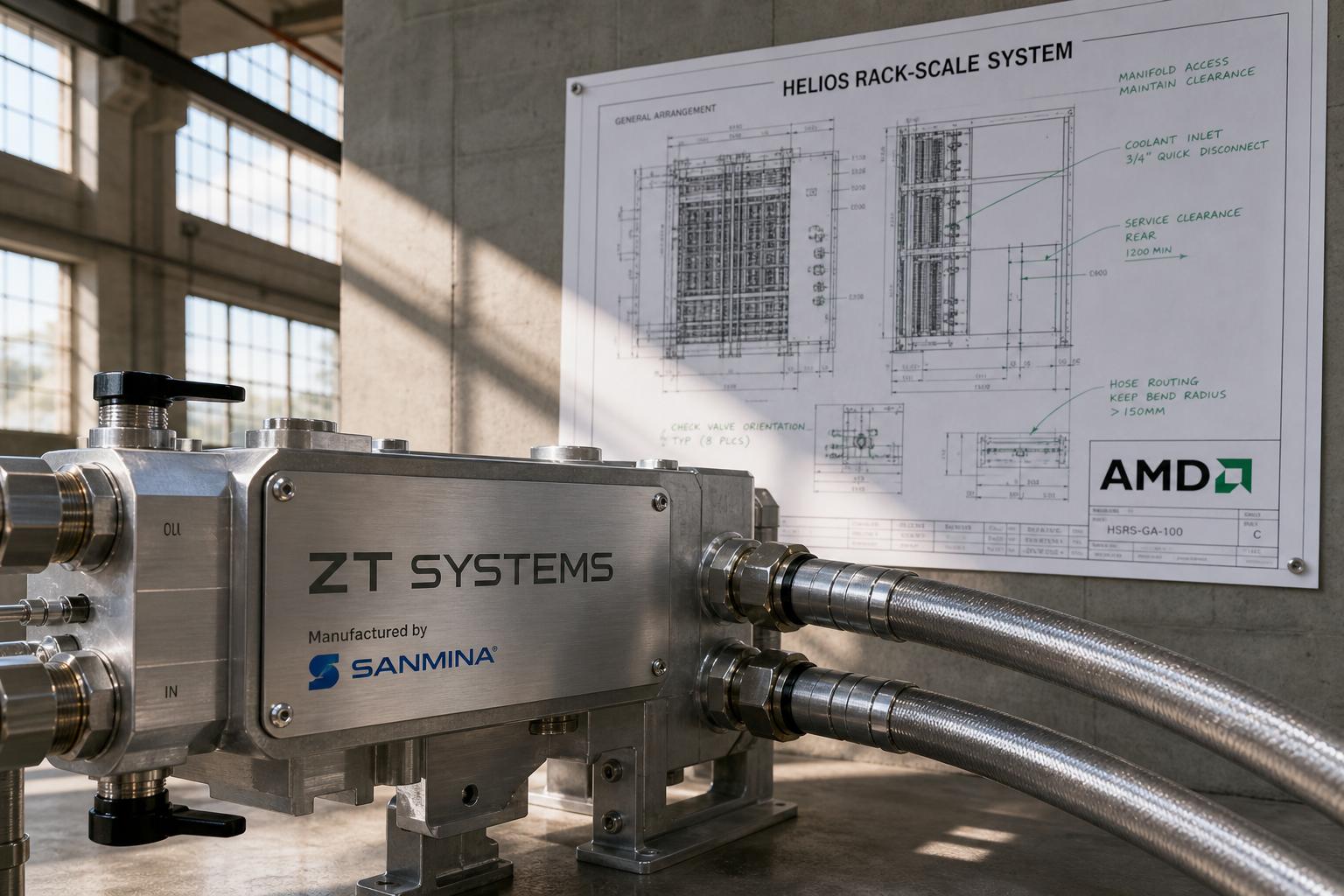
This retained engineering team is now visibly embedded in AMD's most important go-to-market efforts. In October 2025, AMD unveiled "Helios," described as "the most advanced rack-scale reference system from AMD," built around next-generation AMD Instinct MI450 Series accelerators and aligned with an Open Rack Wide (ORW) specification that Meta submitted to the Open Compute Project [10]. At full rack scale, AMD says a 72-GPU Helios system delivers up to 1.4 exaFLOPS of FP8 performance and 31 terabytes of aggregate HBM4 memory, with AMD claiming the design offers "50% more memory capacity than NVIDIA's Vera Rubin system" [10], a vendor performance claim that independent benchmarking had not yet verified as of this writing. AMD also emphasized the rack's cooling and networking engineering specifically, noting "up to 260 TB/s of scale-up interconnect bandwidth and 43 TB/s of Ethernet-based scale-out bandwidth" and that "backside quick-disconnect liquid cooling provides sustained, efficient thermal performance at high density," design considerations directly relevant to the liquid-cooling expertise Sanmina inherited from ZT's manufacturing plants [10].
The same retained ZT design capability underpins AMD's highest-profile customer commitment to date: the six-gigawatt AMD-OpenAI infrastructure partnership announced October 6, 2025, under which "the first 1 gigawatt deployment of AMD Instinct MI450 Series GPUs" is set to begin in the second half of 2026 [11]. AMD Chief Financial Officer Jean Hu said the OpenAI partnership "is expected to deliver tens of billions of dollars in revenue for AMD while accelerating OpenAI's AI infrastructure buildout," and as part of the same agreement AMD issued OpenAI a warrant for up to 160 million shares of AMD common stock, structured so that "the first tranche vests with the initial 1 gigawatt deployment, with additional tranches vesting as purchases scale up to 6 gigawatts," with vesting "further tied to AMD achieving certain share-price targets and to OpenAI achieving the technical and commercial milestones required to enable AMD deployments at scale" [11]. None of this scale of rack-level commitment would be credible without the systems engineering depth AMD acquired from ZT and deliberately chose to keep in-house rather than divest.
What Sanmina Bought: The Manufacturing Business and Its Facilities
The manufacturing business Sanmina acquired is a large, capital-intensive operation, not a shell. Its three primary sites, in Secaucus, New Jersey; Georgetown, Texas; and Almelo, the Netherlands, represent decades of accumulated liquid-cooling, power-delivery, and rack-integration expertise built specifically for hyperscale and, more recently, AI accelerator workloads. Sanmina's own description of the acquired assets emphasizes "large state-of-the-art manufacturing facilities located in New Jersey and Texas, with large amounts of power and advanced liquid cooling capabilities, as well as an operation in the Netherlands" [24].
Sanmina has been explicit that the deal is not simply about adding factory floor space, but about deepening its involvement across the full product lifecycle. The company said the combination "enables solutions for the entire product lifecycle: design, engineering, manufacturing and fulfillment," and that it broadens Sanmina's relationships with hyperscaler and original equipment manufacturer (OEM) customers across "all platforms and technologies in the industry" [24]. This matters because Sanmina's own long-term strategy, as described on an April 2026 earnings call, is explicitly to move "beyond final system integration to include high-technology printed circuit boards, liquid cooling manifolds, and custom optical modules," transitioning from a traditional EMS provider toward what management called a "value-add ODM service provider" [28].
The Equity Purchase Agreement's warranty and covenant sections also reveal operational details about the acquired business, including a specific carve-out addressing the "Dutch Company Subsidiary" (the Almelo, Netherlands operation) and provisions governing an "Exclusive Manufacturer" covenant during the transition period, underscoring that the manufacturing entity Sanmina bought was a genuine multinational operating company with its own credit facilities, tax structures, and existing customer contracts rather than a simple asset transfer [7].
Data Analysis and Evidence
Several distinct sets of figures document the size and financial performance of the businesses that changed hands. Table 1 below consolidates the headline transaction values across all three stages of the ownership change, since press coverage sometimes conflates the two separate deals (AMD's original ZT acquisition and AMD's later sale to Sanmina) under similar dollar figures.
Table 1 below summarizes the three transactions that collectively answer "who owns ZT Systems now," including announcement and closing dates, the parties, and the disclosed consideration structure.
| Transaction | Announced | Closed | Buyer | Seller | Total Disclosed Value |
|---|---|---|---|---|---|
| AMD acquires all of ZT Systems | August 19, 2024 [3] | March 31, 2025 [21] | AMD | Frank D. Zhang, Alpine Eagle LLC, Inventec Corporation, and other holders [2] | $4.9 billion cash and stock, including up to $400 million contingent [3] |
| AMD divests manufacturing to Sanmina | May 19, 2025 [23] | October 27, 2025 [1] | Sanmina Corporation | AMD Design, LLC (AMD subsidiary) [7] | Up to $3 billion: $2.25 billion cash plus $300 million premium (cash/equity) plus up to $450 million contingent [6] |
| Design/engineering team retained | N/A (internal AMD reorganization) | March 31, 2025 [21] | AMD (Data Center Solutions unit) | N/A | Not separately valued; folded into the $4.9 billion acquisition |
This table clarifies a common source of confusion: the "$3 billion" figure widely reported for the Sanmina transaction refers only to the manufacturing carve-out, not to ZT Systems as a whole, and is a completely separate transaction from the original $4.9 billion AMD acquisition eight months earlier. Readers searching for "ZT Systems ownership structure" should note that no single $X billion number captures total consideration across the full multi-year corporate history; the two deals must be added and understood as sequential, not overlapping.
Revenue trajectory. ZT Systems generated roughly $10 billion in annual revenue at the time AMD announced its acquisition in August 2024, according to CEO Lisa Su's own disclosure to reporters [8], with "most of which" derived from the manufacturing unit specifically, per Reuters' contemporaneous reporting [4]. By the time of the May 2025 sale announcement, Sanmina characterized the manufacturing business's "current annual net revenue run-rate" as $5 billion to $6 billion, implying the design business AMD retained accounted for a meaningful share of the original $10 billion figure, or that overall run-rate had moderated during the platform transition described in Sanmina's own release [23].
Post-acquisition performance under Sanmina. The clearest and most current evidence of ZT Systems' financial scale comes from Sanmina's own quarterly disclosures under its new ownership. In its fiscal second quarter of 2026 (ended in late March 2026 and reported April 27, 2026), Sanmina reported total company revenue of $4.01 billion, with ZT Systems revenue alone reaching $1.88 billion for the quarter, a figure that "significantly exceeded" the company's own expectations according to Jure Sola [13]. Analyst commentary summarized in a Morningstar earnings-call transcript recorded Sanmina management's guidance that "Core Sanmina revenue [would] be in the range of $2.2 to $2.3 billion" for the following quarter, "and we expect ZT Systems revenue to be in the range of $1.0 to $1.2 billion" [12], reflecting an expected sequential pullback after the quarter's unusually strong performance. Sanmina raised its fiscal 2026 full-year revenue guidance to $13.7 billion to $14.3 billion, up from prior expectations, and assumed ZT Systems would contribute between $5 billion and $6 billion on an annualized basis for the year [13].
Sanmina also disclosed that its ZT Systems integration is "progressing through a three-phase plan, with the first phase of capital investments in power, liquid cooling, and test cell capacity largely complete" as of the April 2026 earnings call, and that management expects to achieve more than $16 billion in total company revenue for fiscal 2027, driven by next-generation accelerated compute platforms. Inventory on Sanmina's balance sheet rose 75 percent year-over-year, which the company attributed "primarily [to] the structural addition of the ZT Systems business and preparation for future ramps," and the company's board separately authorized an additional $600 million in share repurchases alongside these results [28].
Table 2 below places these post-acquisition figures alongside pre-acquisition benchmarks to show the trajectory of the business under new ownership.
| Metric | Pre-Acquisition (2024) | Post-Acquisition Under Sanmina |
|---|---|---|
| ZT Systems annual revenue | Approximately $10 billion (2024, whole company) [8] | $5 to $6 billion annualized run-rate for the manufacturing business alone, per fiscal 2026 guidance [12] |
| Total employees | Approximately 2,500 [8] | Approximately 1,500 manufacturing staff moved to Sanmina; approximately 1,000 design staff moved to AMD [9] |
| Parent company quarterly revenue | N/A (privately held, no quarterly disclosure) | Sanmina total: $4.01 billion in fiscal Q2 2026, of which ZT Systems contributed $1.88 billion [13] [12] |
| Manufacturing footprint | Secaucus, NJ; Georgetown, TX; Almelo, Netherlands | Same facilities now integrated into Sanmina's approximately 80-site global manufacturing network [25] |
The data show a business that, under Sanmina's ownership, is not merely being absorbed but is actively driving Sanmina's overall growth narrative, contributing nearly half of total company revenue in the most recent reported quarter.
Case Studies and Real-World Examples
The AMD-OpenAI Six-Gigawatt Deployment
The clearest evidence that AMD's decision to retain ZT's design team (rather than sell all of ZT Systems as a single unit) is paying off commercially is the AMD-OpenAI infrastructure partnership. Announced October 6, 2025, the agreement commits OpenAI to deploy six gigawatts of AMD GPU capacity across multiple hardware generations, with an initial one-gigawatt deployment of AMD Instinct MI450 Series GPUs beginning in the second half of 2026. OpenAI co-founder and president Greg Brockman said, "Building the future of AI requires deep collaboration across every layer of the stack. Working alongside AMD will allow us to scale to deliver AI tools that benefit people everywhere" [11]. This deal depends entirely on rack- and cluster-scale systems engineering, precisely the discipline AMD acquired from ZT Systems and chose to keep rather than divest.
Sanmina's Fiscal Q2 2026 Earnings Beat
A second concrete case is Sanmina's own fiscal second-quarter 2026 results, reported April 27, 2026, which serve as the clearest independent evidence to date of ZT Systems' value under new ownership. Sanmina's quarterly revenue of $4.01 billion beat the company's own prior outlook, an outcome Sola attributed directly to ZT Systems: "ZT Systems revenue significantly exceeded our expectations, driven by strong execution and customer demand, resulting in new accelerated compute shipments previously expected in the second half of the year to shift into the second quarter" [13]. The company's book-to-bill ratio of 1.1, reported for the same quarter, reflected positive demand trends across end markets despite some component shortages in memory and custom application-specific integrated circuits (ASICs) [28].
Frank Zhang's Transition From Founder to AMD Executive
The transition of ZT Systems founder Frank Zhang from independent company CEO to AMD senior vice president illustrates how thoroughly the ownership change restructured leadership incentives. Zhang, who had run ZT Systems since 1994 through Alpine Eagle LLC, moved to AMD specifically "to help lead the divestiture of the manufacturing business," meaning the founder of the company was tasked, in his new corporate role, with finding and closing the sale of the very factories he had spent three decades building [21]. That divestiture, to Sanmina, closed roughly seven months after Zhang took on the assignment.
Regulatory Clearance Across Three Jurisdictions
A fourth case worth documenting is the multi-jurisdictional antitrust process the original AMD-ZT deal required, illustrating how even a systems-integration acquisition in the AI hardware sector now draws close regulatory scrutiny. Singapore's CCCS ran a formal public consultation from November 26 to December 10, 2024 before clearing the deal [5], while the European Commission set and ultimately met a March 12, 2025 review deadline [15]. AMD's deal ultimately closed on March 31, 2025, only weeks after that EU deadline, indicating the review concluded on, or close to, schedule.
(Hypothetical Example) A Hyperscaler Choosing Between AMD-Sanmina and Nvidia-Supermicro Supply Chains
To illustrate the practical stakes of this ownership split for a buyer of AI infrastructure, consider a hypothetical large cloud operator evaluating two competing supply paths in 2026: an AMD Instinct-based rack designed by AMD's retained ZT engineering team and manufactured by Sanmina under the new preferred NPI partnership, versus an Nvidia-based rack built in-house by Nvidia's DGX organization or manufactured by a competitor such as Supermicro. Under the AMD-Sanmina path, the operator would negotiate chip supply and system design directly with AMD (which owns the systems engineering intellectual property from the former ZT design team) but would place manufacturing purchase orders with Sanmina under the companies' preferred NPI arrangement [24]. This scenario is illustrative only and does not describe any specific disclosed customer negotiation, but it clarifies why the AMD-Sanmina split, rather than a single combined ZT-AMD entity, was structured the way it was: it separates design IP ownership from manufacturing capacity ownership in a way that mirrors how Nvidia and its own contract manufacturers already operate.
Implications and Future Directions
The AMD-ZT-Sanmina restructuring offers a template that other chip and AI infrastructure companies are likely to study closely. By acquiring ZT Systems whole, extracting the design talent, and reselling the manufacturing assets to an established EMS player, AMD achieved three things simultaneously: it gained rack-scale systems engineering depth to compete with Nvidia's DGX approach, it avoided becoming a systems manufacturer that would compete with its own hyperscale customers, and it converted a capital-intensive manufacturing liability into a cash-and-equity-generating divestiture that offset much of the original acquisition cost [16]. AMD Chief Financial Officer Jean Hu indicated as early as August 2024 that "the minor dilution from the deal in the first year after closing in 2025 would be offset by greater sales of graphics processor units, creating a break-even effect for the deal," with acceleration of revenue growth expected in 2026 [4]. CRN summarized the strategic stakes plainly, noting that AMD made the ZT Systems acquisition "to mount a larger challenge against Nvidia's dominance of the AI infrastructure market," and separately reported CEO Lisa Su's view that a related AMD-OpenAI customer win could have a "compounding effect" resulting in AMD making "well over $100 billion in revenue over the next few years" from other customers deploying similar Instinct infrastructure [22].
For Sanmina, the implications are more transformative than incremental. Management's own April 2026 commentary described fiscal 2026 as "a transition year" for margin structure, with long-term profitability depending on "whether the business remains primarily consignment as currently assumed" and on customer agreements still being finalized that will "dictate the '27 margin profile," while the company's stated intent to move up the value chain, into printed circuit boards, liquid cooling manifolds, and optical modules rather than remaining a pure assembler, suggests it views the ZT Systems acquisition as a platform for structurally higher margins over time, not simply a one-time revenue bump [28].
On Reddit, retail investors in AMD-focused communities have tracked the deal's structure closely since it was first announced, with threads in the r/AMD_Stock community discussing both the original divestiture announcement and its financial implications for AMD shareholders [29]. One widely discussed comment in that thread argued the arrangement effectively let AMD access engineering capability faster than building it alone, reasoning that "it would have taken 5 yrs to develop such capabilities organically" without the acquisition [29], while another compared the scale mismatch, noting Sanmina was "a $4B market cap company" absorbing a "$3B acquisition" that the commenter called "massive for them," and a separate comment reproduced Sanmina's own investor materials indicating the deal was "expected to double Sanmina's revenue scale in three years" [29]. This sentiment should be read as informal community discussion rather than verified analysis, but it underscores that the AMD-ZT-Sanmina ownership chain has been closely, and correctly, understood by financially engaged retail audiences as a genuine three-way split rather than a straightforward single acquisition.
Looking forward, the durability of the AMD-Sanmina "preferred NPI" partnership will likely be tested as new accelerated compute platforms, including AMD's Instinct MI450 successors, move from reference design to volume production. Sanmina has already indicated that new platforms are "scheduled for production in September [2026], but significant revenue impact is expected in fiscal 2027 rather than 2026 due to manufacturing and shipping lead times" [28], meaning the full financial payoff of the ownership restructuring for both companies is still materializing well into 2027 rather than complete as of mid-2026.
Frequently Asked Questions (FAQs)
Who owns ZT Systems now? As of July 2026, ZT Systems' design and customer-enablement business is owned by AMD, part of its Data Center Solutions unit, while ZT Systems' manufacturing business, including its factories and the ZT Systems brand name, is owned by Sanmina Corporation, following Sanmina's completed acquisition on October 27, 2025, an event the ZT Systems newsroom itself now describes as Sanmina having "expanded Cloud and AI capabilities with acquisition of ZT Systems" [17].
What happened to ZT Systems? ZT Systems, an independent, privately held company since 1994, was acquired in full by AMD in a deal announced in August 2024 and completed in March 2025. AMD then split the company, keeping the design and engineering staff and selling the manufacturing business to Sanmina in a deal that closed in October 2025, with Sanmina becoming "a preferred new product introduction (NPI) manufacturing partner" for AMD as part of the arrangement [1].
How much did AMD pay for ZT Systems originally? AMD agreed to pay $4.9 billion in cash and stock, including a contingent payment of up to $400 million, for the entire company in August 2024, a figure CB Insights independently placed in a $4.5 billion to $4.9 billion valuation range [14].
How much did Sanmina pay AMD for the ZT Systems manufacturing business? Sanmina agreed to pay up to $3 billion, consisting of $2.25 billion in cash for net assets, a $300 million premium split between cash and Sanmina stock, and up to $450 million in contingent, performance-based consideration, terms that were also summarized for retail investors in AMD-focused online communities shortly after the announcement [29].
Is ZT Systems still a separate company? Legally, ZT Group Int'l, Inc. is the entity Sanmina acquired and now operates as a wholly owned Sanmina subsidiary and manufacturing brand; it is not an independent, standalone company anymore, though its newsroom continues to publish under the ZT Systems name [27].
What happened to ZT Systems founder Frank Zhang? Zhang joined AMD as senior vice president of ZT Manufacturing following the March 2025 acquisition, specifically to lead the divestiture of the manufacturing business to Sanmina, a process that concluded in October 2025, at which point CRN reported AMD had formally "closed the $3 billion divestiture" while retaining the design organization Zhang no longer led [22].
Does AMD still make servers through ZT Systems? No. AMD retained only ZT's design and customer-enablement teams and does not manufacture servers itself; manufacturing now belongs entirely to Sanmina under a preferred NPI manufacturing partnership with AMD.
Conclusion
The answer to "who owns ZT Systems now" is not a single company, but a deliberate two-way split executed across three transactions over roughly 14 months. AMD completed its full acquisition of the formerly independent, Secaucus-based server maker on March 31, 2025, for $4.9 billion, then divested the manufacturing half to Sanmina Corporation for up to $3 billion in a deal that closed October 27, 2025. Today, AMD owns and operates ZT's former design and customer-enablement organization inside its Data Center Solutions business unit, using that talent on high-profile projects including its Helios rack-scale reference design and the six-gigawatt AMD-OpenAI infrastructure partnership. Sanmina owns the manufacturing plants in New Jersey, Texas, and the Netherlands, along with the ZT Systems brand itself, and by its fiscal second quarter of 2026 that acquired business was generating $1.88 billion in quarterly revenue and materially exceeding Sanmina's own expectations.
This structure reflects a considered strategic choice rather than an accident of deal-making: AMD wanted rack-scale systems engineering capability to compete with Nvidia without becoming a systems manufacturer in competition with its own customers, while Sanmina wanted an immediate, large-scale entry into cloud and AI infrastructure manufacturing that would have taken years to build organically. Both companies appear, based on their most recent public disclosures through mid-2026, to be realizing the benefits they sought, even as Sanmina itself has cautioned that the full margin and revenue profile of the acquired business will not be settled until fiscal 2027. For anyone tracking ZT Systems specifically, the practical takeaway is straightforward: the company as it existed before August 2024 no longer exists as a single entity, its engineering legacy lives on inside AMD, and its manufacturing legacy, including its name, now belongs to Sanmina.
External Sources (29)
About
GPUSmith
Plan and build private AI compute with GPU Smith. We connect workload requirements with GPU hardware, networking, deployment and operating decisions so your infrastructure fits the work it must perform.
GPU Smith provides independent engineering and research for private AI infrastructure. We help technical buyers and operators reason about GPU workload sizing, hardware selection, procurement, deployment and inference operations, from the compute system to the networking, power and cooling requirements around it.
Start with the workload
Useful infrastructure decisions begin with the models, data, throughput, latency and operating constraints a team actually has. GPU Smith helps connect those requirements with system design and deployment choices. The goal is a privately controlled AI environment whose capacity and operational demands are understood before a purchasing decision.
Hardware and supplier research
Our public reference library covers GPUs, complete systems and networking components. The server-vendor directory and manufacturing research help teams investigate suppliers, compare options and follow sources behind technical claims. We distinguish manufacturer specifications from measured benchmarks and advertised capabilities from tested configurations. Reference pages are research resources, not a live inventory listing or a binding equipment quote.
Deployment and operations
GPU Smith's engineering scope includes infrastructure integration, networking, power, cooling and the practical operation of inference workloads. Our published articles explain the tradeoffs behind deployment, procurement and ongoing operations so teams can ask better questions and document decisions.
Work with GPU Smith
Explore the hardware library, GPU references, networking references and vendor research. Contact GPU Smith with your workloads and deployment constraints to discuss a project and confirm current scope, pricing and availability.
Inclusion of a manufacturer or product in our research does not imply a partnership, certification or endorsement.
Disclaimer
This document is provided for informational purposes only. No representations or warranties are made regarding the accuracy, completeness, or reliability of its contents. Any use of this information is at your own risk. GPUSmith shall not be liable for any damages arising from the use of this document. This content was generated with assistance from artificial intelligence tools, which may contain errors or inaccuracies. Readers should verify critical information independently. All product names, trademarks, and registered trademarks mentioned are property of their respective owners and are used for identification purposes only. Use of these names does not imply endorsement. This document does not constitute professional or legal advice. For specific guidance related to your needs, please consult qualified professionals.