GPUSmith Article
Immersion vs Direct-to-Chip Cooling for GPU Clusters
How operators choose between immersion and direct-to-chip liquid cooling for GPU clusters: fluids, PFAS, density, floor loading, warranty, facility water.
Summary
- 01NVIDIA's current rack-scale platforms use cold plates. Immersion remains an option for servers qualified for it or sold as an immersion configuration with a written warranty.
- 02Cold plates have a vendor rack design as a de facto reference, but standards gaps remain around coolant, mechanical interfaces, ownership and maintenance.
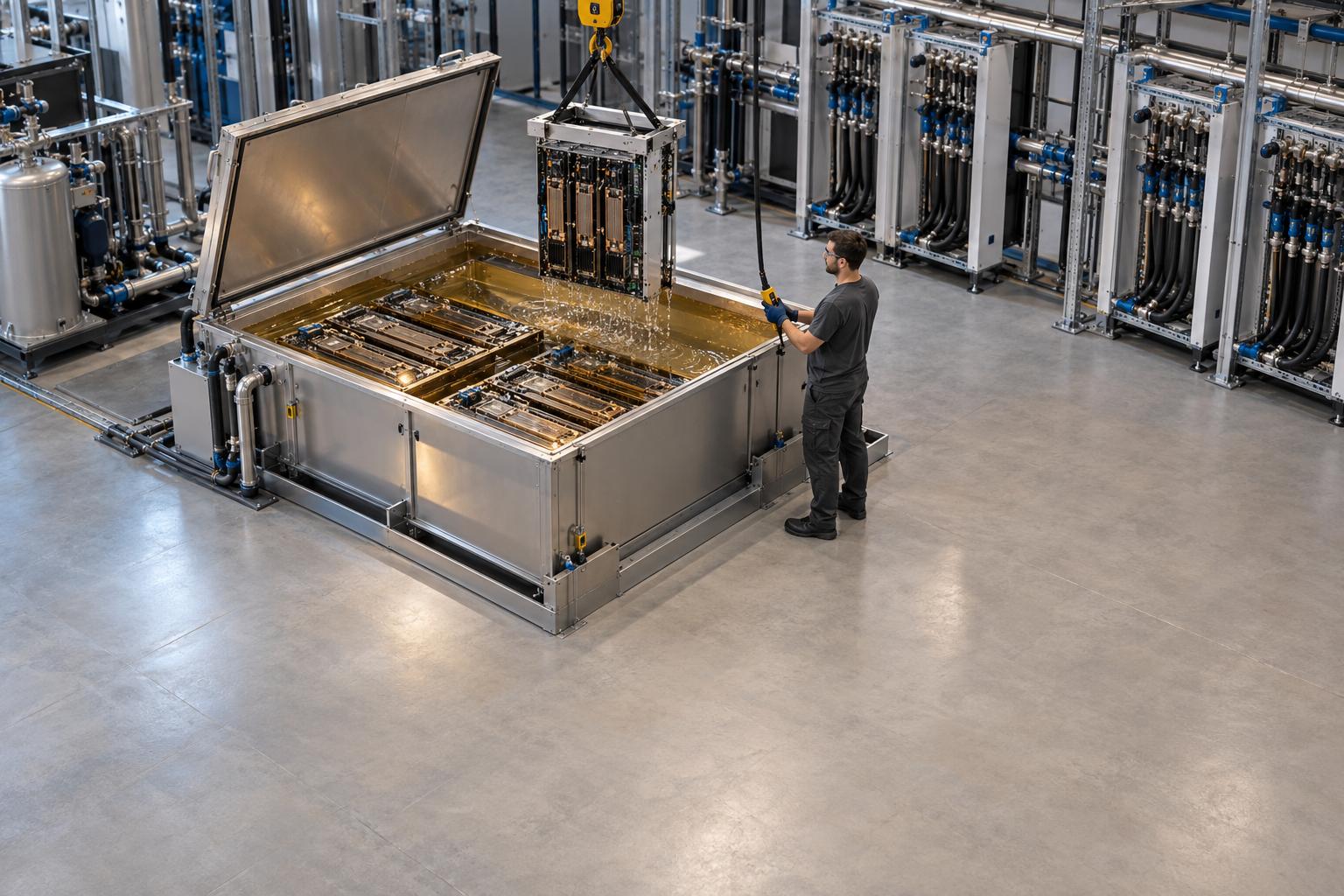
- 03Immersion changes operations through top-access servicing, lifting equipment, drip time, spill management, hardware changes and fluid hygiene.
- 04Compare cooling capacity at the same facility-water temperature. The example immersion tank loses 25% of its rating between 25 °C and 35 °C water.
- 05At 20 MW of GPU load, the article favors cold plates as the default. Immersion works when one party owns server design, fluid, tank and warranty.
Inside this article
- 01The short answer
- 02The taxonomy: six kinds of direct liquid cooling
- 03What immersion is, in OCP's terms
- 04Standards maturity
- 05Fluids, fire and PFAS
- 06Density, weight and floor loading
- 07Serviceability and operations
- 08Resilience and redundancy
- 09OEM support and warranty
- 10Facility water temperatures
- 11Is immersion production-ready at 20 MW?
- 12Decision matrix
- 13FAQ
- 14Sources
The short answer
For NVIDIA's current rack-scale platforms the choice is mostly made for you: they are cold-plate designs. NVIDIA describes the GB200 NVL72 as "a rack-scale, liquid-cooled design" connecting 36 Grace CPUs and 72 Blackwell GPUs [1], and HPE's QuickSpecs for its build of that rack state that "the compute trays are cooled with cold plates that are mounted on the CPUs and GPUs" [2]. The GB300 NVL72 "features a fully liquid-cooled, rack-scale architecture" [3]. Immersion remains an option for servers you can qualify yourself, or that a vendor sells as an immersion configuration with a written warranty.
Market data agrees. Dell'Oro says single-phase DLC "accounts for the vast majority of liquid-cooled capacity coming online today", while immersion "is finding its place through selective adoption" [4].
The taxonomy: six kinds of direct liquid cooling
Uptime Institute counts six commercially available direct liquid cooling (DLC) categories: three cold-plate types (water cold plates, single-phase dielectric cold plates, two-phase dielectric cold plates) and three immersion types (chassis immersion, single-phase immersion, two-phase immersion) [5].
| Category | What touches the silicon | Heat leaves the IT as | Typical form |
|---|---|---|---|
| Water cold plate (single-phase DTC) | Metal plate, water-based coolant inside | Warm liquid in a secondary loop | Standard-width rack, manifolds, CDU |
| Two-phase dielectric cold plate | Metal plate, boiling dielectric inside | Vapor, condensed at the rack or CDU | Rack, refrigerant-style loop |
| Chassis (enclosed) immersion | Dielectric fluid inside a sealed sled | Liquid via dripless connectors | Vertical rack of sealed chassis |
| Single-phase immersion (open bath) | Dielectric fluid bath | Pumped or convected liquid to a heat exchanger | Horizontal tank, servers lowered in from the top |
| Two-phase immersion | Boiling dielectric bath | Vapor, condensed at a coil above the bath | Sealed horizontal tank |
"Direct-to-chip" in vendor language almost always means the first row: a cold plate on each GPU and CPU, fed by a secondary loop from a coolant distribution unit (CDU). HPE's GB200 NVL72 CDU passes that heat to the facility loop through a liquid-to-liquid heat exchanger [2]. For acceptance testing, see our cold plate GPU rack commissioning checklist.
What immersion is, in OCP's terms
As of October 2026, the current Open Compute Project (OCP) revision is Immersion Requirements Rev 2.10, last updated 2023-08-18, after 1.00 (2019-05-20) and 2.00 (2022-01-21) [6]. That explains why some sources cite Rev 1.0 and others, such as Vertiv's 2022 blog, cite Rev 2.0. OCP's immersion project page lists Rev 2.10 (titled v2.1 there) as current and marks rev 2 and rev 1 as legacy. It is "a requirements document and not a specification" [7].
Its definitions (unchanged from Rev 2.0):
- Single-phase immersion: the liquid "is heated and cooled without changing phase"; circulation "can be done through natural or forced convection."
- Two-phase immersion: the liquid "is heated and changes to gas"; the vapor is condensed and returns to the bath "through a natural buoyancy-driven flow."
- Enclosed chassis: sealed sleds, usually stacked in a rack, "pulled out and inserted in horizontal plane for service."
- Open bath: a tank in which multiple IT systems share one body of fluid. Such tanks "can be fully sealed, but are always opened from the top to service IT equipment" [8][6].
OCP has also published a Base Specification for Immersion Fluids (Rev 1.0, 2022-12-01) Warranty Guidelines for Immersion Cooled Technology (Rev 1.0, 2024-04-26) and Server Component Immersion Material Compatibility Testing guidelines (v1.5, 2026-06-05).
Standards maturity
Cold-plate DLC has its own standards gap. Uptime wrote that "there is no comparable standard coolant or line of demarcation for DLC" and that mechanical interface standards "will take years to materialize in product form" [5]. In April 2026 it added that "the industry also lacks a singular consensus on the division of ownership and maintenance for DLC components" [9]. What cold plates have and immersion lacks is a de facto reference: the GPU vendor's own rack design, built and warranted by OEMs.
Fluids, fire and PFAS
Single-phase fluids
OCP groups immersion liquids into "hydrocarbons (i.e. mineral, synthetic or bio oils) and fluorocarbons (i.e. fully engineered liquids)" [8]. Rev 2.10 sets minimums for any immersion fluid: a flash point (closed cup) of at least 150 °C, an auto-ignition point of at least 300 °C, and volume resistivity of at least 2.00 GΩm when new [6]. A flash point at that level still allows the fluid to burn. Uptime's June 2024 report on immersion fluids is titled "Immersion fluids hold promise, but fire risk a concern" [10]. (The full report is paywalled.) Expect your fire engineer and insurer to ask for the fluid's SDS and TDS.
Two-phase immersion and the 3M exit
Two-phase immersion relied on fluorinated fluids. On 2022-12-20 3M announced it would "exit per- and polyfluoroalkyl substance (PFAS) manufacturing" and "work to discontinue the use of PFAS across its product portfolio by the end of 2025" [11]. Uptime says interest in immersion now "almost exclusively means single-phase immersion", which "is largely due to 3M's exit from the segment" [10].
OCP's fluid specification defines PFAS as "any substance that contains a -CF2- or -CF3 group" [12]. At EU level, ECHA's risk assessment committee (RAC) adopted its opinion on the universal PFAS restriction in early March 2026 [13]. The socio-economic committee (SEAC) published a draft opinion in March 2026 for consultation until 2026-05-25. As of 2026-10-28 its final opinion has not been reported as adopted; it is expected by the end of 2026, after which the Commission drafts the restriction for the REACH Committee, with Parliament and Council scrutiny before it enters Annex XVII [14]. For any fluorinated fluid, ask whether it contains those groups and what supply commitment the vendor gives.
Two-phase direct-to-chip
Two-phase cold plates boil a dielectric inside the plate rather than a bath. OCP's March 2026 guidelines for these racks (Revision 1.1) call for fluids that are non-flammable, ASHRAE 34 class A1, with GWP below 700, near-zero ODP, and a boiling point between −26.3 °C and 60 °C [15]. Dell'Oro expects two-phase DLC "to expand gradually", with adoption accelerating "once chip-level TDPs and thermal flux exceed the practical limits of single-phase systems" [4]. Apply the same PFAS check to these fluids.
What cold plates have and immersion lacks is a de facto reference: the GPU vendor's own rack design, built and warranted by OEMs.
Density, weight and floor loading
Filled tanks "can get quite heavy", says OCP's fluid spec, which caps fluid density at 2,000 kg/m³ at 25 °C, a ceiling chosen so as not to exclude any liquid [12]. Rev 2.10 asks vendors to publish bare, full and IT static load in kN/m² [6].
Worked example (derived from vendor datasheets; illustrative, not a design calculation).
Inputs, single-phase tank: the GIGABYTE 25U EIA tank (A1P0-EB0) is rated 80 kW with 25 °C inlet water and 60 kW with 35 °C. The tank measures 0.91 × 1.16 m and weighs 450 kg empty and 1,065 kg with 750 L of coolant. Its CDU measures 0.86 × 0.48 m and weighs 325 kg [16].
Inputs, cold-plate rack: HPE's GB200 NVL72 is 1,068 × 600 mm, 3,245 lb fully loaded, with a rack TDP of "132 kW nominal" and peak electrical design power of about 192 kW [2].
| Derived figure | Immersion tank (no servers) | GB200 NVL72 rack (loaded) |
|---|---|---|
| Footprint | 0.91 × 1.16 = 1.056 m² | 1.068 × 0.600 = 0.641 m² |
| Mass | 1,065 kg | 3,245 lb × 0.4536 = 1,472 kg |
| Distributed load | 1,065 / 1.056 = 1,009 kg/m² ≈ 9.9 kN/m² | 1,472 / 0.641 = 2,297 kg/m² ≈ 22.5 kN/m² |
| Heat per footprint | 80 / 1.056 = 76 kW/m² (55 kW/m² incl. its CDU) | 132 / 0.641 = 206 kW/m² (CDU excluded) |
| Implied fluid density (derived, not a datasheet value) | (1,065 − 450) / 750 ≈ 0.82 kg/L | n/a |
The tank excludes servers; the rack excludes its CDU and aisle space. Even so, the pattern holds: a horizontal tank spreads its load and gives up heat density per square metre, while a DLC rack concentrates both. Check both against slab rating and delivery path; our GPU rack floor loading and delivery path worksheet walks through that check.
Scaling to 20 MW of IT (same inputs, illustrative). At 80 kW per tank: 20,000 / 80 = 250 tanks, 250 × 750 L = 187,500 L of fluid, about 250 × 615 kg ≈ 154 t of fluid mass. If facility water is 35 °C instead of 25 °C, the rating falls to 60 kW: 20,000 / 60 ≈ 334 tanks and about 250,000 L. Fluid capex is then simply fill volume × your quoted price per litre. We found no independent public price, so get it quoted with a top-up allowance.
Serviceability and operations
Cold-plate trays are serviced much like air-cooled ones, if the quick-disconnects behave. Immersion changes the work:
- Access. Open baths are serviced from the top [8]. Lifting equipment and ceiling clearance become part of the design. Rev 2.10 asks vendors to state height clearance "incl. clearance for lid, servicing mechanisms" [6].
- Drip time. Higher-viscosity fluids increase the time equipment must drip before servicing [12].
- Spill and staffing rules. OCP requires spill-absorption capacity for "a catastrophic spill from the full contents of the largest tank", at least one person trained in spill management, and operator training "on the properties of each dielectric liquid in use" [8].
- Hardware changes. OCP's design guide for immersion-cooled IT flags thermal pastes that "may dissolve" (Indium foil is the usual replacement), PSUs that need modification "to allow long-term operation without fans", and optical connectors where fluid replacing the air gap causes "signal reflection loss". Mitigations: air-gap-free or sealed transceivers, or port extenders [17].
- Fluid hygiene. Rev 2.10 says the fluid supplier or solution provider "shall deliver the fluid hygiene/maintenance best practices" [6], and the warranty guideline notes that "some fluid vendors are starting to offer fluid quality monitoring service" [18].
Resilience and redundancy
Uptime's April 2026 analysis: "DLC closely couples the facility infrastructure with the IT", redundant CDUs and manifolds "need to be carefully engineered and operated", and "acceptable ride-through time typically requires UPS power for CDU pumps, at a minimum" [9]. Coolant volume is "much less than that of the air in the data hall", so there is little thermal buffer.
Immersion has more thermal mass in the bath. OCP notes that dielectric ride-through can delay overheating "for seconds or days, depending on the technology", and that quantifying it is still to be defined. Its "High Availability" class requires N+1 or 2N cooling (dual heat exchangers or CDUs), which may be supplemented by ride-through providing "at least 30 minutes of operation without cooling" [6]. Test ride-through at real GPU load during acceptance.
OEM support and warranty
OCP's warranty workstream exists to address "why warranties are not consistently offered for immersion cooling solutions". It notes that "almost all warranties for IT equipment today assume air cooling... and often the only approved use case" [18].
The standard to look for is an explicit rider. Intel, for example, offers a "Xeon Processor Single-Phase Immersion Warranty Rider" for 4th and 5th Gen Xeon with Shell immersion fluids on Supermicro and Submer hardware [19]. As of October 2026 we did not find a comparable public NVIDIA statement either supporting or excluding immersion for its data center GPUs, so we make no claim either way. Before buying, get answers in writing from the server OEM (and, through them, NVIDIA) to these questions:
- Is immersion in this named fluid a supported configuration for this exact SKU, including GPU baseboard, NICs, optics and PSUs?
- Which components must be removed or swapped (fans, thermal paste, labels, transceivers), and who does it?
- What fluid temperature range and fluid-quality limits keep the warranty valid, and who monitors them?
- How are RMA units cleaned and shipped, and who pays?
If the answer to question 1 is not an explicit yes on paper, plan for cold plates.
- 01Confirm the configuration
Get support confirmed for the named fluid and exact SKU, including GPU baseboard, NICs, optics and PSUs.
- 02Identify hardware changes
Ask which components must be removed or swapped and who performs the work.
- 03Set operating limits
Ask which fluid temperatures and fluid-quality limits preserve the warranty and who monitors them.
- 04Agree on RMA handling
Ask how RMA units are cleaned and shipped, and who pays.
If support for the named fluid and exact SKU is not an explicit yes on paper, plan for cold plates.
Facility water temperatures
Both architectures end at a heat exchanger. ASHRAE's fifth edition renamed the liquid-cooling classes by their upper facility-water limit: W17, W27, W32, W40, W45 and W+ (above 45 °C) [20]. OCP Rev 2.10 asks immersion vendors to report density at W-class temperatures and requires a W32 footprint figure [6]. The GIGABYTE tank above loses 25% of its rating between 25 °C and 35 °C water.
On the cold-plate side, NVIDIA said at CES in January 2026 that Vera Rubin can be cooled with 45 °C water "with no chillers necessary", and that the Vera Rubin NVL72 rack will be 100% liquid cooled [21]. Treat it as a vendor claim until the final rack specification is published. Warmer supply water reduces reliance on chillers for either architecture. For the water-consumption side see how much water data centers use.
Is immersion production-ready at 20 MW?
Single-phase immersion is a commercial product, but at 20 MW of GPU load the evidence points away from it as the default:
- The largest share of new liquid-cooled capacity is single-phase DLC, and immersion is in "selective adoption" [4].
- NVIDIA's rack-scale systems are cold-plate products [2].
- Warranty coverage for immersion is "not consistently offered" [18].
- Two-phase immersion lost 3M as a fluid supplier [10].
Immersion at that scale works when one party owns server design, fluid, tank and warranty, as in the Intel/Shell/Supermicro/Submer model. It is a poor fit for NVL72-class hardware whose warranty is your main asset protection.
Decision matrix
- NVIDIA's current rack-scale platforms are cold-plate designs.
- Trays are serviced much like air-cooled ones, if quick-disconnects behave.
- The example DLC rack concentrates load and heat density per square metre.
- Redundant CDUs and manifolds require careful engineering; pump UPS power typically supports ride-through.
- Qualify servers yourself or buy a vendor immersion configuration with a written warranty.
- Open baths need top access, lifting equipment and ceiling clearance.
- The example horizontal tank spreads load while giving up heat density per square metre.
- The bath adds thermal mass; test ride-through at real GPU load during acceptance.
In the worked example, the tank excludes servers; the rack excludes its CDU and aisle space. Check both against slab rating and delivery path.
| Situation | Lean towards | Why |
|---|---|---|
| GB200/GB300 NVL72 or successor racks | Single-phase cold plate | Vendor's own liquid-cooled design; OEM-built and warranted |
| HGX 8-GPU servers, new build | Cold plate (liquid-cooled SKU) | Liquid-cooled HGX SKUs exist, e.g. Cisco/Supermicro's 4U HGX B300 [22]; immersion needs written SKU+fluid approval |
| Mixed fleet in a legacy hall | Cold plate for GPUs, air for the rest | Keeps one air-side design; no tank retrofit |
| Certified immersion stack with written warranty rider | Single-phase immersion | Warranty and fluid risk sit with the vendor |
| Little ceiling height, no lifting gear, small ops team | Cold plate | Top-access servicing and fluid handling add work |
| Long ride-through needed, hardware immersion-qualified | Single-phase immersion | Bath thermal mass; test it |
| Any fluorinated fluid | Defer, or get supply and PFAS commitments | 3M exit; EU restriction pending |
| Hot facility water (W40/W45) is a design goal | Either; compare at equal W-class | Check derated tank kW and rack supply limits |
For chiller plant and containment, see GPU data center cooling design guide.
FAQ
Does immersion void an NVIDIA GPU warranty? We found no public NVIDIA statement either way as of October 2026. Get the OEM's answer in writing for the exact SKU and fluid.
Is two-phase immersion still an option? It exists, but mainstream interest is "nascent" after 3M's PFAS exit [10], and PFAS rules are still being finalised in the EU.
Do immersion tanks need a reinforced floor? Check them against the slab like any rack. In the example above a filled tank (before servers) loads about 9.9 kN/m², versus about 22.5 kN/m² for a loaded GB200 NVL72; the bigger differences are total fluid mass and spill containment.
For an independent review of a cooling architecture before you commit, GPU Smith can help.
Sources
- NVIDIA GB200 NVL72 — NVIDIA, accessed 2026-10-28
- NVIDIA GB300 NVL72 — NVIDIA, accessed 2026-10-28
- NVIDIA GB200 NVL72 by HPE QuickSpecs — Hewlett Packard Enterprise, version 6, 2026-09-08, accessed 2026-10-28
- Data Center Liquid Cooling Market to Approach $7 Billion by 2029 — Dell'Oro Group, 2026-01-08, accessed 2026-10-28
- Direct liquid cooling: pressure is rising but constraints remain — Uptime Institute, 2022-07-06, accessed 2026-10-28
- Liquid cooling will not outgrow its high-density niche — Uptime Institute, 2026-04-15, accessed 2026-10-28
- Immersion fluids hold promise, but fire risk a concern — Uptime Institute Intelligence, 2024-06-25 (public summary), accessed 2026-10-28
- Immersion Requirements Rev 2.10 — Open Compute Project, 2023-08-18, accessed 2026-10-28
- Immersion Requirements Rev 2.0 — Open Compute Project, 2022-01-21, accessed 2026-10-28
- Immersion Requirements Document Rev 1.0 — Open Compute Project, 2019-05-20, accessed 2026-10-28
- OCP Immersion project page — Open Compute Project, accessed 2026-10-28
- Updated immersion cooling requirements from OCP pave the way for increased adoption — Vertiv, 2022-08-24, accessed 2026-10-28
- Base Specification for Immersion Fluids Rev 1.0 — Open Compute Project, 2022-12-01, accessed 2026-10-28
- Server Component Immersion Material Compatibility Testing v1.5 — Open Compute Project, 2026-06-05, accessed 2026-10-28
- Warranty Guidelines for Immersion Cooled Technology Components, Equipment and Systems Rev 1.0 — Open Compute Project, 2024-04-26, accessed 2026-10-28
- Design Guidelines for Immersion-Cooled IT Equipment Rev 1.01 — Open Compute Project, 2020-12-07, accessed 2026-10-28
- Guidelines for Using Dielectric Heat Transfer Fluids in Two-Phase Cold Plate-Based Liquid-Cooled Racks Rev 1.1 — Open Compute Project, March 2026, accessed 2026-10-28
- 3M to Exit PFAS Manufacturing by the End of 2025 — 3M, 2022-12-20, accessed 2026-10-28
- EU universal PFAS restriction process enters its decisive phase: SEAC draft opinion — Linklaters, 2026-04-09, accessed 2026-10-28
- ECHA Risk Assessment Committee Adopts Opinion on Universal PFAS Restriction — ChemLinked, 2026-03-06, accessed 2026-10-28
- Intel and Shell Advance Immersion Cooling in Xeon-Based Data Centers — Intel, 2025-05-13, accessed 2026-10-28
- AI Server for NVIDIA HGX B300, Liquid Cooled (data sheet) — Cisco, accessed 2026-10-28
- GIGABYTE 25U EIA Tank A1P0-EB0 — GIGABYTE, accessed 2026-10-28
- Major changes to ASHRAE's fifth edition of thermal guidelines, part 3: liquid cooling chapter updates — Upsite Technologies, 2024-07-31, accessed 2026-10-28
- Vera Rubin hot water cooling reveal triggers HVAC share drop — DatacenterDynamics, 2026-01-07, accessed 2026-10-28
External Sources (22)
About
GPUSmith
Plan and build private AI compute with GPU Smith. We connect workload requirements with GPU hardware, networking, deployment and operating decisions so your infrastructure fits the work it must perform.
GPU Smith provides independent engineering and research for private AI infrastructure. We help technical buyers and operators reason about GPU workload sizing, hardware selection, procurement, deployment and inference operations, from the compute system to the networking, power and cooling requirements around it.
Start with the workload
Useful infrastructure decisions begin with the models, data, throughput, latency and operating constraints a team actually has. GPU Smith helps connect those requirements with system design and deployment choices. The goal is a privately controlled AI environment whose capacity and operational demands are understood before a purchasing decision.
Hardware and supplier research
Our public reference library covers GPUs, complete systems and networking components. The server-vendor directory and manufacturing research help teams investigate suppliers, compare options and follow sources behind technical claims. We distinguish manufacturer specifications from measured benchmarks and advertised capabilities from tested configurations. Reference pages are research resources, not a live inventory listing or a binding equipment quote.
Deployment and operations
GPU Smith's engineering scope includes infrastructure integration, networking, power, cooling and the practical operation of inference workloads. Our published articles explain the tradeoffs behind deployment, procurement and ongoing operations so teams can ask better questions and document decisions.
Work with GPU Smith
Explore the hardware library, GPU references, networking references and vendor research. Contact GPU Smith with your workloads and deployment constraints to discuss a project and confirm current scope, pricing and availability.
Inclusion of a manufacturer or product in our research does not imply a partnership, certification or endorsement.
Disclaimer
This document is provided for informational purposes only. No representations or warranties are made regarding the accuracy, completeness, or reliability of its contents. Any use of this information is at your own risk. GPUSmith shall not be liable for any damages arising from the use of this document. This content was generated with assistance from artificial intelligence tools, which may contain errors or inaccuracies. Readers should verify critical information independently. All product names, trademarks, and registered trademarks mentioned are property of their respective owners and are used for identification purposes only. Use of these names does not imply endorsement. This document does not constitute professional or legal advice. For specific guidance related to your needs, please consult qualified professionals.